
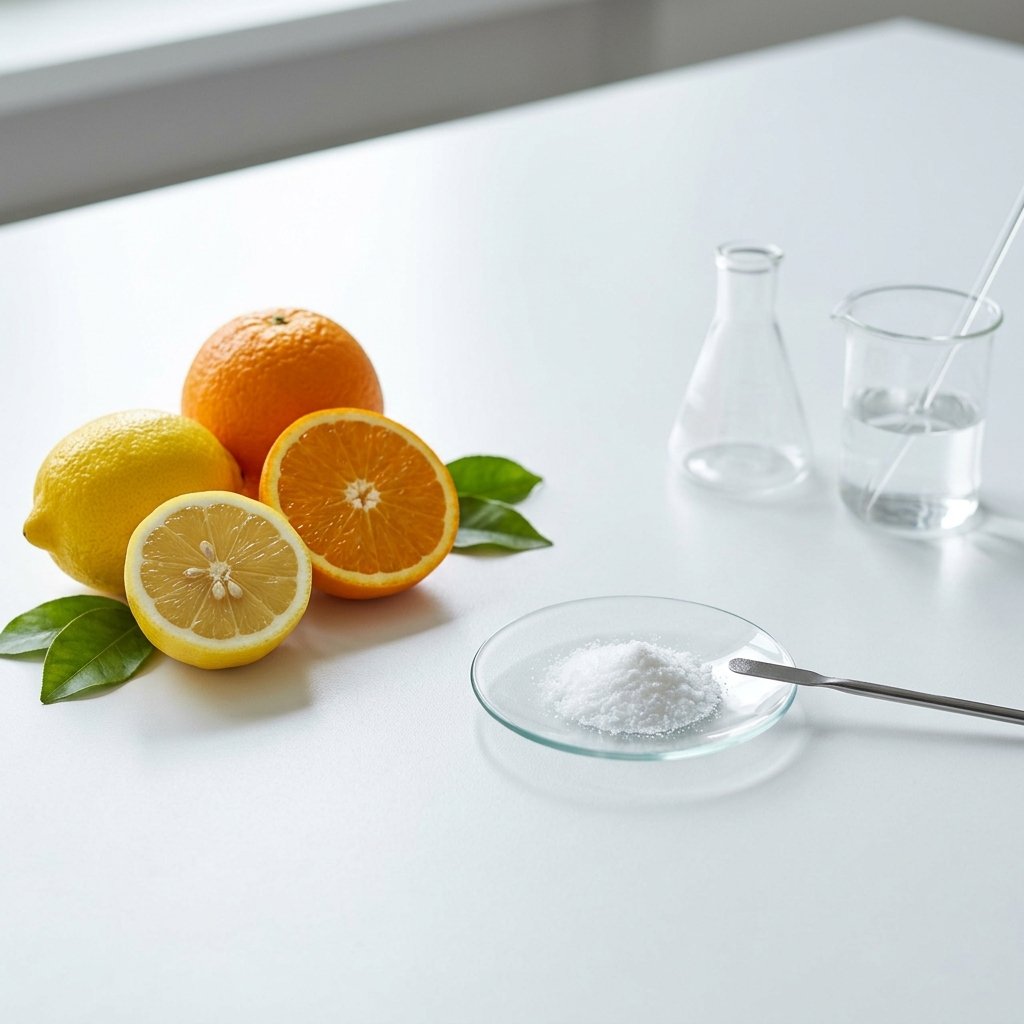
Enter any food processing plant or chemistry lab and you will hear both terms used interchangeably citric acid and vitamin C. Both of them taste sour, both of them appear on ingredient labels and both of the terms are acids. That is why it is quite natural to wonder: is citric acid vitamin C?
The short answer is no citric acid does not contain vitamin C. Still, the deeper answer is much more interesting, and it is important to know the difference when you are developing a product, operating a production line, or establishing the knowledge base in basic chemistry.
What Is Citric Acid Really?
Citric acid is a weak organic acid with the molecular formula C₆H₈O₇. It is a tricarboxylic acid, that is, it has three carboxyl (–COOH) groups in its structure.
It is found naturally in citrus fruits, lemons, lime and oranges but most of the current industrial citric acid is made by fermentation of Aspergillus niger using sucrose or glucose as the carbon source.
Key industrial uses of citric acid include:
- Food and beverage acidulant (pH control, flavor enhancement)
- Chelating agent in cleaning and water treatment
- Pharmaceutical excipient and buffering agent
- Descaling agent in industrial equipment
💡 Fact: Over 2.4 million metric tons of citric acid are produced globally each year, making it one of the most widely manufactured organic acids in the world. Nearly 70% of this production goes directly into the food and beverage industry.
What Is Ascorbic Acid (Vitamin C)?
Ascorbic acid is the chemical name for Vitamin C. Its molecular formula is C₆H₈O₆ one fewer oxygen atom than citric acid, but with a completely different structural arrangement.
Ascorbic acid is a lactone (a cyclic ester), and its biological activity depends entirely on its specific ring structure. It functions in the human body as:
- An antioxidant that neutralizes free radicals
- A cofactor for collagen synthesis enzymes
- An electron donor in several metabolic reactions
- An immune system modulator
💡 Fact: Humans are among the very few mammals that cannot synthesize their own Vitamin C. This is due to a mutation in the gene encoding the enzyme L-gulonolactone oxidase, the final step in ascorbic acid biosynthesis.
Citric Acid vs Ascorbic Acid: The Core Differences
At a glance, these two molecules look similar: same carbon count, similar formulas but structurally and functionally, they are entirely different compounds.
| Property | Citric Acid (C₆H₈O₇) | Ascorbic Acid / Vitamin C (C₆H₈O₆) |
| Molecular Formula | C₆H₈O₇ | C₆H₈O₆ |
| Structure Type | Tricarboxylic acid (open chain) | Lactone (cyclic ester) |
| pKa (first) | 3.13 | 4.17 |
| Vitamin Activity | None | Yes essential vitamin |
| Antioxidant Property | Weak (indirect, via chelation) | Strong (direct free radical scavenging) |
| Natural Source | Citrus fruits, fermentation | Citrus fruits, vegetables, synthesis |
| Stability (heat) | Very stable | Degrades above 70°C |
| Industrial Role | Acidulant, chelator, preservative | Nutrient supplement, antioxidant |
The structural difference between these two molecules is not a minor technicality, it is the entire reason one is a vitamin and the other is not.
Why Citric Acid Is Not Vitamin C
The biological role of vitamin C is related to the capacity to donate electrons and be reduced and oxidized specifically ascorbic acid is reduced and oxidized to dehydroascorbic acid and vice versa. It is biologically active due to this redox cycle.
Citric acid is unable to carry out this redox action. It does not have -OH groups formed in the lactone ring structure that is required to donate electrons in biological systems. These three carboxyls in citric acid have quite other chemistry.
In simple terms:
- Citric acid makes food sour and controls pH
- Vitamin C does that and interacts directly with immune function, collagen synthesis, and antioxidant pathways
- Sourness does not equal vitamin activity
Can Citric Acid Replace Vitamin C?
In nutrition? Absolutely not. In some industrial applications? Partially with important caveats.
| Application | Citric Acid | Ascorbic Acid | Can Citric Acid Substitute? |
| pH adjustment in food | ✅ Excellent | ✅ Works | ✅ Yes |
| Antioxidant preservation | ⚠️ Indirect (chelates metals) | ✅ Direct | ⚠️ Partially |
| Vitamin C supplementation | ❌ No activity | ✅ Full activity | ❌ No |
| Collagen synthesis support | ❌ No | ✅ Yes | ❌ No |
| Immune function | ❌ No | ✅ Yes | ❌ No |
| Flavor/sour profile in beverages | ✅ Yes | ✅ Yes | ✅ Yes |
If you are a food technologist trying to prevent browning or metal-catalyzed oxidation, citric acid can be a useful tool but not because it replicates vitamin C. It works by chelating metal ions like iron and copper that would otherwise catalyze oxidation reactions.
Can I Use Citric Acid Instead of Ascorbic Acid in Processing?
In food manufacturing and industrial settings, this is a legitimate operational question.
Yes, you can use citric acid instead of ascorbic acid when:
- You need acidification or pH control
- You are targeting microbial stability through water activity or pH reduction
- You want a metal chelator to improve shelf life
No, you cannot use citric acid instead of ascorbic acid when:
- The label must declare Vitamin C content
- Nutritional claims or RDA compliance is required
- You need a direct-acting antioxidant for lipid or color stability
- The product is a dietary supplement, infant formula, or fortified food
From a regulatory standpoint, substituting citric acid for ascorbic acid in a fortified food or supplement would be a compliance violation in virtually every jurisdiction globally.
How Both Acids Work Together in Industry
Citric acid and ascorbic acid are often used together not as substitutes but as complements.
In fruit juice processing, for example:
- Citric acid lowers the pH, creating an inhospitable environment for microbes
- Ascorbic acid scavenges oxygen radicals that degrade color and flavor
- Together, they extend shelf life more effectively than either does alone
This synergistic use is common across:
- Canned fruit and vegetable processing
- Beverage manufacturing
- Pharmaceutical tablet formulations
- Cosmetic and skincare formulations
Key Takeaways
Does citric acid have vitamin C? No and now you know why.
They have the same molecular formula and a natural occurrence in citrus fruits, yet they are not chemically the same molecule and their biological functions are entirely different. Citric acid is an effective industrial acid and a major intermediate in cellular metabolism. Ascorbic acid is a very important essential nutrient that cannot be replaced by the human body.
Industrial formulators use what they are best at, and realize that nothing can take the place of vitamin C when it is needed in genuine nutritional activity. It is just not possible in chemistry.
FAQs
1. How does citric acid affect mineral absorption in the body?
Citric acid can enhance the absorption of certain minerals like calcium, magnesium, and iron by forming soluble complexes in the digestive tract. This makes minerals easier to absorb compared to their insoluble forms. However, it does not provide any nutritional value itself like vitamins do.
2. Why is ascorbic acid more sensitive to heat than citric acid?
Ascorbic acid has a delicate lactone ring structure that easily breaks down when exposed to heat, light, or oxygen. This leads to loss of its vitamin activity during cooking or processing. In contrast, citric acid has a more stable structure, allowing it to withstand higher temperatures without degradation.
3. What role does citric acid play in food preservation beyond acidity?
Citric acid helps preserve food not only by lowering pH but also by binding metal ions that promote oxidation. This reduces spoilage and delays changes in color and flavor. Its chelating ability makes it especially useful in processed and packaged foods.
4. Can vitamin C deficiency occur even if citric acid intake is high?
Yes, consuming foods high in citric acid does not prevent vitamin C deficiency because citric acid has no biological vitamin activity. The body specifically requires ascorbic acid to support immune function and collagen production. Without adequate vitamin C intake, deficiency symptoms can still develop.
5. How are citric acid and ascorbic acid labeled differently in food products?
Citric acid is typically listed as an acidity regulator or preservative on ingredient labels, often without nutritional claims. Ascorbic acid, on the other hand, is labeled as vitamin C and may include its contribution to daily nutritional requirements. This distinction is important for both regulatory compliance and consumer awareness.