
Malic acid vs citric acid looks like a small choice, but it changes taste, cost, cleaning power and shelf stability. Both are food-safe organic acids, yet they behave differently in a drink, a candy coating or a descaling bath. This guide shows where each one wins, so you buy the right one the first time.
What Is Citric Acid?
Citric acid is a white, odorless crystal that dissolves easily in water. It is a tricarboxylic acid, which means each molecule carries three acid groups. Industries use it to add sourness, control pH and bind metal ions. You will find it in foods, medicines, cosmetics and household cleaners, where it works as a safe and flexible ingredient.
How It Is Made
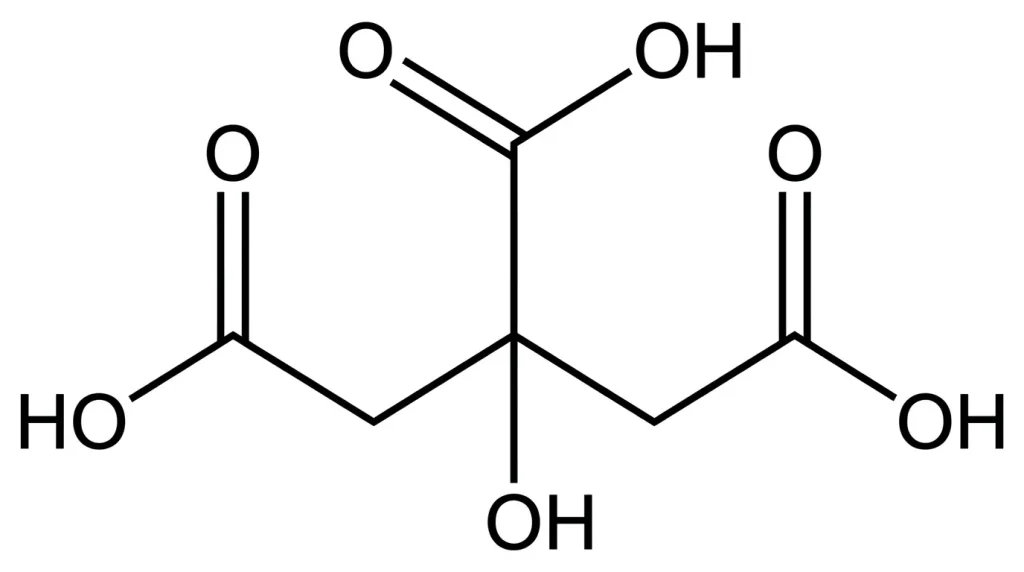
Commercial citric acid comes from fermentation, not from squeezing lemons. The mold Aspergillus niger feeds on sugar from corn or molasses and releases citric acid. The liquid is then filtered, purified and crystallized. Early producers extracted it from lemons, but fermentation took over because it is cheaper and more reliable at a large scale.
Overall reaction (simplified):
C₆H₁₂O₆ + 1.5 O₂ → C₆H₈O₇ + 2 H₂O.
n plain words, sugar and oxygen give citric acid and water. Real fermentation runs through many enzyme steps inside the mold, so actual yields are always below this theoretical equation. It shows the best possible result, not what a plant actually gets.
What Is Malic Acid?
Malic acid is a white crystalline solid that also dissolves easily in water. It is a dicarboxylic acid, so each molecule carries two acid groups instead of three. The name comes from malum, the Latin word for apple, because apples are rich in it. Industry uses it where a smoother, longer-lasting sour taste is needed.
How It Is Made: L-Malic vs DL-Malic Acid
Malic acid can exist as two mirror-image forms, so it is sold in two types:
- L-malic acid: the natural form found in fruit and living cells. It is made by enzyme or fermentation routes.
- DL-malic acid: a 50:50 mix of both mirror forms. It is usually made by heating maleic or fumaric acid with water under pressure.
Hydration reaction:
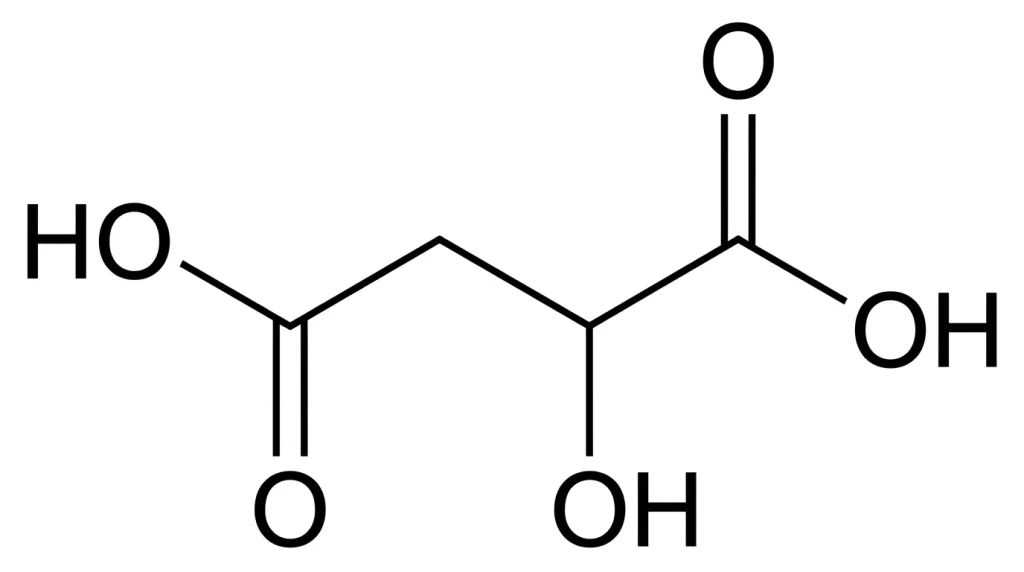
Both routes add water across a double bond:
C₄H₄O₄ + H₂O → C₄H₆O₅.
Maleic or fumaric acid plus water gives malic acid. Without a catalyst, water can add from either side of the double bond, which creates the 50:50 DL mix. The enzyme fumarase adds it on one side only, so it gives just the L-form.
Citric acid has no mirror-image forms, so it has no such split. Its molecule has no chiral center, so one version of the molecule covers every grade. That keeps citric acid simpler to specify and buy.
Malic Acid vs Citric Acid: Side-by-Side Comparison Table
| Property | Citric Acid | Malic Acid |
| Formula | C₆H₈O₇ | C₄H₆O₅ |
| Chemical name | 2-hydroxypropane-1,2,3-tricarboxylic acid | 2-hydroxybutanedioic acid |
| Molecular weight | 192.12 g/mol (anhydrous), 210.14 g/mol (monohydrate) | 134.09 g/mol |
| Acid groups | 3 | 2 |
| CAS number | 77-92-9 (anhydrous), 5949-29-1 (monohydrate) | 97-67-6 (L-form), 6915-15-7 (DL-form) |
| E number | E330 | E296 |
| Solubility in water (20°C) | About 59 g per 100 mL | About 55 g per 100 mL |
| Moisture pickup | Moderate | Higher, cakes sooner |
Which Is More Acidic? pH and pKa Explained
Citric acid is slightly stronger, but the gap is small. A lower pKa means a stronger acid, and citric acid has the lower value at each step. The pKa is the pH at which half of an acid group has released its proton. The table below also shows the pH of a 1% solution and the total acid each gram can supply.
| Measure | Citric Acid | Malic Acid |
| pKa1 | About 3.13 | About 3.40 |
| pKa2 | About 4.76 | About 5.20 |
| pKa3 | About 6.40 | None (only two acid groups) |
| Useful buffer range | About pH 2.5 to 6.5 | About pH 2.5 to 6 |
| pH of a 1% solution | About 2.2 to 2.3 | About 2.3 to 2.4 |
| Acid capacity per gram (anhydrous) | About 0.0156 equivalents | About 0.0149 equivalents |
Each acid group gives up its proton in a separate step, starting with the easiest one. The double arrows show a balance, because the acid and its ion exist together in solution. Citric acid has three steps, while malic acid has only two.
| Step | Citric Acid | Malic Acid |
| First proton | C₆H₈O₇ ⇌ C₆H₇O₇⁻ + H⁺ | C₄H₆O₅ ⇌ C₄H₅O₅⁻ + H⁺ |
| Second proton | C₆H₇O₇⁻ ⇌ C₆H₆O₇²⁻ + H⁺ | C₄H₅O₅⁻ ⇌ C₄H₄O₅²⁻ + H⁺ |
| Third proton | C₆H₆O₇²⁻ ⇌ C₆H₅O₇³⁻ + H⁺ | None |
What this means for your choice:
- Buffering: the third acid group gives citric acid a wider working range, which helps in buffered products.
- Deciding factor: the pH gap is too small to decide the choice, so taste, metal binding and cost matter more.
Taste Difference: Which Is More Sour?
The two acids taste different even when the pH is close. Citric acid is fast and clean, while malic acid is slow and round. Your tongue reads sourness by speed and length, not just by strength. That is why food scientists treat the two acids as different tools, not as simple swaps.
| Feature | Citric Acid | Malic Acid |
| Onset | Fast, hits the front of the tongue | Builds more slowly |
| Finish | Fades quickly | Lingers longer |
| Character | Sharp, clean, bright | Smooth, rounded, apple-like |
| Flavor match | Lemon, lime, berry | Apple, cherry, stone fruit |
Published sourness ratings vary by test method and by product, so no single ratio is reliable for every formula. Sugar, flavor and pH all change how sour an acid feels. Run a small bench trial with your real recipe instead of trusting a fixed number. Write down the dose that matches your target taste, and reuse it for later batches.
Why Blends of Both Are Used
- Sour candy coating: citric acid gives the first jolt and malic acid keeps the sourness going.
- Sweetener-heavy drinks: malic acid is often used to round out the aftertaste of high-intensity sweeteners.
- Fruit drinks: a blend lets formulators tune how fast the sourness arrives and how long it stays.
Natural Sources: Where Each Acid Appears
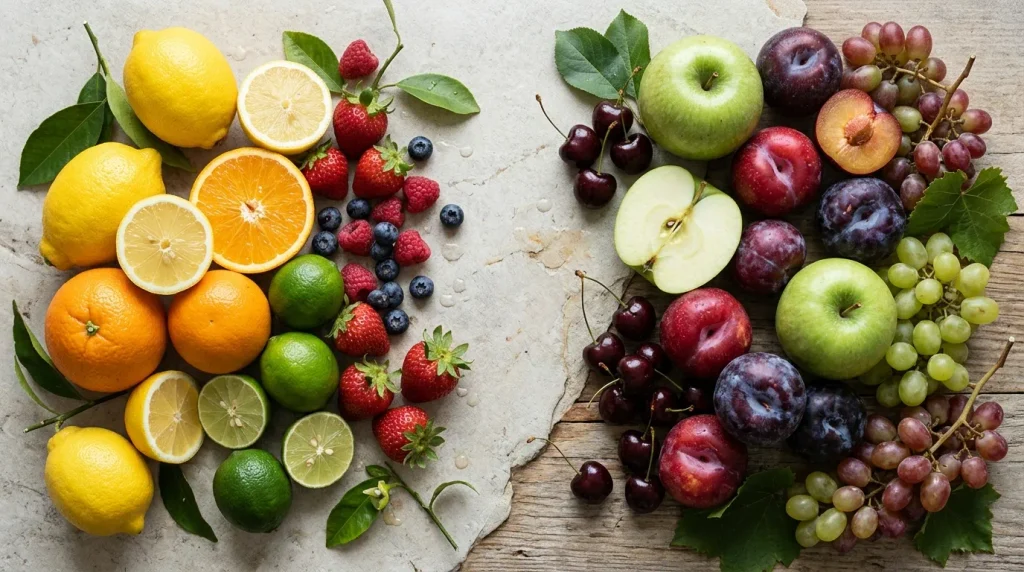
| Acid | Dominant In | Also Found In |
| Citric acid | Lemons, limes, oranges | Berries, tomatoes |
| Malic acid | Apples, cherries, plums | Grapes, citrus fruits |
Fruit content does not tell you where the commercial supply comes from. Most fruits hold both acids in different ratios, which is why each fruit has its own sour profile. Buy by grade and purity, not by fruit of origin. A label that says apple or lemon describes the flavor, not the source of the acid.
Uses by Industry
| Industry | Citric Acid | Malic Acid |
| Food and beverages | Soft drinks, jams, sauces, dairy, canned foods. Sets pH and supports preservation | Fruit flavors, sour candy, chewing gum, sports drinks |
| Pharmaceuticals and supplements | Effervescent tablets (reacts with sodium bicarbonate), pH adjuster, citrate salts such as sodium citrate | Acidulant and base for salts such as magnesium malate |
| Cosmetics and personal care | pH adjuster, metal binder, mild alpha hydroxy acid (AHA) | Gentle AHA that supports exfoliation |
| Cleaning | Descaler and detergent builder | Mild cleaner for delicate jobs |
| Water treatment and industrial | Chelating agent, scale removal, stainless steel passivation | Few uses, mainly specialty formulations |
In cosmetics, keep the final pH and acid level within the safe range for the product type, whether leave-on or rinse-off. Leave-on products stay on the skin for hours, so they need a gentler pH and a lower acid level than a rinse-off wash. Always test the finished formula for skin comfort and stability.
Effervescent Tablet Reaction
In effervescent tablets, the acid reacts with sodium bicarbonate and releases carbon dioxide gas, which makes the fizz. The tablet stays stable while dry, and the reaction starts only when it touches water. Both acids work, but they use different amounts of bicarbonate. Full neutralization looks like this:
| Acid | Balanced Equation |
| Citric acid | C₆H₈O₇ + 3 NaHCO₃ → Na₃C₆H₅O₇ + 3 H₂O + 3 CO₂ |
| Malic acid | C₄H₆O₅ + 2 NaHCO₃ → Na₂C₄H₄O₅ + 2 H₂O + 2 CO₂ |
By weight, 1 g of anhydrous citric acid fully neutralizes about 1.31 g of sodium bicarbonate, and 1 g of malic acid about 1.25 g. Real tablets often use partial neutralization, so tune the ratio on the bench. Moisture also matters, because a damp tablet can start to fizz in the pack and lose strength.
Cleaning and Descaling Notes
- Why citric acid works: its three acid groups bind calcium and iron strongly, which lifts limescale and rust stains.
- Typical solution: 5% to 10% citric acid in warm water (50 to 100 g per liter). Soak, then rinse well.
- Surfaces to avoid: marble, limestone and other natural stone, because acids etch calcium carbonate.
Limescale is mostly calcium carbonate (CaCO₃). The acid dissolves it and releases carbon dioxide gas, which is why you see bubbles. Hard water leaves this deposit on kettles, heating elements and shower heads, and it builds up in layers over time. Here is the balanced reaction for each acid:
| Acid | Balanced Equation |
| Citric acid | 3 CaCO₃ + 2 C₆H₈O₇ → Ca₃(C₆H₅O₇)₂ + 3 H₂O + 3 CO₂ |
| Malic acid | CaCO₃ + C₄H₆O₅ → CaC₄H₄O₅ + H₂O + CO₂ |
The fizzing you see is the CO₂. In theory, 1 g of CaCO3 needs about 1.28 g of citric acid, so use an excess for real scale. Calcium citrate is only sparingly soluble, so rinse well to avoid a white film. Warm water and a soft cloth usually clear any film that remains.
Cost and Availability
Citric acid is made in very large volumes by many producers, so it is easy to find and usually costs less per kilogram. Malic acid is made at a smaller scale by fewer producers, so it usually costs more. Most buyers use malic acid only where its taste or mildness adds real value.
Can You Substitute Malic Acid for Citric Acid?
Conversion Steps
- Start 1:1 by weight: use anhydrous citric acid as the base, since both acids supply almost the same acid per gram.
- Adjust for the monohydrate: if your citric acid is the monohydrate, it holds about 8.6% water, so use roughly 1.09 g of it for every 1 g of anhydrous.
- Change in small steps: move up or down by 5% to 10% at a time.
- Measure pH: check each trial with a calibrated meter.
- Taste the finished product: a malic acid version tastes rounder and stays longer. Keep a small share of citric acid if you want the sharp edge back.
When Not to Swap
| Situation | Why Not |
| Home or commercial canning | Tested recipes are validated with citric acid or bottled lemon juice to reach a safe acidity. Changing the acid can change safety |
| Buffered products | The pKa values differ, so the buffer range and final pH shift |
| Descaling | Malic acid binds calcium less strongly, so scale lifts more slowly |
| Effervescent products | Reaction speed and moisture sensitivity change, which can hurt shelf life |
Grades and Forms to Buy
| Use | Citric Acid Grade | Malic Acid Grade |
| Food and beverage | Food grade (FCC) | Food grade (FCC) |
| Pharma and supplements | USP or BP grade | Pharma grade where specified |
| Cleaning and industrial | Technical grade | Technical grade |
- Anhydrous vs monohydrate (citric): check which form the spec lists, because the acid content per kilogram differs.
- L- vs DL- (malic): L-malic acid is the natural form. DL-malic acid is the common low-cost form for general food use. Check your product spec and local rules.
- Paperwork: ask for the certificate of analysis (COA) and the safety data sheet (SDS) with every lot.
Safety, Handling and Storage
GRAS Status and Dietary Safety
- Food use: both acids are GRAS under U.S. FDA rules (21 CFR 184.1033 for citric acid, 21 CFR 184.1069 for malic acid).
- Teeth: both can erode enamel when sipped often in drinks. Citric acid is often rated more erosive because it also binds calcium on the tooth surface.
Hazards and PPE
- Hazard: powders and strong solutions irritate the eyes, skin and airways.
- PPE: wear safety goggles and gloves, and add a dust mask if the powder is airborne.
- Eye contact: rinse with water for at least 15 minutes and get medical help.
- Never mix with bleach: acids and hypochlorite bleach release chlorine gas (OCl⁻ + Cl⁻ + 2 H⁺ → Cl₂ + H₂O).
- Spills: sweep up without making dust, and follow local rules for disposal.
Storage
- Container: keep in a cool, dry place in tightly closed packaging, and reseal opened bags to stop caking.
- Keep away from: strong bases, oxidizers, reducing agents and reactive metals.
Common Mistakes When Choosing Between Them
- Measuring by volume: powders pack differently, so weigh them instead of using scoops.
- Testing only in plain water: sugar, flavor and pH change how each acid performs, so test in the real product.
- Making fruit-extract claims: commercial citric and malic acid are not fruit extracts, so do not imply this on a label.
Which One Should You Buy?
| Your Priority | Better Choice |
| Lowest cost and wide availability | Citric acid |
| Strongest descaling and metal binding | Citric acid |
| Wide buffer range | Citric acid |
| Smooth, long-lasting sourness | Malic acid |
| Apple or stone fruit flavor | Malic acid |
| Softer sweetener aftertaste | Malic acid |
| Fast hit plus long finish | A blend of both |
The malic acid vs citric acid decision comes down to taste, cleaning power, cost and the rules of your product. Citric acid is the all-round workhorse for acidulation, descaling and canning. Malic acid earns its higher price where a smooth, lasting tartness matters, such as fruit flavors and sour candy. Many formulas get the best result from using both.
Ready to buy? Check the citric acid and malic acid pages at Chemvexa to compare grades and request the SDS or COA you need. Start with a small trial order, test it in your real product, then scale up once the taste, pH and performance match your target.