
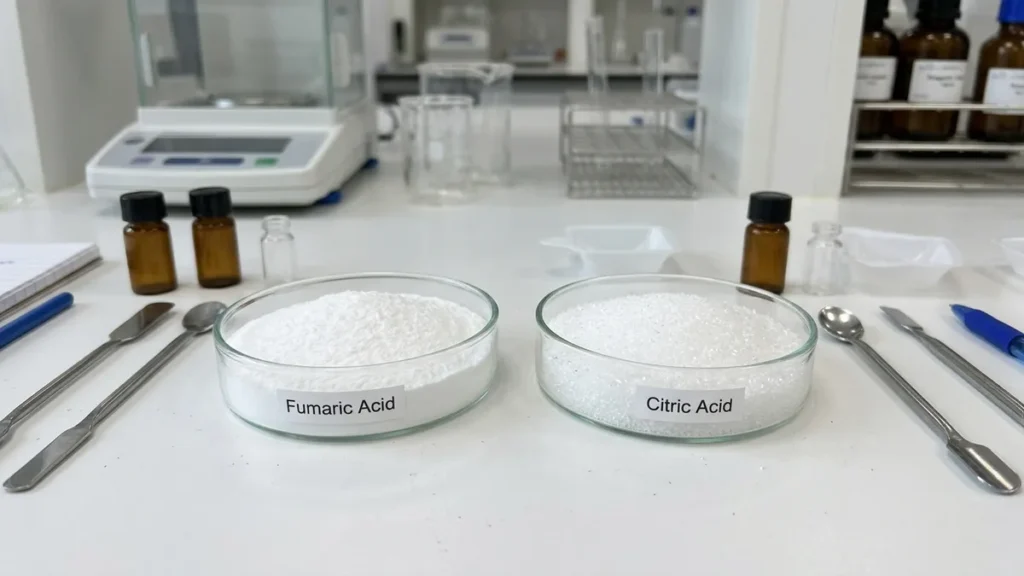
Fumaric acid and citric acid may both provide acidity, but their performance differs across food, pharmaceutical and industrial applications. Factors such as dissolving speed, moisture resistance and lasting sourness can influence product quality and shelf life. Understanding how these properties affect formulation helps manufacturers choose the right acid for consistent results and reliable performance.
Fumaric Acid vs Citric Acid at a Glance
Fumaric acid is the trans form of butenedioic acid, and its double bond keeps the molecule flat and rigid. Citric acid is a hydroxy acid with three carboxyl groups and a more flexible shape. These structural differences drive almost everything covered below.
| Detail | Fumaric acid | Citric acid |
|---|---|---|
| Formula | C₄H₄O₄ (HOOC-CH=CH-COOH) | C₆H₈O₇ anhydrous, C₆H₈O₇·H₂O monohydrate |
| Molecular weight | 116.07 g/mol | 192.12 g/mol anhydrous, 210.14 g/mol monohydrate |
| CAS number | 110-17-8 | 77-92-9 anhydrous, 5949-29-1 monohydrate |
| E number | E297 | E330 |
| Carboxyl groups | 2 | 3 |
| Known for | Dry-mix stability, lasting tartness | Fast dissolving, buffering, chelation |
Acid Strength and Buffering
Fumaric acid gives up its two protons at pKa 3.03 and 4.44. Citric acid gives up three, at pKa 3.13, 4.76 and 6.40. The first steps are almost identical, so at around pH 3 neither acid is clearly stronger.
The third step is what sets citric acid apart. It lets citric acid hold pH steady across pH 3.0 to 6.2, which is why formulators use it as the standard pH control in drinks, cosmetics and pharmaceuticals.
| Acid | pKa values |
|---|---|
| Fumaric acid | pKa₁ 3.03, pKa₂ 4.44 |
| Citric acid | pKa₁ 3.13, pKa₂ 4.76, pKa₃ 6.40 |
Water Solubility and Dissolving Speed
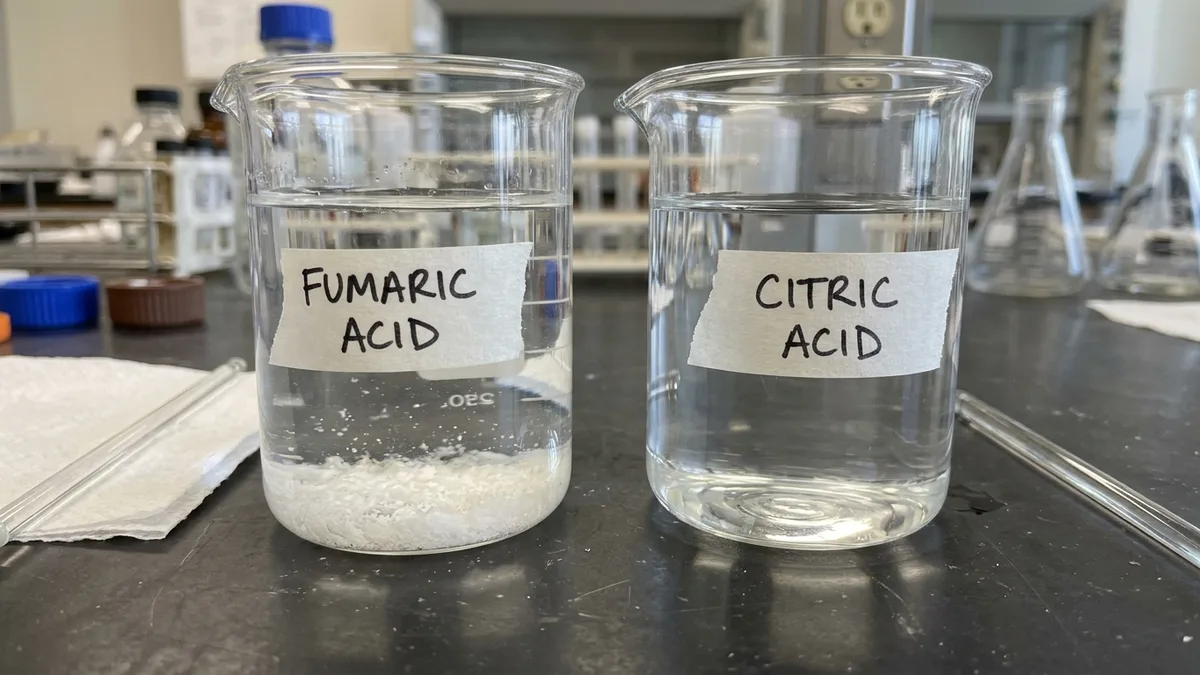
Citric acid dissolves at about 590 g/L in water at 20 °C. Fumaric acid manages only about 5 to 7 g/L at 25 °C, which is roughly 100 times less. Its rigid crystals pack tightly, and water struggles to pull them apart.
This gap decides whether fumaric acid can work in a liquid product. Heat raises its solubility sharply, and a few handling steps help in the plant:
- Use warm water: Dissolve fumaric acid in hot water before blending it into the batch.
- Pick the right grade: Fine-mesh or cold-water-soluble grades dissolve much faster than standard crystals.
- Allow mixing time: Plan extra stirring time, because fumaric acid dissolves slowly even when it will eventually go into solution.
Taste and Sourness
Citric acid hits the tongue fast, peaks early and fades quickly. That sharp snap suits citrus flavors. Fumaric acid starts more slowly, but its flatter tartness lingers, which rounds out berry, apple and other fruit flavors.
Weight for weight, fumaric acid tastes sourer. Because of this, product developers often combine the two acids. Citric acid supplies the quick first hit, and fumaric acid carries the finish.
Moisture Behavior and Shelf Life
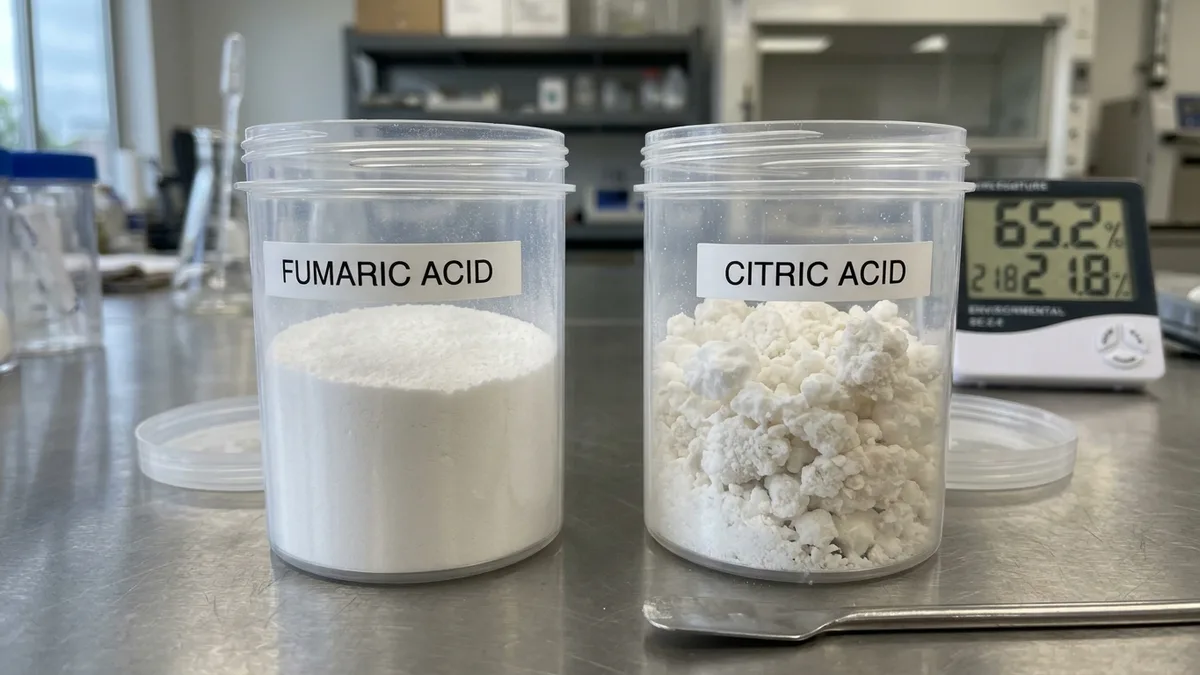
Anhydrous citric acid is hygroscopic, meaning it pulls water vapor from the air. In humid storage it clumps and sets into hard lumps. Fumaric acid is non-hygroscopic, so it stays free-flowing even in warm, damp warehouses.
That makes fumaric acid the safer pick for powdered drink mixes, gelatin dessert mixes and dry seasoning blends. Products that sit on shelves for months keep their texture and acid strength much better with it.
Metal Binding and Cleaning Power
Citric acid grabs calcium, magnesium and iron ions through its carboxyl and hydroxyl groups. This chelating action lets it dissolve limescale, soften water and stabilize formulas against metal-driven spoilage. It is a standard detergent builder for the same reason.
Fumaric acid binds metals only weakly, and its low solubility makes it a poor cleaner. For descaling kettles, boilers and equipment, or for water treatment, citric acid is the right acid.
Production and Cost
Citric acid is made by fermenting sugars with the mold Aspergillus niger, then recovering and purifying the acid. It is produced at huge global scale. Fumaric acid is made mainly by isomerizing maleic acid, which comes from maleic anhydride.
Citric acid is usually cheaper per kilogram. Fumaric acid is sourer, so a batch needs less of it, which narrows the cost gap in practice. Always compare quotes at your own order volume before deciding.
Safety, Handling and Storage
Hazards and Regulatory Status
Both acids have low toxicity at food-use levels. Fumaric acid’s oral LD50 in animal tests is very high, about 10 g/kg. Citric acid is GRAS in the US, and fumaric acid is an approved food additive.
As powders, both irritate the eyes. Fine dust of either one can also form a combustible cloud, so control dust in handling areas.
PPE and First Response
Wear safety goggles, gloves and a dust mask when handling bulk powder. If dust gets in the eyes, rinse with water for at least 15 minutes and get medical advice if irritation continues. For skin contact, wash with water.
Storage and Incompatibilities
Keep both acids in tightly closed containers in a cool, dry place. Citric acid needs extra protection from humidity. Both should stay away from strong oxidizers and strong bases.
Keep citric acid away from bicarbonates, because the reaction releases CO₂. Dispose of waste under local regulations, and read the supplier SDS for your exact grade.
Industry Uses Compared
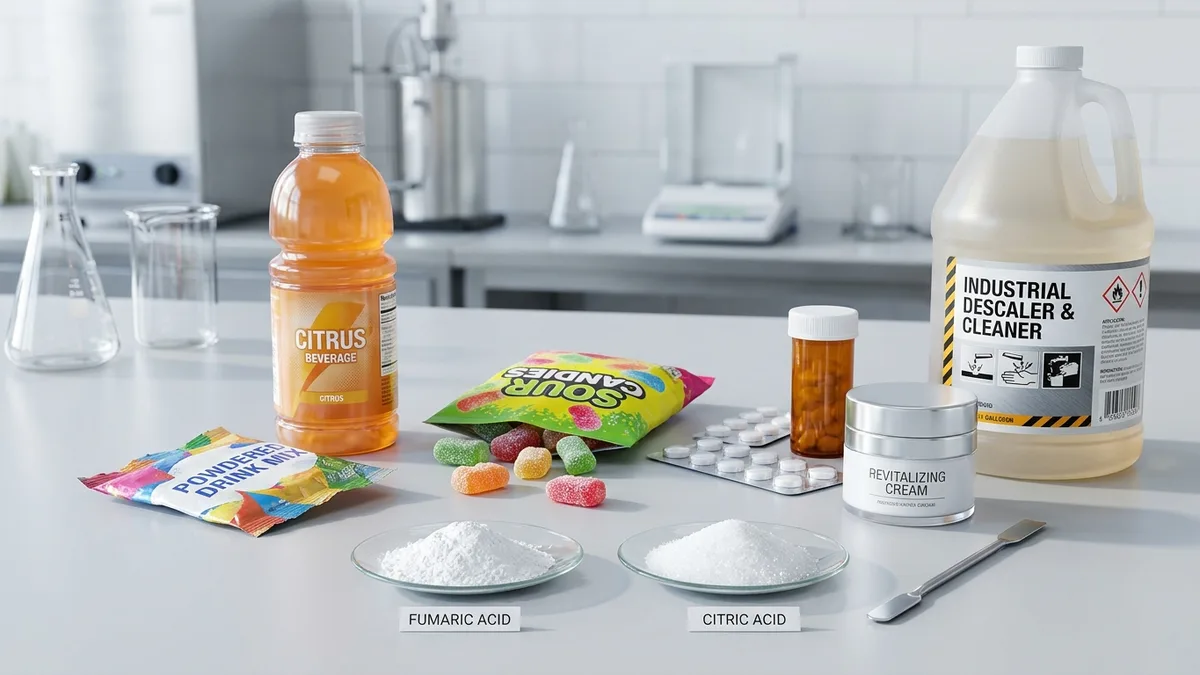
| Industry | Better fit | Reason |
|---|---|---|
| Ready-to-drink beverages | Citric acid | Dissolves fast |
| Powdered drink mixes | Fumaric acid, often blended | Stays dry |
| Sour candy sanding | Fumaric acid or a blend | Lasting tartness |
| Baking powder | Fumaric acid | Slow, controlled reaction with bicarbonate |
| Canning and preserving | Citric acid | Tested recipes are built on it |
| Pharmaceuticals and effervescents | Citric acid | Fast dissolving, buffering |
| Cosmetics and personal care | Citric acid | pH control, chelation |
| Cleaning and detergents | Citric acid | Descaling |
| Water treatment | Citric acid | Metal binding |
| Metal treatment | Citric acid | Passivation of stainless steel |
| Unsaturated polyester and alkyd resins | Fumaric acid | Reactive double bond |
Citric acid covers more industries overall. Fumaric acid wins where moisture control or chemical reactivity matters. Browse the citric acid directory page to compare grades.
Fumaric Acid vs Citric Acid: Which Should You Choose?
Start from your product, not from the spec sheet. Each situation below points to one clear pick:
- Dry powder with a long shelf life: Choose fumaric acid, or a fumaric and citric blend.
- Clear liquid or syrup: Choose citric acid for fast, full dissolving.
- Tartness that lingers: Choose fumaric acid, or add it to a citric base.
- pH buffering or metal binding: Choose citric acid.
- Cleaning or descaling: Choose citric acid.
- Polyester or alkyd resin production: Choose fumaric acid.
How to Swap One Acid for the Other
A common starting rule is 1 g of fumaric acid for about 1.5 g of citric acid, which is roughly 0.65 g of fumaric acid per 1 g of anhydrous citric acid. Citric acid monohydrate holds about 8.6% water, so use slightly less fumaric acid in that case. Confirm every swap with a taste panel and a pH check.
| Anhydrous citric acid | Starting fumaric acid |
|---|---|
| 100 g | About 65 g |
| 500 g | About 325 g |
| 1 kg | About 650 g |
Going the other way, expect a sharper and shorter sourness. Do not swap acids in these cases:
- Tested canning recipes: A different acid can change the safe acidity.
- Clear liquids with a high acid load: Fumaric acid may not fully dissolve.
- Cleaning formulas: Fumaric acid cannot match citric acid’s descaling.
- Leavening systems: A change in acid speed shifts how the dough rises.
Buying Grades and Forms
Match the grade to the job. Food and beverage buyers want food grade (FCC). Pharma and supplement buyers often need USP. Technical grade suits cleaning and resin work. Ask for the COA and SDS before you order, and check that the CAS number matches.
For citric acid, choose anhydrous or monohydrate and pick a particle size, since fine grades dissolve faster while coarse grades resist caking. For fumaric acid, choose a fine or cold-water-soluble grade when dissolving speed matters.
Choosing between fumaric acid and citric acid depends on how the final product needs to perform, particularly in terms of solubility, shelf life and acidity. Fumaric acid is better suited to dry formulations that require lasting tartness and moisture stability, while citric acid offers greater flexibility in liquids, pH control and cleaning applications. Understanding these differences helps manufacturers select the right acid, maintain product quality and avoid formulation issues. Chemvexa‘s catalog carries each chemical with its formula, specifications, grades and safety notes, backed by guides that explain how those chemicals are used, handled and stored safely.
FAQs
1. Is fumaric acid stronger than citric acid?
Fumaric acid tastes sourer per gram than citric acid, making it useful for products requiring stronger, longer-lasting tartness. However, their first pKa values are nearly identical. Citric acid has an additional dissociation step, giving it a wider buffering range.
2. Can I use fumaric acid instead of citric acid in drinks?
Yes, fumaric acid can be used in powdered drink mixes to provide lasting sourness. However, its poor cold-water solubility makes it less suitable for ready-to-drink beverages. Citric acid dissolves much faster and works better in liquid formulations.
3. Is fumaric acid safe to eat?
Yes, fumaric acid is an approved food additive (E297) used to regulate acidity and provide tartness. It has low toxicity at normal food-use levels. However, excessive consumption of acidic ingredients may cause stomach irritation and affect tooth enamel.
4. Is citric acid the same as vitamin C?
No, citric acid and vitamin C are two different chemical compounds. Vitamin C is ascorbic acid, which acts as an antioxidant, while citric acid is mainly used for acidity control, pH adjustment and metal binding in food and other formulations.
5. Which is cheaper, fumaric acid or citric acid?
Citric acid is generally cheaper per kilogram because it is produced on a much larger scale. Fumaric acid offers greater souring power, so smaller quantities may be needed in certain formulations. The final cost depends on dosage, grade and order volume.