

Citric acid (C₆H₈O₇) is a sour organic acid that lowers pH and dissolves limescale. Baking soda (NaHCO₃) is a mild alkaline salt that releases CO₂, neutralizes odors and scrubs gently. In short, citric acid vs baking soda is acid vs base, so each one suits a different job.
Many buyers treat them as partners because they fizz together. That fizz is a neutralization reaction, and it changes how you should use each product. This guide covers the chemistry, the real-world uses, safety and how to pick the right grade.
Citric Acid vs Baking Soda: Key Differences at a Glance
The table below puts the most important facts side by side. Later sections explain what these differences mean in practice, so the numbers are not repeated there.
| Factor | Citric acid | Baking soda |
| Formula | C₆H₈O₇ | NaHCO₃ |
| CAS number | 77-92-9 (anhydrous) | 144-55-8 |
| E number | E330 | E500(ii) |
| Compound type | Organic tricarboxylic acid. | Inorganic acid salt. |
| Solution pH | About 2.2 (1% solution). | About 8.3 (0.1 M solution). |
| Taste | Sharply sour | Salty, slightly bitter. |
| Solubility in water (20 °C / 68 °F) | About 590 g/L | About 96 g/L |
| Heat behavior | Melts near 153 °C (307 °F) | Starts breaking down near 50 °C (122 °F). |
| Main job | Acidulant, descaler, chelating agent. | Leavening agent, buffer, deodorizer, mild abrasive. |
What Is Citric Acid?
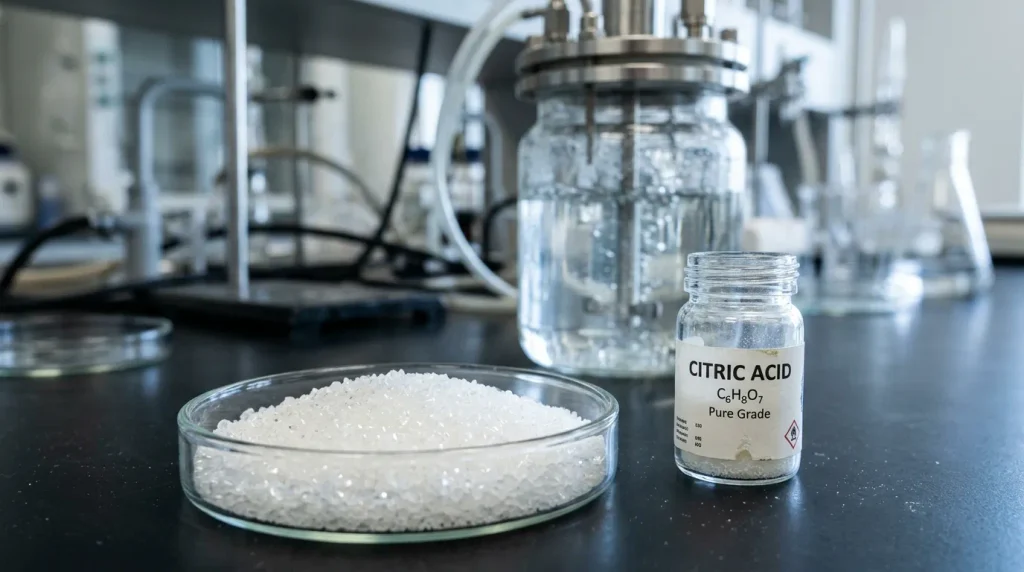
Citric acid is a weak organic acid found naturally in citrus fruits, where lemon juice holds roughly 5% to 6% of it. The citric acid sold commercially is not squeezed from lemons. It is made by fermenting sugars from molasses or corn glucose with the mold Aspergillus niger, then purifying the crystals.
It comes in two forms. Anhydrous citric acid has no bound water, while the monohydrate (C₆H₈O₇·H₂O, CAS 5949-29-1) carries one water molecule per acid molecule. Grades include food grade, USP for pharmaceutical and personal care use, and technical grade for cleaning and industrial work.
What Is Baking Soda?
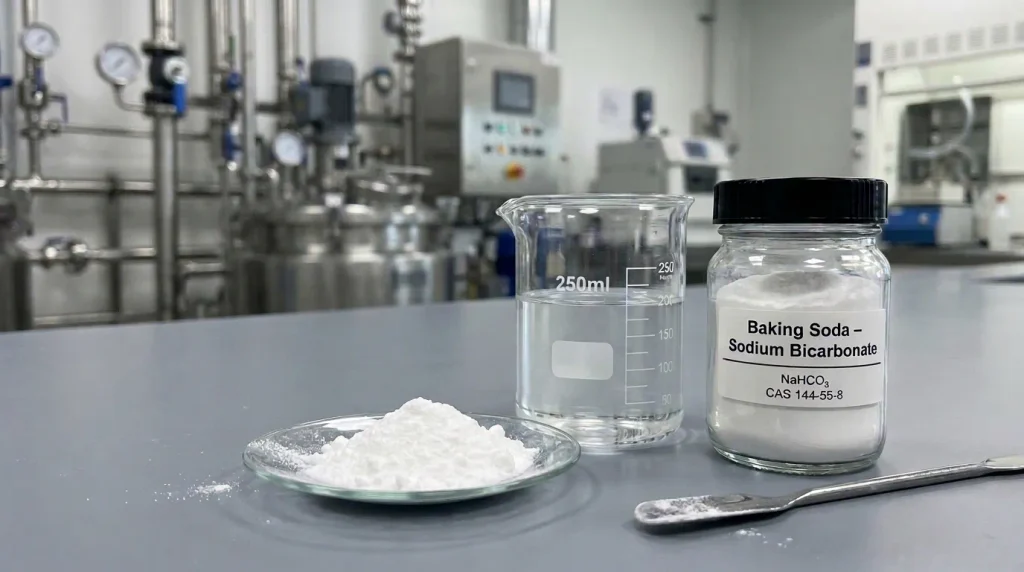
Baking soda is sodium bicarbonate, also called sodium hydrogen carbonate or bicarbonate of soda. Most of it is made from soda ash (sodium carbonate) using the Solvay process, or from the mineral trona. The result is a fine white powder that is stable when kept dry.
It is not the same as baking powder, which is baking soda blended with a dry acid and starch. Baking soda is sold in food grade, USP and technical grades, and in different particle sizes. Fine powders dissolve and react faster, while coarse grades suit scrubbing and slower release.
Chemical Nature: Acid vs Base
Citric acid is triprotic, which means each molecule can release three hydrogen ions (H⁺). Its pKa values are about 3.13, 4.76 and 6.40, one for each step. This is why it is strong enough to attack scale and bind metal ions, even though it counts as a weak acid.
Baking soda sits on the other side of neutral. The bicarbonate ion (HCO₃⁻) accepts H⁺ to form carbonic acid, which quickly falls apart into water and CO₂. This ability to soak up acid makes baking soda a buffer, meaning it resists sudden pH changes in a solution.
Physical Differences That Matter in Practice
The table shows the numbers. Here is what they change when you handle the products:
- Dissolving speed: Citric acid dissolves fast, even in cool water, so it suits liquid cleaners, beverages and descaling baths. Baking soda dissolves slowly and leaves grains behind, which works well as a paste but poorly for clear solutions.
- Heat: Baking soda gives off CO₂ as it warms, which creates lift in the oven but can weaken it in hot storage. Citric acid stays stable across normal cooking and cleaning temperatures.
- Taste in food: Citric acid adds tartness on purpose. Too much baking soda leaves a soapy, metallic taste, so dosing must be precise.
Functional Differences: What Each One Does
Descaling and Limescale Removal
Limescale is mostly calcium carbonate (CaCO₃). Citric acid reacts with it to form calcium citrate and CO₂ gas, and it also binds free calcium ions in a process called chelation. Rinse well afterward so no residue stays on the surface.
Baking soda is alkaline, so it cannot dissolve scale. It only loosens light film through gentle abrasion. For kettles, coffee machines, shower heads and boilers, citric acid is the correct choice.
Leavening and CO₂ Release
Baking soda only makes gas when it meets an acid, such as buttermilk, yogurt, honey or lemon juice. The CO₂ bubbles expand in the oven heat and make the batter rise. Without an acid in the recipe, the soda stays unreacted and leaves an off flavor.
Citric acid on its own gives no lift. It simply supplies the acid that sets off the reaction. This is why effervescent products and some dry mixes pair the two.
Chelating, Buffering and Deodorizing
The three carboxyl groups in citric acid grab metal ions such as calcium, iron and copper. This helps stop discoloration and rancidity in foods and cosmetics, and it softens water in detergents.
Baking soda works as a pH buffer, which is why it is used for pool alkalinity and in antacids. It also neutralizes acidic odors, such as spoiled milk or fridge smells, by reacting with the odor molecules.
What Happens When You Mix Citric Acid and Baking Soda?
The Reaction
Mixed with water, the two react in a classic acid-base neutralization:
C₆H₈O₇ + 3NaHCO₃ → Na₃C₆H₅O₇ + 3CO₂ + 3H₂O
Each citric acid molecule gives up three H⁺ ions, and each bicarbonate accepts one. The products are trisodium citrate (sodium citrate), carbon dioxide gas and water. The bubbles you see are CO₂ leaving the liquid.
Ratio by Moles and Weight
The balanced equation shows a 1 : 3 mole ratio. Because the two compounds have different molar masses, the weight ratio is different from the mole ratio.
| Item | Citric acid (anhydrous) | Baking soda |
| Moles in the reaction | 1 | 3 |
| Mass per mole | 192.12 g | 3 × 84.01 = 252.03 g |
| Ratio by weight | 1 | About 1.31 |
| Example | 10 g | About 13.1 g |
If you use citric acid monohydrate (210.14 g/mol), you need about 1.2 g of baking soda per 1 g of acid. Check which form is on your label before you calculate.
Why Mixing Cancels Their Cleaning Power
Once the reaction finishes, most of the acid and base are used up. The fizz looks active, but it is only CO₂ escaping, and the leftover sodium citrate solution has little descaling or scrubbing power. For cleaning, apply the two separately and rinse in between.
Never mix them in a sealed bottle. The CO₂ builds pressure fast and can burst the container.
Citric Acid vs Baking Soda for Cleaning
Choose by the type of dirt. Acids attack mineral deposits and rust, while alkaline products and abrasives handle grease and odors.
| Job | Better choice | Notes |
| Kettle, coffee maker and shower head scale | Citric acid | Use a 5% to 10% solution (50 to 100 g per liter), soak 30 to 60 minutes, then rinse well. Follow the appliance maker’s guidance |
| Hard-water spots on glass, tile and stainless steel | Citric acid | Apply a diluted solution, keep contact time short, then wipe dry |
| Greasy pans and oven residue | Baking soda | Make a paste with water and scrub gently |
| Fridge, drain and carpet odors | Baking soda | Neutralizes acidic odors rather than masking them |
Know where not to use each one:
- Natural stone: Keep citric acid off marble, limestone and travertine, because acid etches calcium carbonate surfaces.
- Aluminum: Avoid long soaks with either product, since strong acids and alkaline solutions can dull or discolor it.
- High-gloss finishes: Baking soda is a mild abrasive and can leave fine scratches when scrubbed hard.
- Bleach: Never combine citric acid with a bleach product, because the mix releases toxic chlorine gas.
Citric Acid vs Baking Soda in Food and Baking
In food, citric acid controls tartness and acidity in candy, drinks, jams and preserves. It also helps protect color and slows spoilage by lowering pH. Baking soda adjusts dough chemistry, browns baked goods faster and supplies the leavening gas described earlier.
For home canning, always follow tested recipes. Citric acid is a standard way to acidify tomatoes, commonly at 1/4 teaspoon per pint or 1/2 teaspoon per quart jar, or about 1 tablespoon of bottled lemon juice per pint. Never add baking soda to a canning recipe, because it raises pH and can make the product unsafe.
Industrial Uses by Industry
| Industry | Citric acid | Baking soda |
| Food and beverage | Acidulant, flavor, preservative aid (E330). | Leavening, pH control (E500(ii)). |
| Pharmaceuticals | Acid source in effervescent tablets, buffer, excipient. | Antacid, effervescent base, buffer. |
| Cosmetics and personal care | pH adjuster, chelating agent, bath bomb acid. | Bath bomb base, mild exfoliant, deodorant ingredient. |
| Detergents and cleaning | Descaler, builder, water softener. | Mild abrasive, odor control, alkalinity booster. |
| Water treatment | Membrane and boiler cleaning, metal chelation. | Alkalinity and pH increase. |
Safety, Handling and Storage
Both products are low-risk compared with most industrial chemicals, but they still need basic care. Always read the SDS for the exact product and grade you buy.
- Citric acid: It is classified as a serious eye irritant (GHS Eye Irrit. 2A). Wear safety glasses and gloves, and a dust mask when pouring large amounts of powder.
- Baking soda: Hazard is low, but airborne dust can irritate eyes and airways.
- Incompatibilities: Keep citric acid away from strong bases, strong oxidizers and bleach. Keep baking soda away from acids until you want a reaction.
- Storage: Keep both in sealed, labeled containers in a cool, dry place. Citric acid forms hard lumps in humid air and baking soda cakes. Keep baking soda away from strong-smelling products.
- First response: For eye contact, rinse with water for at least 15 minutes. If a large amount is swallowed, contact a doctor or poison control.
Can You Substitute One for the Other?
No. They have opposite chemistry, so swapping one for the other fails in cleaning, food and formulations. What you can do is replace each with a suitable alternative:
- Instead of citric acid: Use lemon juice or white vinegar in cooking and cleaning. Cream of tartar works as a dry acid for activating baking soda, but it behaves differently. Vinegar (acetic acid, about 5%) works for light scale but is slower on heavy deposits and has a strong smell.
- Instead of baking soda: Use baking powder at roughly three times the amount in baking. Do not use washing soda (sodium carbonate) in food, because it is far more alkaline.
How to Tell Them Apart
Two white powders can look identical, so label everything. If a container is unmarked, use this quick check:
- Read the label or SDS: The CAS number settles it (77-92-9 for citric acid, 144-55-8 for baking soda).
- Test the pH: Dissolve a pinch in water and dip a pH strip. Citric acid reads strongly acidic, baking soda reads mildly alkaline.
- Run the vinegar test: Add a few drops of vinegar. Baking soda fizzes, citric acid does not.
Do not taste unlabeled chemicals.
Which One Should You Buy?
Pick the grade by end use, not by price alone. Food, pharmaceutical and personal care applications need a grade backed by a certificate of analysis (COA) and a current SDS.
| Use | Citric acid grade | Baking soda grade |
| Food, beverage and home canning | Food grade | Food grade |
| Supplements, pharmaceuticals, personal care | USP | USP |
| Cleaning, descaling, water treatment | Technical | Technical |
| Laboratory work | ACS or reagent | ACS or reagent |
Also check the form and particle size. Fine powders dissolve faster and suit bath bombs and dry mixes, while coarser crystals handle slower reactions and easier pouring. For citric acid, confirm whether you are buying anhydrous or monohydrate, since the dosing math changes.
Choosing the right ingredient depends on the purpose, whether it is food preparation, household cleaning or industrial applications. Understanding how different compounds behave helps prevent ineffective mixtures and unnecessary chemical reactions. For reliable results, always consider the intended use, product grade and handling requirements. Chemvexa offers citric acid in suitable grades for different applications.
FAQs
1. Which is stronger, citric acid or baking soda?
They are not directly comparable because one is an acid and the other a base. Citric acid is the more aggressive of the two: its solution sits far from neutral, while baking soda stays only mildly alkaline. That is why citric acid etches stone and baking soda does not.
2. Can I use citric acid and baking soda together to clean?
Use them one after the other, not as one mixture. Apply citric acid for scale and rinse, then use a baking soda paste for grease or odors. Mixing them first wastes both.
3. What ratio of baking soda to citric acid is used for bath bombs?
A common recipe uses 2 parts baking soda to 1 part citric acid by weight. That is more baking soda than the 1.31 : 1 balance point, so the finished product stays gentle on skin and does not turn acidic. Always use cosmetic-safe grades.
4. Are citric acid and baking soda food safe?
Both are widely used food ingredients when you buy food grade. Use measured amounts, because too much citric acid is harshly sour and too much baking soda tastes soapy. For canning, follow tested recipes only.