
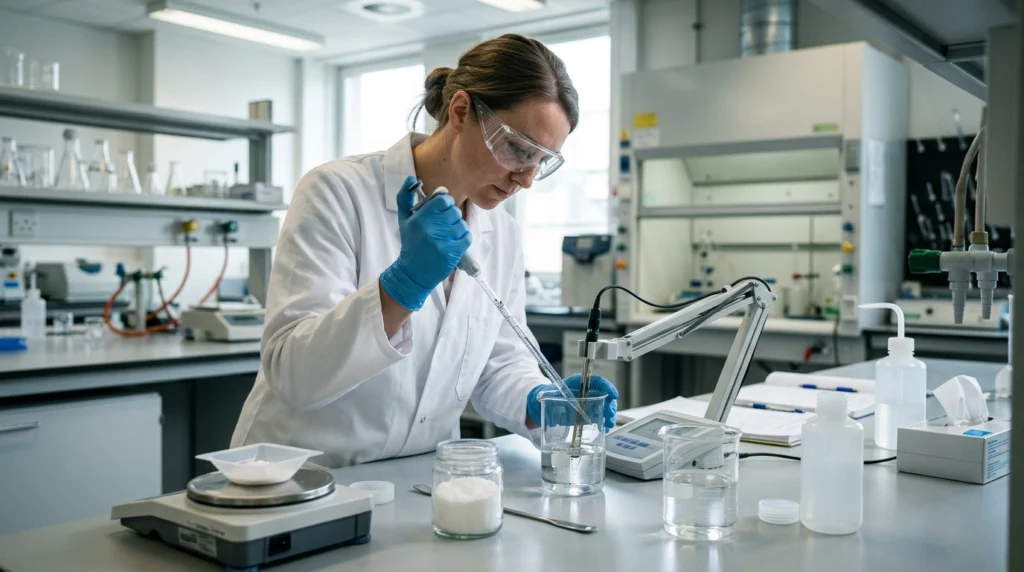
A citric acid buffer helps maintain a stable pH in laboratory experiments, food processing and chemical applications. This guide explains how to make a citrate buffer step by step, choose the correct chemicals, calculate mixing ratios and adjust pH. Learn how to prepare different concentrations and store your buffer properly.
What Is a Citric Acid Buffer?
A buffer is a liquid that resists changes in pH. If you add a little acid or base to it, the pH barely moves. Plain water doesn’t do this, and one drop of acid can change its pH a lot. That is why buffers matter in any work where pH must stay stable.
A citric acid buffer (also called a citrate buffer) is made from two parts: citric acid, a weak acid and the sour stuff in lemons, and sodium citrate, the salt form of citric acid. Together they work like a pair. The acid neutralizes any base that gets added, and the salt neutralizes any acid that gets added.
Why Use a Citric Acid Buffer? (Common Uses)
Citrate buffer shows up in many fields because it is cheap, safe, and works well in the acidic range. Labs use it daily, and so do food and cosmetic makers. The table below shows where it is used most often and what job it does in each place.
| Field | How It’s Used |
| Science labs | Keeping pH steady during experiments and enzyme tests. |
| Medical labs (IHC) | Antigen retrieval, which helps stains stick to tissue samples. |
| Food and drinks | Controlling sourness and keeping products stable. |
| Medicines | Keeping drug mixtures at a safe pH. |
| Cosmetics | Keeping skincare products gentle on skin. |
How a Citric Acid Buffer Works (pKa and Buffer Range)
Citric acid has three acidic hydrogens, so it has three pKa values. Each one marks a pH where the acid can hold the pH steady. Having three of them is what makes citrate buffer useful over such a wide range.
| pKa | Value |
| pKa1 | 3.13 |
| pKa2 | 4.76 |
| pKa3 | 6.40 |
So what is pKa? It is the pH where an acid is half-used and half-not. A buffer works best within about 1 pH unit above or below a pKa. That means a citrate buffer works well from about pH 3.0 to 6.2. Outside this range, it stops protecting the pH well, so pick a different buffer if you need a higher or lower pH.
What You Need (Materials and Reagents)
Chemicals:
- Citric acid monohydrate (powder)
- Trisodium citrate dihydrate (powder)
- Distilled water
Equipment:
- Digital weighing scale (0.01 g accuracy is best)
- Two beakers (100 ml or more)
- Measuring cylinder (100 ml)
- Glass stirring rod
- pH meter (calibrated)
- Two clean bottles with lids
- Funnel and filter paper
- Labels and a marker
Optional: Dropper or pipette, magnetic stirrer.
Tip: Use distilled water, not tap water. Tap water has minerals that can change your pH, and even small changes will throw off your final reading. Distilled water is cheap and keeps your results clean and repeatable every time you make a batch.
Citric Acid vs. Sodium Citrate (Which Form to Use)
Check the label before you buy. Citric acid comes in more than one form, and the exact form changes the weight you need. Mixing them up is the most common reason a buffer comes out at the wrong pH, so take a minute to read the bottle.
| Chemical | Also Called | Molecular Weight | Used For |
| Citric acid monohydrate | Citric acid (with water) | 210.14 g/mol | The acid part |
| Citric acid anhydrous | Citric acid (dry) | 192.12 g/mol | The acid part (use less grams) |
| Trisodium citrate dihydrate | Sodium citrate | 294.10 g/mol | The salt part |
This guide uses citric acid monohydrate and trisodium citrate dihydrate. If your label says “anhydrous,” your grams will be different, so don’t copy the numbers below. Recalculate using the molecular weight from the table first.
Safety Precautions
Citrate buffer is mild, but you should still work like you are in a real lab. Good habits protect your eyes and skin and keep your work clean. Follow the points below every time, even for a small batch.
- Wear gloves, safety glasses, and a lab coat.
- Citric acid powder stings if it gets in your eyes. Rinse with clean water for 15 minutes if that happens.
- Don’t taste or smell chemicals in the lab.
- If you use NaOH or HCl to adjust pH, be extra careful. Both are strong and can burn skin.
- Label every bottle clearly.
Before You Start: Choose Your Concentration and pH
Decide two things first. The first is concentration, meaning how strong the buffer should be. This guide uses 0.1 M, the most common choice. The second is pH, meaning the exact value you need. For this recipe, it must fall between 3.0 and 6.0.
If you are not sure what to pick, the table below gives a good starting point for common jobs. Always follow your protocol if you have one, since some experiments need a very specific pH and concentration.
| If You Need | Choose |
| Enzyme tests, general lab work | 0.1 M, pH 4 to 5. |
| IHC antigen retrieval | 10 mM, pH 6.0. |
| Acidic buffer for chemistry | 0.1 M, pH 3.0. |
Which Method Should You Use? (3 Ways to Make Citrate Buffer)
There are three common ways to make citrate buffer. They give the same kind of result, but they differ in how easy they are and what chemicals you need. Pick the one that matches what you have on your shelf.
| Method | Best For | Difficulty |
| 1. Citric acid + sodium citrate stock solutions (this guide) | Most people, most accurate. | Easy |
| 2. Citric acid + NaOH | When you don’t have sodium citrate. | Medium |
| 3. Sodium citrate + HCl | When you only have sodium citrate. | Medium |
We use Method 1 because it’s the easiest and gives the most reliable results. You only mix two ready solutions and never handle strong acids or bases. That makes it the safest choice for beginners and students.
How to Make Citric Acid Buffer (Step-by-Step)
We will make 100 ml of 0.1 M citrate buffer at pH 6.0. You’ll find ratios for other pH values in the chart further down. Follow the steps in order, and don’t skip the pH check at the end, because it is the only way to know your buffer is right.
Step 1: Prepare the Citric Acid Stock Solution (Solution A)
A stock solution is a ready solution you can mix later. Making stocks first is more accurate than weighing tiny amounts every time, and you can reuse them for many different pH values.
- Weigh 2.10 g of citric acid monohydrate.
- Pour it into a beaker.
- Add about 70 ml of distilled water.
- Stir with a glass rod until the powder fully disappears and the liquid is clear.
- Pour it into a measuring cylinder and add distilled water until it reaches 100 ml.
- Pour into a bottle and label it “A: 0.1 M Citric Acid.”
Why we add water in two steps: the powder takes up space too. If you add exactly 100 ml of water at the start, your final volume will be more than 100 ml and the concentration will be wrong. Dissolving first and topping up after fixes this.
Step 2: Prepare the Sodium Citrate Stock Solution (Solution B)
This step is the same as Step 1, just with the salt instead of the acid. The same rule applies: dissolve in less water first, then top up to the final volume. Take your time here, since small errors in weight change the final pH.
- Weigh 2.94 g of trisodium citrate dihydrate.
- Pour it into a second beaker.
- Add about 70 ml of distilled water.
- Stir until fully dissolved.
- Add distilled water to make 100 ml.
- Pour into a bottle and label it “B: 0.1 M Sodium Citrate.”
Tip: Use a different beaker and rod for each solution, or rinse them well in between. Leftover acid in the salt solution (or the other way round) will quietly change your concentrations.
Step 3: Mix the Two Solutions in the Right Ratio
For pH 6.0, mix 19 ml of Solution A (citric acid) with 81 ml of Solution B (sodium citrate). Pour both into a clean beaker and stir gently for 30 seconds. The mixture should stay clear, with no cloudiness or particles.
Why the ratio matters: More citric acid (A) means a lower pH, and more sodium citrate (B) means a higher pH. The ratio decides your final pH, which is why you can make any pH in the range just by changing the amounts of A and B.
Step 4: Check the pH With a pH Meter
Never trust the ratio alone. Small weighing and measuring errors always creep in, so a quick pH check tells you if your buffer is correct. A calibrated meter is the only reliable way to confirm it.
- Calibrate your pH meter first, using pH 4.0 and pH 7.0 buffer solutions.
- Rinse the probe with distilled water and pat it dry gently.
- Put the probe into your mixed buffer.
- Wait until the number stops changing (about 30 seconds).
- Write down the reading.
If the meter reads 6.0, you’re done. If it’s slightly off, go to Step 5.
Tip: Check the pH at room temperature, around 25°C. Temperature slightly changes pH readings, so measuring a cold buffer straight from the fridge will give you a misleading number.
Step 5: Adjust the pH
Your pH may be a little off because of small weighing or measuring errors. That is normal and easy to fix with the stock solutions you already made. Use the table to decide which one to add.
| If Your pH Is | Add |
| Too high (above target) | A few drops of Solution A (citric acid) |
| Too low (below target) | A few drops of Solution B (sodium citrate) |
Add only 2 to 3 drops at a time, stir, and check again. Going slowly is the key. If you add too much, you’ll overshoot and waste your buffer, and then you will have to correct in the opposite direction.
Step 6: Bring to Final Volume
If you added extra drops in Step 5, pour the buffer into a measuring cylinder and add distilled water until it reaches 100 ml. Stir gently so the solution mixes evenly. This keeps the concentration at 0.1 M after the extra drops.
If your pH was already perfect, your total is already 100 ml (19 + 81), so you can skip this step. Just move on to filtering and storing the buffer.
Step 7: Filter and Store the Buffer
Filtering removes tiny particles and any dust that fell in while you worked. Storing the buffer correctly keeps it usable for weeks, so don’t rush this last step.
- Place filter paper in a funnel over a clean bottle.
- Pour the buffer through slowly.
- Close the lid tightly.
- Label it with: buffer name, pH, concentration, date made.
- Store it in the fridge (about 4°C).
Quick Mixing Ratio Chart (pH 3.0 to 6.0)
Use this chart when you need a different pH. The amounts are for 100 ml of 0.1 M citrate buffer, using the same Solution A and Solution B you made above. Pick your target pH, measure the two volumes, and mix as in Step 3.
| Target pH | Solution A (0.1 M Citric Acid) | Solution B (0.1 M Sodium Citrate) |
| 3.0 | 93 ml | 7 ml |
| 4.0 | 66 ml | 34 ml |
| 4.5 (approx.) | 54 ml | 46 ml |
| 5.0 | 41 ml | 59 ml |
| 6.0 | 19 ml | 81 ml |
Scaling up: for 500 ml, multiply every number by 5, including the grams for the stock solutions. For 1 liter, multiply by 10. Important: these are starting values. Always confirm the final pH with a pH meter before you use the buffer.
Other Ways to Make Citrate Buffer (Citric Acid + NaOH, Powder Method)
Method 2: Citric Acid + NaOH
Dissolve citric acid in water (for 0.1 M, use 21.01 g of the monohydrate per liter). Slowly add NaOH solution while stirring and checking the pH. Stop when you reach your target pH, then add water to the final volume.
This works, but NaOH is a strong chemical, so it needs extra care. Wear gloves and glasses, and add the base slowly so you don’t overshoot your target pH. Overshooting is the classic failure of this method, and it is the same risk handled step by step when citric acid is neutralized with a base on its own.
Method 3: Sodium Citrate + HCl
Dissolve sodium citrate in water. Slowly add HCl while checking the pH, then stop at your target pH and top up with water. This is useful when you only have the salt form.
Like Method 2, it uses a strong chemical, so go slowly and keep checking with the pH meter. (Want details? See our full guide on citrate buffer using NaOH.)
Popular Citrate Buffer Recipes (0.1 M, 10 mM, pH 3, pH 4.5, pH 6)
0.1 M Citrate Buffer
Use the ratio chart above. It covers every pH from 3.0 to 6.0 and needs only the two stock solutions from Steps 1 and 2.
10 mM Citrate Buffer
Make the 0.1 M buffer first, then dilute it 1 to 10. Mix 10 ml of 0.1 M buffer with 90 ml of distilled water. Then check the pH again, because dilution can shift it slightly.
10 mM Citrate Buffer pH 6.0 (for IHC, Direct Method)
This is the classic recipe for antigen retrieval in IHC. Dissolve 2.94 g of trisodium citrate dihydrate in 1 liter of distilled water. Adjust to pH 6.0 using dilute HCl, adding slowly. Some labs add 0.5 ml of Tween 20 for staining work.
pH 3, pH 4.5, pH 6 Buffers
These three pH values are the most requested ones, so here they are in one place. Each row gives the volumes of Solution A (0.1 M citric acid) and Solution B (0.1 M sodium citrate) needed for 100 ml of 0.1 M buffer. Mix them as in Step 3, then confirm the pH with a calibrated meter.
| Target pH | Solution A (0.1 M Citric Acid) | Solution B (0.1 M Sodium Citrate) | Best For |
| 3.0 | 93 ml | 7 ml | Acidic buffer for chemistry |
| 4.5 (approx.) | 54 ml | 46 ml | Enzyme tests, general lab work |
| 6.0 | 19 ml | 81 ml | IHC antigen retrieval (dilute to 10 mM) |
Notice the pattern: the lower the pH, the more citric acid you need, and the higher the pH, the more sodium citrate you need. These are starting values, so small weighing errors can shift the result. If your reading is off, adjust with 2 to 3 drops of A or B at a time
Common Mistakes to Avoid
Most buffer problems come from a few simple mistakes. Check this list before you start, and again if your pH comes out wrong.
- Using the wrong form of citric acid (anhydrous vs. monohydrate)
- Using tap water instead of distilled water
- Adding all the water at once while making stock solutions
- Not calibrating the pH meter
- Adding too much acid or base at once when adjusting pH
- Using a buffer outside pH 3.0 to 6.2
- Skipping the label
Troubleshooting: Why Your Buffer pH Is Off
If your buffer doesn’t behave, the table below matches the most common problems to their cause and fix. In most cases the problem is the weights, the form of citric acid, or an uncalibrated meter.
| Problem | Why It Happens | Fix |
| pH is far from the target | Wrong grams, or the wrong form of citric acid | Check the label and the weights, then remake |
| pH keeps drifting | The pH meter isn’t calibrated | Recalibrate with fresh standards |
| pH is slightly off | Small weighing or measuring errors | Adjust with drops of A or B |
| Different pH after dilution | Dilution changes the ionic strength a bit | Re-check the pH after diluting |
| Cloudy liquid | Dirty bottle or contamination | Throw it away and remake with clean tools |
How Long Does Citrate Buffer Last? (Storage and Shelf Life)
In the fridge, citrate buffer usually stays good for about 1 month. The cold slows down the growth of germs, which is the main reason a buffer goes bad. At room temperature, it spoils faster because bacteria and mold can grow in it.
Throw it away if it looks cloudy, has particles, or smells strange. Don’t try to save it, since remaking it takes only a few minutes. Always label the bottle with the date you made it so you know exactly how old it is.
Making a citric acid buffer requires accurate measurements, the correct chemical forms and careful pH testing. By choosing the right ratio of citric acid and sodium citrate, you can prepare buffers for different laboratory applications. Always verify the final pH with a calibrated meter and store the solution in a clean, labelled bottle.
FAQs
1. Can citric acid buffer be used instead of phosphate buffer?
Citric acid buffer can replace phosphate buffer when the required pH falls within the acidic range of approximately 3.0 to 6.2. However, the two buffers have different chemical properties and may interact differently with enzymes, proteins and other substances. Always choose a buffer based on your experiment’s requirements.
2. What is the difference between citrate buffer and acetate buffer?
Citrate buffer is commonly used in the pH range of approximately 3 to 6.2, while acetate buffer is most effective around pH 3.8 to 5.8. Citrate can also bind certain metal ions, which may affect some reactions. The best choice depends on the target pH and the chemicals involved.
3. Can citric acid buffer be used for enzyme activity?
Yes, citric acid buffer can maintain the pH needed for studying enzymes that function under acidic conditions. However, enzyme activity depends on the specific enzyme, temperature, ionic strength and buffer composition. Check the recommended conditions for your enzyme before selecting a citrate buffer.
4. Does citric acid buffer affect protein stability?
Citric acid buffer can help maintain the pH required for protein stability, but its suitability depends on the protein and experimental conditions. Citrate can bind certain metal ions, potentially affecting proteins that require those ions for their structure or activity. Test compatibility before using it in sensitive protein applications.
5. What is the difference between citrate buffer and citric acid solution?
A citric acid solution contains citric acid dissolved in water, whereas a citrate buffer contains a suitable balance of citric acid and its conjugate base. This balance allows the buffer to resist small changes in pH. A plain citric acid solution generally offers less resistance to added acid or base.