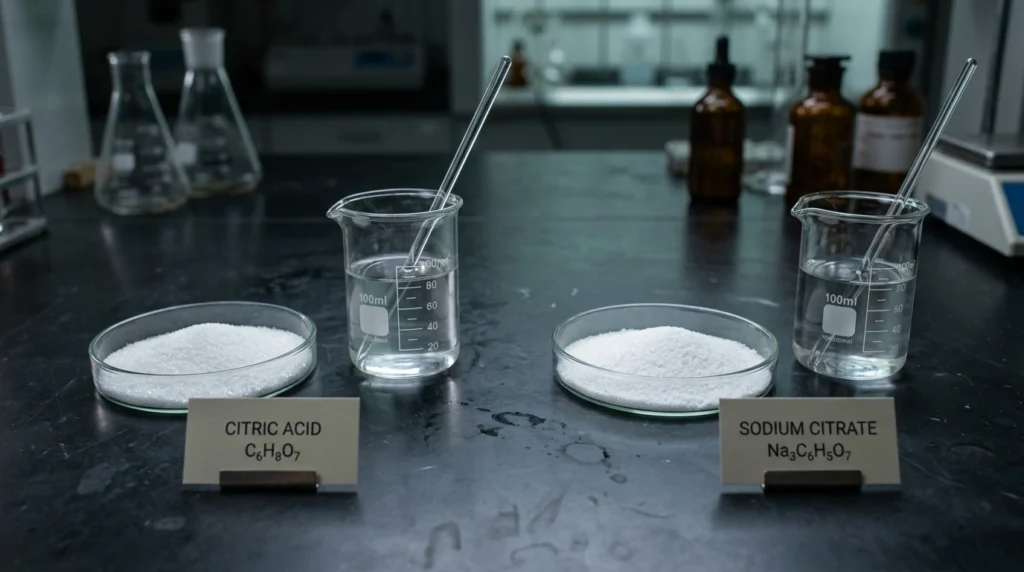
No. Citric acid (C₆H₈O₇) is the acid. Citrate is its negatively charged ion, or any salt or ester made from it, such as sodium citrate. They share one carbon backbone but differ in pH, taste and function, so they are not freely interchangeable.
Buyers mix these terms up all the time, and the mix-up can cost you a batch. A formulator who swaps citric acid for sodium citrate loses the acidity. A soapmaker who adds citric acid without adjusting lye loses the bar’s balance.This guide explains the chemistry in plain terms. It also shows how each form behaves in real products and which one to order.
What Is Citric Acid?
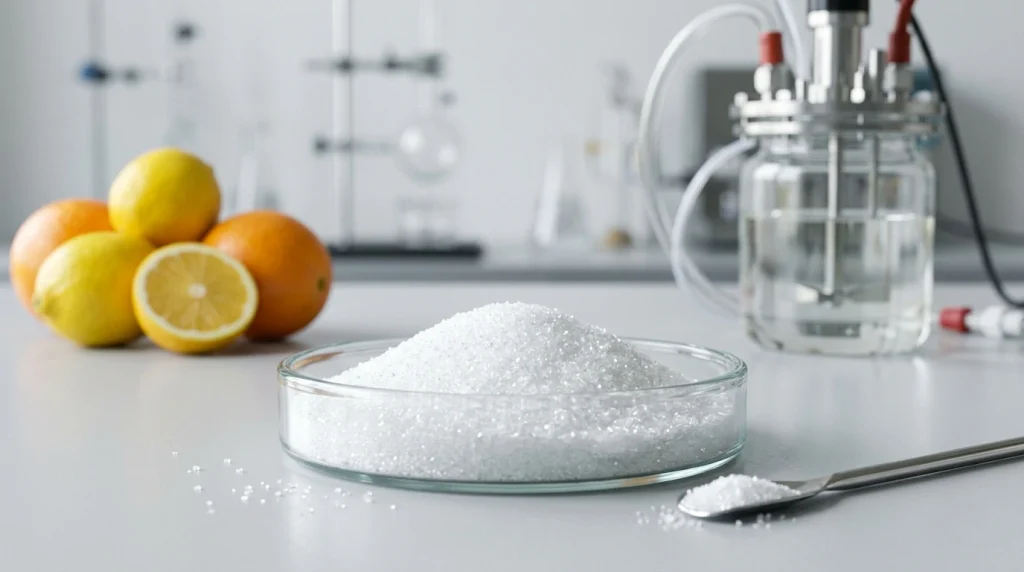
Citric acid is a weak, water-soluble organic acid. It is a tricarboxylic acid, which means each molecule carries three acidic –COOH groups. It occurs naturally in citrus fruit, and industry makes it mostly by fermenting sugar with Aspergillus niger.
Here are the core identifiers:
| Property | Anhydrous | Monohydrate |
| Formula | C₆H₈O₇ | C₆H₈O₇·H₂O |
| Molecular weight | 192.12 g/mol | 210.14 g/mol |
| CAS number | 77-92-9 | 5949-29-1 |
| pKa values (25 °C) | 3.13, 4.76, 6.40 | same |
| pH of a 1% solution | about 2.2 | about 2.2 |
The monohydrate holds about 8.6% water by weight. Account for that when you convert recipes between the two forms.
What Does “Citrate” Mean?

“Citrate” is a broader word. Chemically, it is the anion left after citric acid gives up hydrogen ions (H⁺). The fully deprotonated form is C₆H₅O₇³⁻.
In everyday use, “citrate” also names any compound built on that ion. These include salts, where a metal replaces the hydrogen, and esters, where an alcohol does. So a bottle labeled “citrate” can be a very different material from the acid.
| Compound | Formula | CAS | Typical use |
| Trisodium citrate | Na₃C₆H₅O₇ | 68-04-2 | Buffer, emulsifying salt, chelator |
| Tripotassium citrate | K₃C₆H₅O₇ | 866-84-2 | Acidity regulator, pharma use |
| Calcium citrate | Ca₃(C₆H₅O₇)₂ | 813-94-5 | Calcium fortification |
| Magnesium citrate | Mg₃(C₆H₅O₇)₂ | 3344-18-1 | Supplements, pharma |
| Triethyl citrate | C₁₂H₂₀O₇ | 77-93-0 | Plasticizer, cosmetic solvent |
In food labeling, citric acid is E330. Sodium, potassium and calcium citrates fall under E331, E332 and E333.
How Citric Acid Becomes Citrate
Neutralization turns the acid into its salt. Add a base such as sodium hydroxide (NaOH) or sodium carbonate, and each –COOH group loses its hydrogen. Water forms, and the citrate ion pairs with sodium.
The full reaction with sodium hydroxide is:
C₆H₈O₇ + 3 NaOH → Na₃C₆H₅O₇ + 3 H₂O
One mole of anhydrous citric acid (192.12 g) consumes three moles of NaOH (120 g). That is about 0.625 g of NaOH per 1 g of anhydrous citric acid, or about 0.57 g per 1 g of monohydrate.
Partial neutralization gives mono- and disodium citrates. This is how formulators build a citrate buffer. The pair works best between about pH 3.0 and 6.2, which matches the acid’s pKa range.
Citric Acid vs Citrate: Key Differences
| Feature | Citric acid | Trisodium citrate |
| Nature | Free acid | Salt of the acid. |
| pH of 1% solution | about 2.2 | about 7 to 9 (5% solution). |
| Taste | Sharp, sour | Mild, slightly salty. |
| Main job | Acidify, descale, preserve. | Buffer, emulsify, sequester. |
| Reaction with baking soda | Releases CO₂ | No fizz |
| Reaction with lye | Consume NaOH. | Neutral, no lye adjustment. |
| Sodium content | None | About 23% by weight (dihydrate). |
The practical lesson is simple. Citric acid changes pH downward. Citrate salts hold pH steady and bind metal ions.
Both forms act as chelators, because the citrate ion grabs calcium (Ca²⁺) and magnesium (Mg²⁺). That is why both soften water and help stabilize formulas.
Where Each Form Is Used
1. Food And Beverage:
- Citric acid: Gives tartness in candy and drinks, lowers pH for preservation, and slows browning in cut produce.
- Sodium citrate: Acts as an emulsifying salt in processed cheese. It pulls calcium from casein so the cheese melts smoothly without breaking. Typical use runs a few percent of cheese weight, tuned by recipe.
2. Pharmaceuticals:
- Sodium citrate: Used as an anticoagulant in blood collection and storage, since it binds the calcium that clotting needs.
- Potassium citrate: Used to raise urinary pH and citrate levels in kidney stone management.
3. Cosmetics And Personal Care:
- Citric acid: Adjusts pH in shampoos, lotions and toners.
- Sodium citrate: Buffers formulas and chelates metals that cause discoloration.
4. Cleaning And Water Treatment:
- Citric acid: Dissolves limescale and mineral deposits.
- Sodium citrate: Works as a mild builder in detergents, softening water without phosphates.
- Soapmaking: Citric acid reacts with lye and shifts the recipe. Sodium citrate does not, which is why many makers prefer it for hard-water chelation.
Can You Substitute One for the Other?
Usually not. The swap changes pH, and pH is often the whole point.
- Canning: Never replace citric acid with sodium citrate. Sodium citrate does not acidify, so it will not make a low-acid food safe. Use a tested recipe and follow its acid amount exactly.
- Descaling: Sodium citrate dissolves scale poorly. Use citric acid.
- Cheese sauces and emulsions: Citric acid can curdle dairy proteins by dropping pH. Use sodium citrate.
- Buffers: Use both together to set a target pH.
Grades and Forms to Know Before You Buy
Check the exact material on the label. “Citrate” alone tells you nothing about the cation.
- Food grade (FCC): For food and beverage production.
- USP/BP: For pharmaceutical, supplement and some cosmetic uses.
- Technical/industrial: For cleaning, water treatment and non-consumable products.
- Form: Citric acid comes as anhydrous or monohydrate. Sodium citrate comes as a dihydrate, anhydrous or liquid solution.
Confirm the purity, particle size and hydrate form on the certificate of analysis. Mismatched hydrate forms are a common source of dosing errors.
Safety and Storage
Citric acid is low in toxicity, but the dust is an eye irritant. Wear safety glasses and gloves when you handle powder or concentrated solutions. Avoid mixing it with strong oxidizers, strong bases or reducing agents, because the reactions can be violent or release heat.
Sodium citrate is milder, though it can still irritate eyes in bulk powder form. Rinse eyes with water for several minutes after contact. Always follow the product SDS for disposal rules. Store both in sealed containers in a cool, dry place. Citric acid cakes when exposed to humidity, and the monohydrate can lose water in warm storage.
Understanding the chemical properties of each ingredient helps prevent formulation errors and ensures better product performance. The right choice depends on your application, required pH and intended results. Always check the grade, purity and specifications before purchasing. Visit ChemVexa to source quality chemicals for your formulation and industrial needs.
FAQs
1. Is citrate natural or synthetic?
Citrate occurs naturally in citrus fruit and in your own metabolism. Commercial citric acid is mostly made by fermenting sugar with Aspergillus niger, then neutralized with a base to make citrate salts.
2. Can I use sodium citrate instead of citric acid?
Only when you need buffering or emulsifying, such as in cheese sauces. It cannot replace citric acid for acidifying, descaling or canning, because it does not lower pH.
3. Is potassium citrate the same as citric acid?
No. Potassium citrate is the potassium salt of citric acid and is much less acidic. It is used as an acidity regulator and in pharmaceuticals, for example to help manage some kidney stones.
4. Is magnesium citrate the same as citric acid?
No. Magnesium citrate is a magnesium salt of citric acid, used mainly as a magnesium source in supplements. Citric acid does not supply magnesium and has a very different pH and use.
5. Is citrate acidic or basic?
Citrate salts are close to neutral to mildly basic in water. A 5% trisodium citrate solution has a pH of about 7 to 9, while a 1% citric acid solution is about pH 2.2. This is why citrate works as a buffer.