
Phosphoric acid and citric acid are widely used across food, cleaning, metal treatment and industrial applications, but they differ significantly in strength, chemical properties and performance. While phosphoric acid is known for its stronger acidic action and rust conversion properties, citric acid offers excellent chelation and gentler cleaning. Understanding how these acids compare can help you choose the right one for your application, safety requirements and desired results.
Phosphoric Acid vs Citric Acid at a Glance
| Property | Phosphoric acid | Citric acid |
| Acid type | Inorganic (mineral) | Organic (carboxylic) |
| Formula | H₃PO₄ | C₆H₈O₇ |
| CAS number | 7664-38-2 | 77-92-9 (anhydrous), 5949-29-1 (monohydrate) |
| Molecular weight | 97.99 g/mol | 192.12 g/mol (anhydrous), 210.14 g/mol (monohydrate) |
| Usual form | Clear, syrupy liquid (75% or 85%) | White crystals or powder |
| pKa values | 2.15, 7.20, 12.35 | 3.13, 4.76, 6.40 |
| pH of 0.1 M solution | About 1.6 | About 2.1 |
| Food additive code | E338 | E330 |
| Made from | Phosphate rock | Fermented sugars |
| Main hazard (concentrated) | Corrosive | Eye irritant |
Chemical Differences
1. Acid Type: Inorganic vs Organic
Phosphoric acid is a mineral acid. It contains phosphorus, hydrogen and oxygen, and no carbon chain. Citric acid is an organic acid built on a six-carbon backbone with three carboxylic acid groups (–COOH) and one hydroxyl group.
That one split explains a lot. Organic acids tend to be gentler and easier for microbes to break down. Mineral acids tend to be stronger and more stable.
2. Formula, CAS Number and Molecular Weight
Phosphoric acid is H₃PO₄ with a molecular weight of about 98 g/mol. Citric acid is C₆H₈O₇ at about 192 g/mol, almost twice as heavy per molecule. Citric acid monohydrate carries one water molecule and weighs about 210 g/mol.
This matters when you buy. A kilogram of 85% phosphoric acid holds about 8.7 mol of H₃PO₄. A kilogram of anhydrous citric acid holds about 5.2 mol.
3. Acid Strength and pKa Values
Both acids are triprotic, meaning each molecule can give up three protons. Phosphoric acid has the lower first pKa (2.15 vs 3.13), so it is the stronger acid. At the same molar concentration it gives a lower pH.
Here’s the twist. In the pH range most foods and cleaners live in (about 2 to 7), citric acid releases almost all three protons. Phosphoric acid mostly releases one. So per mole, citric acid can neutralize more base in that range than you’d guess from its pKa alone.
| Dissociation step | Phosphoric acid | Citric acid |
| pKa1 | 2.15 | 3.13 |
| pKa2 | 7.20 | 4.76 |
| pKa3 | 12.35 | 6.40 |
4. Buffering Range
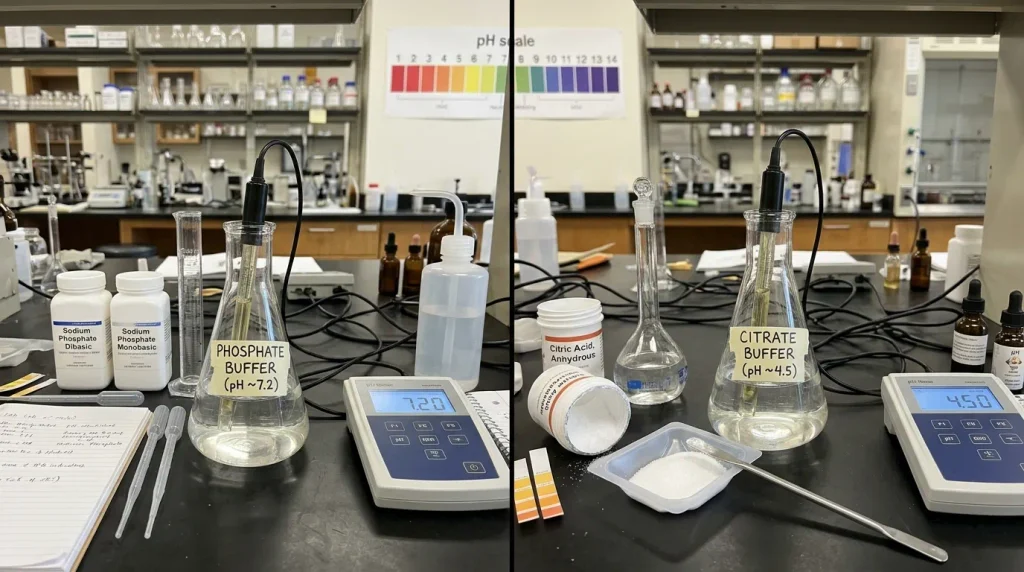
A buffer works best within about one pH unit of a pKa. Citric acid, with three pKa values between 3 and 6.5, buffers well across pH 2.5 to 6.5. That’s why citrate buffers are standard in drinks, jams and pharmaceutical solutions.
Phosphate buffers shine near neutral, roughly pH 6.2 to 8.2, thanks to the 7.20 pKa. Phosphoric acid also buffers around pH 1.1 to 3.1, but few products need that.
5. Chelation Ability
Chelation means wrapping around a metal ion and holding it in solution. Citric acid does this very well with calcium, iron, copper and magnesium. The metal stays dissolved instead of dropping out as scale or sludge.
Phosphoric acid works differently. It reacts with many metal ions to form phosphate salts, and plenty of those salts are insoluble at higher pH. That makes it useful for coatings but less useful when you want metals to stay in solution.
Physical Differences
1. Physical Form and Concentrations
Phosphoric acid is sold as a water solution, most often 75% or 85% by weight. Pure H₃PO₄ is a solid that melts at about 42 °C (108 °F), so the liquid grades are what you’ll actually handle. A cool warehouse can make 85% acid start to crystallize near 21 °C (70 °F), and gentle warming brings it back.
Citric acid comes as a dry crystalline solid, either anhydrous or monohydrate. You can also buy pre-made solutions, usually 25% to 50%. Dry powder is easier to ship and store, and it keeps well when sealed.
2. Solubility and pH of Solution
Phosphoric acid mixes with water in any ratio. Citric acid dissolves well too, at about 59 g per 100 mL of water at 20 °C (68 °F), and more in hot water.
A 1% citric acid solution sits around pH 2.2. An equivalent mass of phosphoric acid gives a lower pH because the molecule is lighter and stronger. For recipes, always measure pH rather than trusting weight percent alone.
3. Density, Viscosity and Hygroscopicity
The 85% grade is dense, about 1.69 g/mL, and noticeably thicker than water. It pours slowly and clings to equipment. Both phosphoric acid and anhydrous citric acid pull moisture from the air.
In humid storage, citric acid powder clumps into hard cakes. Keep bags sealed and off damp floors. Phosphoric acid just gets more dilute if the container is left open.
Source and Production Differences
Phosphate Rock vs Fermentation
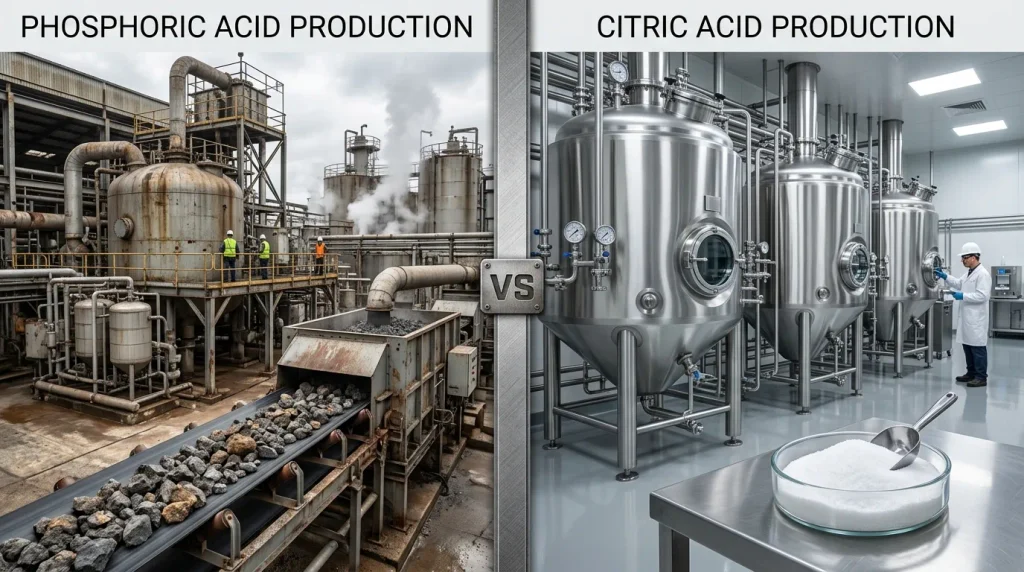
Most phosphoric acid starts as phosphate rock. In the wet process, the rock reacts with sulfuric acid to make crude phosphoric acid and gypsum, and that acid is then purified for food and industrial use. The thermal process burns elemental phosphorus and hydrates the product, which gives a purer acid at higher cost.
Citric acid comes from fermentation. The mold Aspergillus niger feeds on sugars from corn or sugar cane molasses and releases citric acid. The acid is then separated, purified and crystallized.
Natural vs Mineral-Derived Origin
Citric acid occurs naturally in citrus fruit. Lemon juice contains roughly 5% to 6% by weight. But commercial citric acid is made by fermentation, not squeezed from lemons.
Phosphoric acid doesn’t exist free in nature. Phosphates do, in rocks, bones and living cells. The acid itself is an industrial product.
Performance Differences
1. Taste Profile
Citric acid tastes bright and fruity. The sourness hits fast and fades fast, which suits lemon, lime and berry flavors. Phosphoric acid tastes sharper and drier, with a lingering bite that sits well under caramel and spice notes.
Neither acid is “better” for taste. Each one fits a different flavor profile.
2. Descaling Effectiveness
Both acids dissolve limescale (calcium carbonate) by the same basic reaction:
CaCO₃ + 2H⁺ → Ca²⁺ + H₂O + CO₂.
At the same concentration, phosphoric acid usually works faster because it is stronger. Citric acid at 5% to 10% still clears most kettle and coffee machine scale at 50 to 60 °C (120 to 140 °F).
Watch the rinse. Over-neutralized citric acid can leave calcium citrate residue, and phosphoric acid can leave calcium phosphate if the pH climbs. Rinse well with clean water either way.
3. Rust Removal: Conversion vs Chelation
Phosphoric acid converts iron oxide into iron phosphate. That bluish-gray layer is hard and paintable, which is why many rust converters and primers use it. Citric acid dissolves rust by chelating iron, so you end up with clean, bare metal.
| Goal | Better fit | Why |
| Strip rust to bare metal | Citric acid | Iron stays dissolved, surface rinses clean |
| Treat rust before painting | Phosphoric acid | Leaves a phosphate layer that helps paint stick |
| Soak small parts, tools, bolts | Citric acid | Mild, safe at typical 5% to 10% soak strengths |
| Brush onto large rusted panels | Phosphoric acid | Gel and liquid forms stay put on vertical surfaces |
4. Corrosion Behavior on Metals and Surfaces
Both acids attack carbon steel, zinc and aluminum if you leave them on too long. Both also etch marble, limestone and concrete. Test any acid on a hidden spot first.
On stainless steel, citric acid is a well-accepted passivation agent. Phosphoric acid is also fine at room temperature, but hot concentrated phosphoric acid can attack 304 stainless, so 316 is the safer choice for process equipment. After citric acid on bare steel, dry the part fast or it will flash-rust.
5. Stability and Formulation Compatibility
Phosphoric acid solutions are very stable. Dilute citric acid solutions are food for microbes, so a half-empty jug can grow mold within weeks. Make citric solutions fresh or add a preservative if the formula allows it.
In formulas with hard water, phosphoric acid can form cloudy calcium and magnesium phosphates as pH rises. Citric acid ties those ions up instead and keeps liquids clear. That’s one reason it’s popular in cleaners and drink bases.
Application Differences by Industry
| Industry | Phosphoric acid | Citric acid |
| Food and beverage | Colas, root beer, some processed foods | Soft drinks, juices, candy, jams, canned tomatoes, wine |
| Pharma and cosmetics | Dental etching gels, phosphate buffers | pH adjuster, effervescent tablets, citrate buffers |
| Cleaning | Acid cleaners for dairy and beverage lines | Descaler powders, dishwasher tablets, eco cleaners |
| Metal treatment | Phosphating, electropolishing | Stainless passivation |
| Water treatment | Corrosion control dosing | Membrane cleaning |
| Agriculture | Phosphate fertilizer feedstock | Micronutrient chelates, spray-water pH |
Regulatory Differences
1. Food Additive Codes and GRAS Status
In the US, both acids are generally recognized as safe (GRAS) for use in food at normal levels. In Europe, phosphoric acid is E338 and citric acid is E330. Both have FCC and USP monographs.
Ingredient labels simply read “phosphoric acid” and “citric acid.” Nobody can legally use technical grade in food, so match the grade to the job.
2. Phosphate Restrictions in Detergents
Many US states cap phosphorus in household detergents, including dishwasher products, at about 0.5% by weight. Wastewater permits at some industrial sites also limit phosphorus discharge. These rules target phosphorus, so phosphoric acid cleaners can trigger discharge questions that citric acid cleaners never do.
| Topic | Phosphoric acid | Citric acid |
| US food status | GRAS | GRAS |
| EU additive number | E338 | E330 |
| Ground transport (US DOT) | UN1805, Class 8 corrosive | Typically not regulated |
| Detergent phosphorus limits | Apply | Do not apply |
Safety and Handling Differences
1. Hazard Classification and PPE
Concentrated phosphoric acid (75% to 85%) is corrosive. It causes severe skin burns and serious eye damage. Citric acid powder is mainly an eye irritant, and its dust can bother the nose and throat.
- Phosphoric acid PPE: Chemical splash goggles, nitrile or neoprene gloves, an acid-resistant apron and a face shield when pouring from drums.
- Citric acid PPE: Safety glasses or goggles, gloves and a dust mask if you’re handling bulk powder.
- Dilution rule: Always add acid to water, slowly, never the reverse. Diluting 85% phosphoric acid releases heat.
2. Incompatibilities
Keep phosphoric acid away from strong bases, cyanides, sulfides and most reactive metals, which can release hydrogen gas. Citric acid should stay away from strong oxidizers, strong bases and metal nitrates.
Never mix either acid with bleach. Any acid plus sodium hypochlorite releases chlorine gas.
3. Storage Requirements
Store 85% phosphoric acid in HDPE, polypropylene, fiberglass or glass-lined containers. Type 316 stainless works for many setups. Avoid carbon steel, aluminum and galvanized steel.
Citric acid wants a cool, dry spot in a sealed bag or drum. Moisture is its enemy. Label every container with the name and concentration.
4. Spill and First-Aid Response
- Phosphoric acid spill: Wear full PPE, contain the spill, then neutralize with sodium bicarbonate or soda ash until the fizzing stops. Absorb with inert material, collect it and rinse the area.
- Citric acid spill: Sweep up dry powder without raising dust, then wipe the surface with water. Absorb liquid spills with an inert material.
- Skin or eye contact: Flush with running water for at least 15 minutes and remove contaminated clothing. Get medical care for any eye exposure or burn from 85% acid.
- Swallowing: Rinse the mouth, do not induce vomiting and call Poison Control (1-800-222-1222 in the US) or emergency services.
Always follow the SDS from your supplier for your exact product.
Commercial Differences
1. Cost per Unit of Acidity
Compare price per mole of acid, not price per kilogram. A kilogram of 85% phosphoric acid carries about 8.7 mol of H₃PO₄ versus about 5.2 mol in a kilogram of anhydrous citric acid. Prices swing with raw material and freight costs, so request a fresh quote.
For jobs that need the full buffering power of citric acid, the story shifts again. Always count the acid you actually need at your target pH.
2. Available Grades
| Grade | Phosphoric acid | Citric acid |
| Food (FCC) | Yes | Yes |
| USP | Yes | Yes |
| ACS reagent | Yes (85%) | Yes |
| Technical or industrial | Yes (75% and 85%) | Yes |
3. Packaging, Shipping and Shelf Life
Phosphoric acid ships as a hazardous liquid in jugs, drums and IBC totes, and freight carriers treat it as Class 8. Citric acid powder ships in bags and fiber drums, and it generally moves as non-hazardous freight. That can cut shipping costs and paperwork.
Both keep well when sealed. Citric acid powder lasts for years if kept dry. Phosphoric acid stays stable for years in a closed, compatible container.
Which One Should You Choose?
| Your job | Pick | Reason |
| Cola or dark soda | Phosphoric acid | Dry, lingering tang |
| Fruit drinks, candy, jams | Citric acid | Clean, fast sourness |
| Kettle and appliance descaling | Citric acid | Safe on seals and food-contact parts |
| Heavy scale in industrial plants | Phosphoric acid | Faster at the same concentration |
| Rust removal to bare metal | Citric acid | Chelates iron, leaves clean metal |
| Rust treatment before paint | Phosphoric acid | Builds a paintable phosphate layer |
| Stainless steel passivation | Citric acid | Accepted alternative to nitric acid |
| Acidic buffer (pH 2.5 to 6.5) | Citric acid | Three pKa values in range |
| Near-neutral buffer (pH 6.2 to 8.2) | Phosphate (from phosphoric acid) | pKa2 of 7.20 |
| Phosphorus-free or eco-labeled product | Citric acid | No phosphorus, biodegradable |
| Fertilizer feedstock | Phosphoric acid | Supplies phosphate |
Can You Substitute One for the Other?
Sometimes. In descaling and general pH adjustment, citric acid can often replace phosphoric acid, though the cleaning speed and rinse behavior change. In soda, the swap changes the flavor, so expect to reformulate.
For a first bench trial, 1 g of 85% phosphoric acid carries about the same number of acid moles as roughly 1.7 g of anhydrous citric acid. Treat that as a starting point only. Then measure pH and titratable acidity, and taste test.
| Swap | Works? | Watch for |
| Citric for phosphoric in soda | Yes, with reformulation | Fruitier taste, different mouthfeel |
| Citric for phosphoric in descaling | Yes | Slower action, rinse thoroughly |
| Citric for phosphoric in rust conversion | No | No phosphate coating forms |
| Phosphoric for citric in chelation jobs | Rarely | Insoluble phosphates can form |
| Either one in tested canning recipes | No | See the canning note below |
Common Mistakes When Choosing or Mixing These Acids
- Buying by weight only: Compare cost per mole of acid, not per kilogram, or the cheaper-looking option may cost more per job.
- Using the wrong grade: Technical grade does not belong in food, drinks, cosmetics or pharma. Ask for the certificate of analysis.
- Assuming stronger means better: A pH 1.6 acid can damage seals, plastics and finishes that a pH 2.1 acid would leave alone.
- Skipping the patch test: Stone, aluminum, galvanized steel and some plastics react to both acids. Try a small hidden area first.
- Ignoring discharge rules: Phosphoric acid wash water can break phosphorus limits. Check your permit before rinsing to drain.
- Mixing cleaners: Combining two products to “boost” cleaning can create a hazard. Use one acid at a time and rinse between steps.
Choosing between phosphoric acid and citric acid depends on your application, required strength and desired results. Each offers distinct benefits, from rust treatment and industrial cleaning to descaling and food formulations. Make the right choice for your needs with quality chemicals from ChemVexa. Browse our range of phosphoric acid and citric acid to find the right grade for your requirements.
FAQs
1. Is phosphoric acid stronger than citric acid?
Yes. Phosphoric acid has a lower first pKa (2.15 vs 3.13), so it dissociates more fully and gives a lower pH at the same concentration. Citric acid is still a real acid and can release all three of its protons in the pH range most products use.
2. Is phosphoric acid or citric acid safer to consume?
Both are GRAS at normal food levels, and both can erode tooth enamel in acidic drinks. Concentrated phosphoric acid (85%) and pure citric acid powder are not for eating or drinking. People on phosphorus-restricted diets, such as those with kidney disease, should ask their doctor about phosphate additives.
3. Which is better for rust removal?
It depends on the goal. Citric acid dissolves rust and leaves bare metal, so it suits tools and small parts. Phosphoric acid converts rust into iron phosphate, which is better when you plan to prime and paint.
4. Which is better for descaling?
For kettles, coffee machines and dishwashers, citric acid is the safer everyday choice. Phosphoric acid works faster on heavy mineral deposits in industrial equipment. Use the acid your equipment maker approves.
5. Can citric acid replace phosphoric acid in soda?
Chemically yes, but the taste changes. Citric acid gives a fruitier, shorter sourness, while phosphoric acid gives a dry, lingering tang. Reformulate and taste test rather than swapping one for one.