
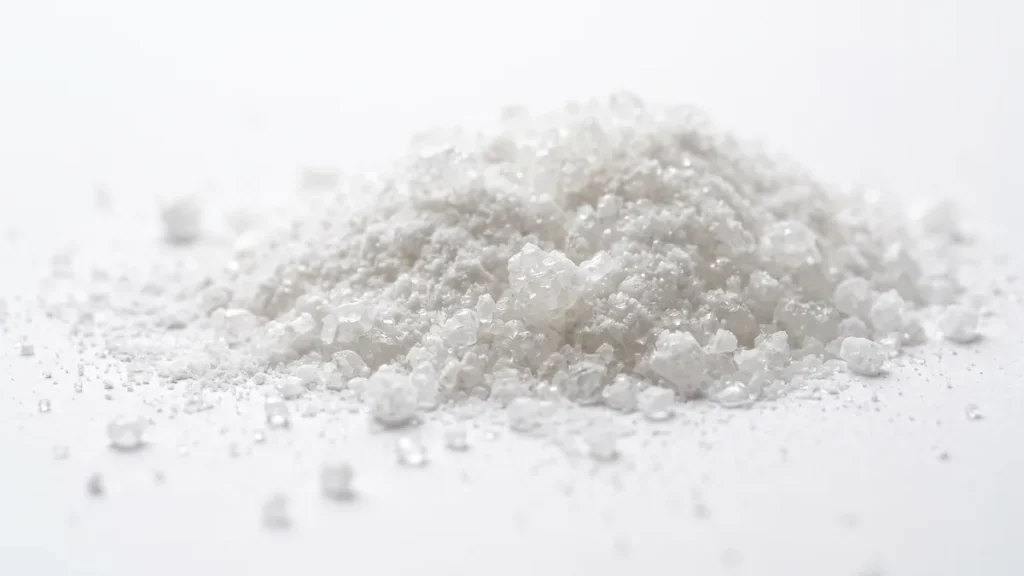
Potassium citrate (tripotassium citrate, K₃C₆H₅O₇, E332) is the potassium salt of citric acid. It is a white, odorless, highly water-soluble powder. Food, beverage and pharmaceutical makers use it as a buffer, acidity regulator and sequestrant, and as a potassium source.
Key specifications at a glance:
| Property | Value |
|---|---|
| Chemical name | Tripotassium 2-hydroxypropane-1,2,3-tricarboxylate |
| Common names | Potassium citrate, tripotassium citrate, citric acid tripotassium salt |
| Formula (anhydrous) | K₃C₆H₅O₇ |
| Formula (monohydrate) | K₃C₆H₅O₇·H₂O |
| Molar mass | 306.39 g/mol (anhydrous); 324.41 g/mol (monohydrate) |
| CAS numbers | 866-84-2 (anhydrous); 6100-05-6 (monohydrate) |
| E number | E332 (E332(ii) is tripotassium citrate) |
| Appearance | White, odorless, hygroscopic crystals or granular powder |
| Water solubility | Very high, about 154 to 167 g per 100 mL at room temperature |
| pH of 5% solution | About 7.5 to 9.0 |
| Parent acid | Citric acid (C₆H₈O₇, E330) |
What Is Potassium Citrate?
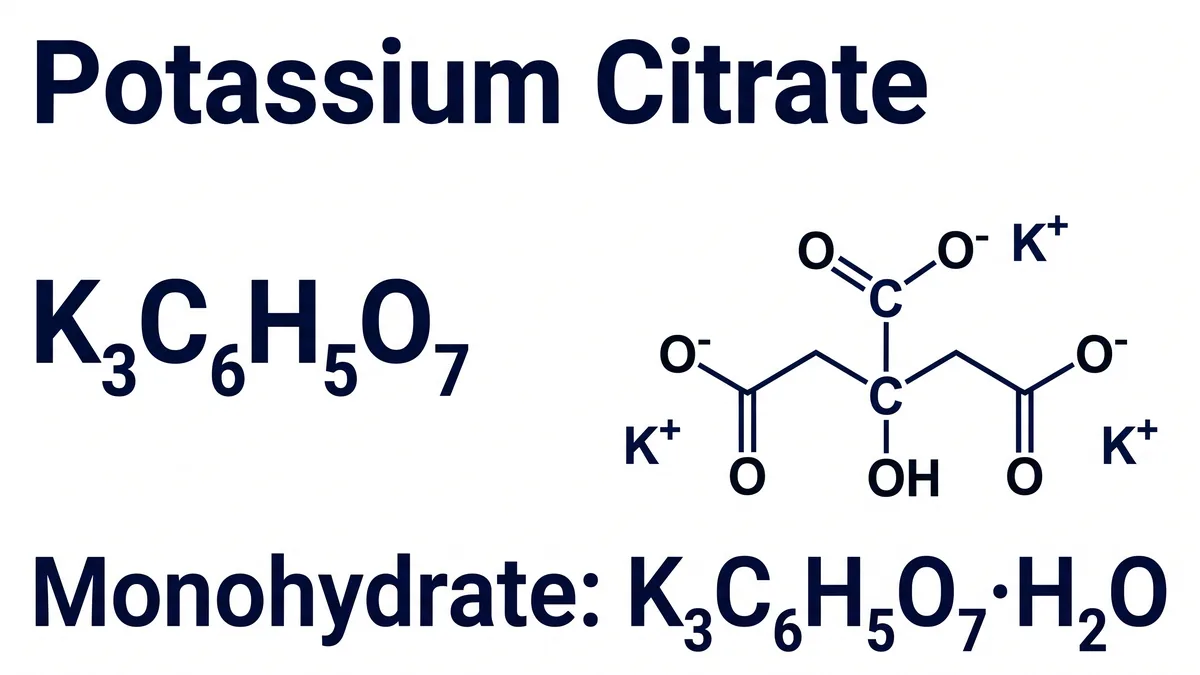
Potassium citrate belongs to the citrate salt family. Each molecule of citric acid carries three acidic hydrogens. In potassium citrate, all three are replaced by potassium ions (K⁺), which is why the name “tripotassium citrate” is also correct.
That swap changes the behavior completely. Citric acid is sour and strongly acidic. Potassium citrate is mildly alkaline, tastes saline, and has no sour bite. It keeps the useful chelating and buffering ability of the citrate ion while adding potassium instead of sodium.
Potassium citrate formula and forms
The potassium citrate formula is K₃C₆H₅O₇ (some sources write C₆H₅K₃O₇). The citrate anion is C₆H₅O₇³⁻, balanced by three K⁺ ions. You will also see the monohydrate, K₃C₆H₅O₇·H₂O, which holds one water molecule per formula unit.
This matters when you buy. The two forms have different potassium content and different CAS numbers, so always confirm which one a spec sheet describes.
A related compound is monopotassium citrate (KH₂C₆H₅O₇), listed as E332(i). It keeps two acidic hydrogens and is more acidic. In most food and pharmaceutical language, “potassium citrate” means the tripotassium salt.
How Potassium Citrate Is Made From Citric Acid
Manufacturers neutralize citric acid with a potassium base. The base can be potassium hydroxide (KOH), potassium carbonate (K₂CO₃) or potassium bicarbonate (KHCO₃). The solution is then filtered, concentrated and crystallized or granulated.
The main reactions are:
- With potassium hydroxide: C₆H₈O₇ + 3 KOH → K₃C₆H₅O₇ + 3 H₂O
- With potassium carbonate: 2 C₆H₈O₇ + 3 K₂CO₃ → 2 K₃C₆H₅O₇ + 3 CO₂ + 3 H₂O
- With potassium bicarbonate: C₆H₈O₇ + 3 KHCO₃ → K₃C₆H₅O₇ + 3 CO₂ + 3 H₂O
Carbonate and bicarbonate routes fizz as carbon dioxide leaves the tank. The reaction is finished when the effervescence stops. Purity therefore depends on the citric acid grade and the quality of the potassium source.
Key Properties of Potassium Citrate
Solubility and hygroscopicity
Potassium citrate dissolves freely in water and is nearly insoluble in ethanol. That is a big practical edge over calcium citrate, which dissolves only to about 0.85 g per liter at room temperature. High solubility lets you make concentrated liquid premixes without cloudiness.
The same property has a downside. Potassium citrate is hygroscopic, so it pulls moisture from humid air and can cake or clump. Good packaging and sealed storage are part of quality, not an extra.
Buffering and chelation
The citrate ion buffers across roughly pH 3 to 6.5, following citric acid’s three pKa values of about 3.13, 4.76 and 6.40. It also binds metal ions such as Ca²⁺, Mg²⁺ and Fe³⁺. This chelation (sequestration) stops metals from causing haze, discoloration or off-flavors.
Potassium citrate on its own gives a mildly alkaline solution. Blending it with citric acid in set ratios gives a stable buffer at your target pH.
Elemental potassium by form
Formulators often need the potassium content, not just the product weight. Values below are calculated from molar masses:
| Form | Elemental potassium (by weight) |
|---|---|
| Anhydrous potassium citrate | 38.28% |
| Potassium citrate monohydrate | 36.16% |
| 50% w/w solution (anhydrous basis) | About 19% (by calculation) |
| Potassium chloride (for reference) | About 52.4% |
Potassium chloride carries more potassium per gram. Potassium citrate wins where taste, buffering or chelation are also needed.
Potassium Citrate vs Citric Acid
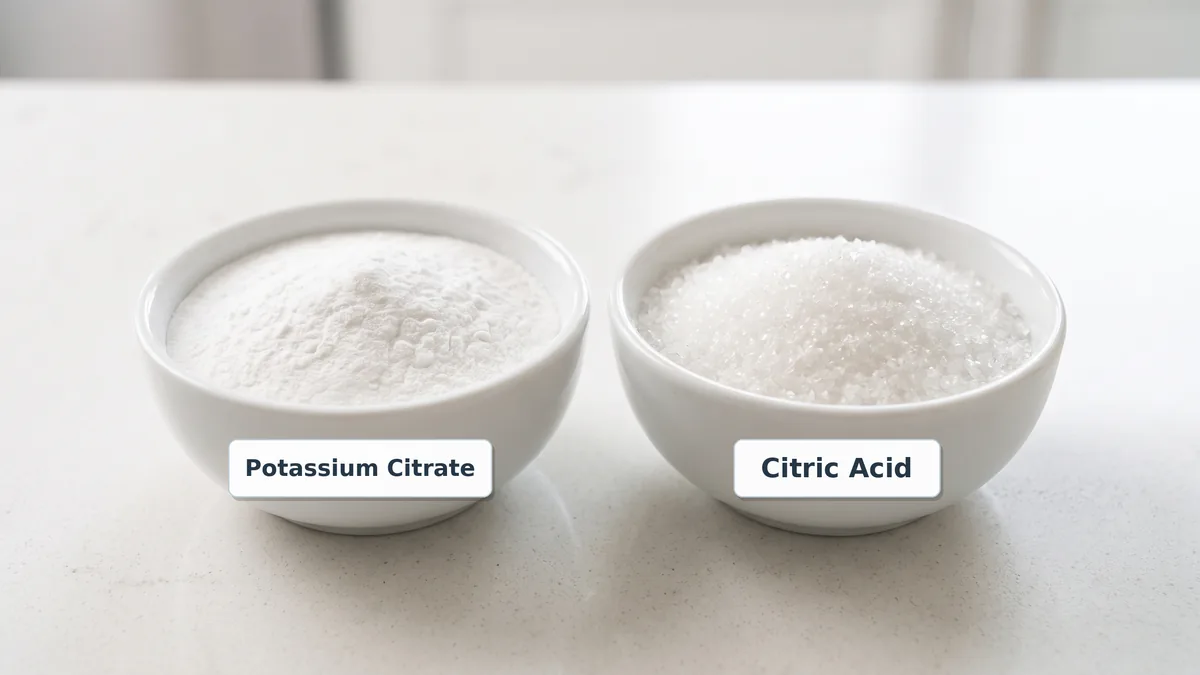
Both come from the same carbon skeleton, yet they behave very differently in a formula. This is the potassium citrate vs citric acid question buyers ask most, and the honest answer starts one step back, with what citric acid is and how it behaves before any of its salts enter the picture.
| Feature | Potassium citrate | Citric acid |
|---|---|---|
| Formula | K₃C₆H₅O₇ | C₆H₈O₇ |
| E number | E332 | E330 |
| Nature | Mildly alkaline salt | Strong organic acid |
| Taste | Saline, not sour | Sharply sour |
| pH effect | Raises pH | Lowers pH |
| Main role | Buffer, sequestrant, potassium source | Acidulant, preservative aid, descaler |
| Best for | Acid control without added sourness | Sourness and strong pH drop |
Use citric acid to make a product acidic. Use potassium citrate to hold acidity steady, soften it or neutralize excess acid. Many beverage and pharmaceutical systems use both together as a citrate buffer.
Potassium Citrate vs Sodium Citrate
Within the citrate family, the closest comparison is sodium citrate (E331). The two work almost identically as buffers and emulsifying salts. The difference is the cation, and that decides which one a label, diet or regulation allows.
| Feature | Potassium citrate | Sodium citrate |
|---|---|---|
| Formula | K₃C₆H₅O₇ (monohydrate K₃C₆H₅O₇·H₂O) | Na₃C₆H₅O₇ (usually the dihydrate, Na₃C₆H₅O₇·2H₂O) |
| E number | E332 | E331 |
| Solubility in water | Very high, about 154 to 167 g/100 mL | High, roughly 40 to 65 g/100 mL for the dihydrate (references vary) |
| Taste | Saline, slightly cooling; can turn bitter at high levels | Salty, mildly tart |
| Elemental mineral | 38.28% K (anhydrous) | 26.7% Na (anhydrous) |
| Typical uses | Low-sodium foods, electrolyte drinks, pharmaceutical buffers, wet chemical fire agents | Processed cheese, soft drinks, anticoagulant solutions, general food buffering |
| Which to choose | When sodium must be limited or potassium is wanted | When cost matters and sodium is acceptable |
Sodium citrate is usually the cheaper default. Potassium citrate earns its place in “reduced sodium” claims and potassium-fortified products.
The rest of the family follows the same logic. Magnesium citrate (E345) and calcium citrate (E333) are chosen for the mineral they deliver, while potassium and sodium citrate are chosen for solubility and buffering.
How the Body Handles Citrate: Alkalizing Chemistry and Potassium Citrate Benefits
This section is informational only. It explains the chemistry behind the potassium citrate benefits you will see discussed, and it is not medical advice.
After absorption, citrate enters normal metabolism (the Krebs cycle) and is converted to bicarbonate. That bicarbonate is an alkali, so citrate salts act as an “alkali load.” The potassium is handled like dietary potassium, and the kidneys excrete the excess.
This mechanism is why potassium citrate appears in clinical research on urine chemistry. Low urinary citrate and acidic urine are recognized risk factors for calcium kidney stones. Citrate binds urinary calcium and raises urine pH.
Prescription extended-release potassium citrate products exist for these medical uses, and they are managed by physicians. Anyone considering potassium citrate for a health reason should talk to a healthcare professional first.
For formulators, the practical benefits are different:
- Sodium reduction: Replaces sodium citrate in low-sodium recipes.
- Mild flavor: Buffers acidity without adding sourness.
- Metal control: Sequesters trace metals that cause haze or color change.
- Easy dissolving: Works in concentrated liquid systems.
Potassium Citrate Uses by Sector

Food and beverage
In food, potassium citrate works as an acidity regulator, buffer and sequestrant. It is common in processed cheese and cheese sauces, where it acts as an emulsifying salt that keeps proteins and fat blended. It also appears in gelatin desserts, puddings, jams and jellies, where pH control helps pectin set.
In drinks, it buffers flavor acids, protects color and adds potassium. Sports drinks and electrolyte mixes use it as a potassium source with a gentler taste than potassium chloride.
Pharmaceutical and supplement
Pharmaceutical makers use potassium citrate as a buffer, an alkalizing agent and a potassium source in oral solutions, effervescent products and tablets. Prescription products are regulated drugs.
A potassium citrate supplement sold over the counter normally contains a small amount of elemental potassium per serving. US rules limit how much potassium nonprescription supplements may carry, commonly about 99 mg per serving. Supplement makers need FCC or USP material with full documentation.
Industrial and other uses
Beyond food and pharma, potassium citrate has several technical roles:
- Fire suppression: Concentrated potassium citrate solutions are used in wet chemical extinguishers for kitchen (Class K) fires.
- Cleaning and detergents: The citrate ion acts as a biodegradable builder and chelant.
- Personal care: It adjusts pH and sequesters metals in cosmetic formulas.
- Laboratory work: It is used in buffer preparation and in some aqueous two-phase extraction systems.
Potassium Citrate Grades: FCC, USP and Technical
The right grade depends on the end use and on what your quality system demands. Do not buy a lower grade and hope to upgrade it later.
| Grade | Typical use | What to check |
|---|---|---|
| Food (FCC) | Food, beverages, nutrition products | Heavy metals, assay, loss on drying, allergen and GMO statements |
| USP / pharmaceutical | Drugs, supplements, medical formulations | Compendial assay, impurity limits, full traceability |
| Technical / industrial | Cleaning, fire suppression, water treatment | Assay, pH, insolubles; it must not enter food or drugs |
The compendial assay for FCC and USP material is typically 99.0% to 100.5% on the dried basis. Monohydrate and anhydrous material will list different loss-on-drying limits, so match the form to your process.
Buyer’s Decision Guide
Choosing potassium citrate is mostly about matching the product to the job. A short checklist prevents expensive mistakes.
- Check the form: Is it anhydrous or monohydrate? The potassium percentage and the weighing basis change between them.
- Match the grade: Use FCC or USP for anything people eat or take. Keep technical grade strictly for industrial work.
- Request the COA and SDS: Confirm assay, pH, heavy metals, loss on drying and the lot number before you scale up.
- Think about humidity: Hygroscopic powder needs sealed, moisture-barrier packaging. Liquid concentrates avoid the clumping problem.
- Compare against alternatives: If sodium is acceptable, sodium citrate is usually cheaper. If you need sourness, you want citric acid instead.
- Plan for the label: Check how E332 and potassium claims must appear on your finished product.
Safety, Handling and Storage
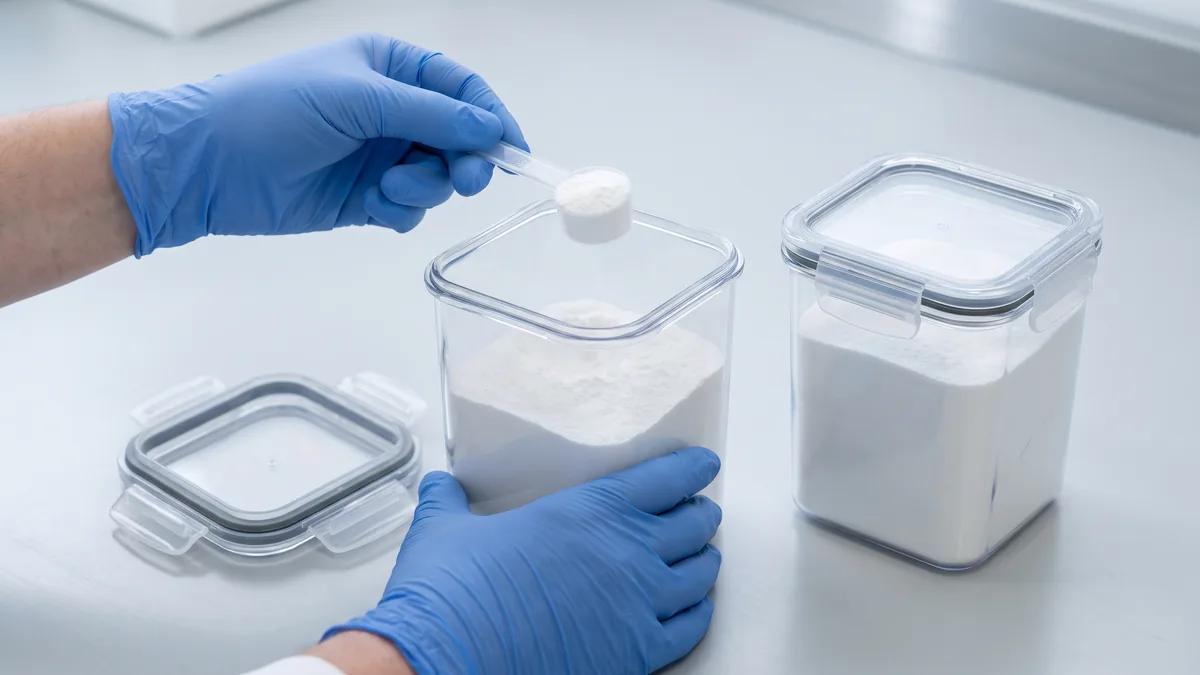
Potassium citrate is generally regarded as low in hazard in industrial handling. Always follow the supplier’s SDS, because classification can differ by grade and concentration.
Handling:
- Wear safety glasses and gloves. Dust can irritate eyes and airways.
- Limit dust and wash hands after use.
- Keep it away from strong oxidizers and strong acids, which are incompatible.
Storage:
- Keep it in a tightly closed container in a cool, dry place.
- Reseal bags straight after use, since the powder absorbs moisture.
- Check the supplier’s stated shelf life, often around two to three years in sealed packaging.
Health note: Potassium is an essential mineral, but too much can be dangerous. People with kidney disease, heart conditions or on certain medicines (such as potassium-sparing diuretics or ACE inhibitors) can be at risk from added potassium. Common side effects of oral potassium salts include stomach upset, nausea and loose stools. Anyone thinking about a potassium citrate supplement should ask a doctor or pharmacist first.
Spills and disposal: Sweep up dry material, avoid creating dust and dispose of it according to local rules. Large quantities should be handled as your SDS directs.
Potassium citrate rewards buyers who read past the product name: the form, the grade and the storage decide how it behaves long before the recipe does. Treat those three as the real specification and the salt rarely disappoints. That reading is what Chemvexa is for: a chemical platform with a product catalog of specifications and grades, safety resources and guides written from the chemistry outward, so a salt can be checked properly before it ever reaches the recipe.
FAQs
1. Is potassium citrate the same as citric acid?
No. Potassium citrate is the potassium salt of citric acid. It is mildly alkaline and not sour, while citric acid is strongly acidic and sharply sour. They are chemical relatives, not substitutes.
2. What does E332 mean?
E332 is the European food additive code for potassium citrates. E332(i) is monopotassium citrate and E332(ii) is tripotassium citrate. In US labeling the ingredient is simply declared as potassium citrate.
3. Is potassium citrate the same as potassium chloride?
No. Potassium chloride (KCl) holds more potassium per gram, but it tastes harsher and bitter. Potassium citrate carries less potassium, yet it adds buffering and chelation. Which one fits depends on whether you want a mineral source alone or also pH control.
4. Why does potassium citrate clump?
It is hygroscopic, so it absorbs water vapor from the air. Even small humidity leaks cause caking. Store it sealed, scoop quickly and keep containers in a dry area.
5. Is potassium citrate safe to take as a supplement?
That depends on the person, so this guide cannot say. Potassium intake needs care for people with kidney problems or those taking certain medicines. Speak with a healthcare professional before using any potassium citrate supplement.