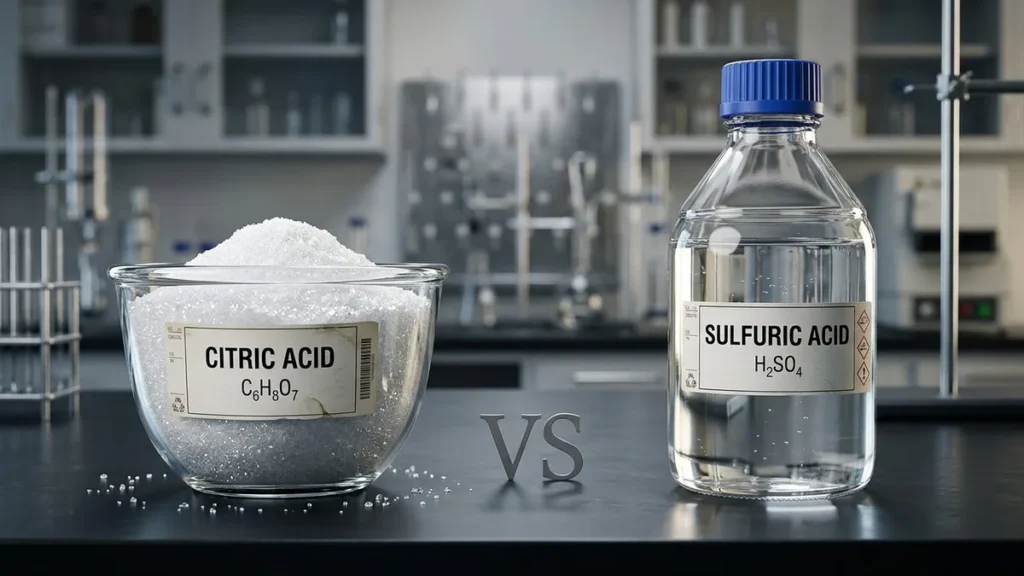
Citric acid and sulfuric acid are both everyday workhorses, yet they sit at opposite ends of the strength and safety scale. One is a mild organic acid found in citrus fruit and used in food. The other is a powerful mineral acid behind the fertilizer, battery and metal industries. The citric acid vs sulfuric acid choice changes your equipment, your PPE, your process results and your budget.
1. Chemical Class, Formula and Source
Citric acid is an organic tricarboxylic acid, which means each molecule carries three carboxyl groups that can release a proton. Manufacturers make it by fermenting sugar sources such as corn or sugarcane with the mold Aspergillus niger. The crystals are then purified and sold in several grades. This fermentation route is why citric acid is accepted in food and personal care products.
Sulfuric acid is a mineral (inorganic) acid with two protons that can be released. It is made from sulfur through the contact process, where sulfur burns to sulfur dioxide, oxidizes to sulfur trioxide, and is absorbed into concentrated acid and diluted to the target strength. Large plants run this process continuously, which is why the acid is so widely available.
| Property | Citric Acid | Sulfuric Acid |
|---|---|---|
| Formula | C₆H₈O₇ | H₂SO₄ |
| Molecular weight | 192.12 g/mol (anhydrous) | 98.08 g/mol |
| CAS number | 77-92-9 (anhydrous), 5949-29-1 (monohydrate) | 7664-93-9 |
| Class | Organic, triprotic | Mineral, diprotic |
| Other names | 2-hydroxypropane-1,2,3-tricarboxylic acid, E330 | Oil of vitriol, E513 |
| Source | Sugar fermentation | Contact process |
2. Acid Strength and pKa
Strength is the biggest chemical difference between the two. A pKa value shows how easily an acid gives up a proton, and the lower the number, the stronger the acid. Sulfuric acid sits far below citric acid on this scale, so it is the stronger acid at every step of dissociation.
| Constant | Citric Acid | Sulfuric Acid |
|---|---|---|
| pKa₁ | 3.13 | about -3 |
| pKa₂ | 4.76 | 1.99 |
| pKa₃ | 6.40 | none |
| Strength class | Weak acid | Strong acid |
Why Sulfuric Acid Is Stronger
Sulfuric acid gives up its first proton completely in water, so essentially every molecule dissociates at that step. Its second proton is still fairly strong, with a pKa₂ near 2. In practice, a sulfuric acid solution delivers a large and steady supply of hydrogen ions.
Citric Acid as a Buffer
Citric acid releases protons only partly, so most of its molecules stay intact in solution. Its three steps are spaced closely, from 3.13 to 6.40, which makes it a very useful buffer between about pH 2.5 and 7. Sulfuric acid has no buffering zone in that range. It simply drives the pH down and holds it there.
3. pH at Common Concentrations
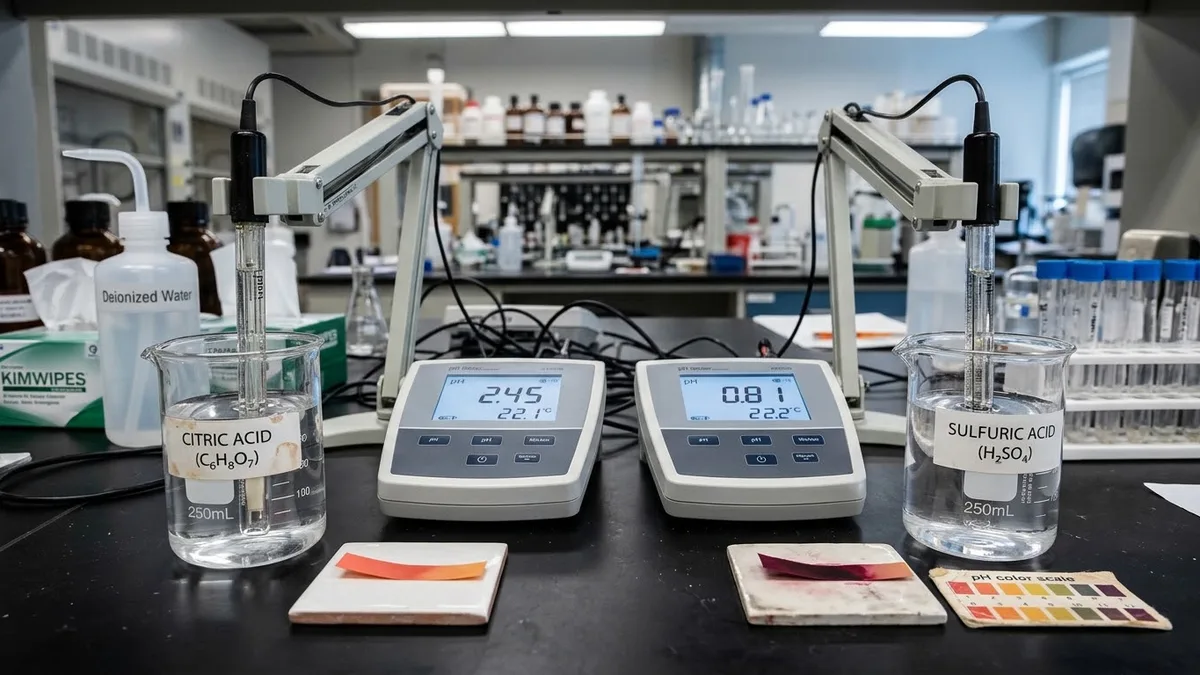
At equal weight percent, sulfuric acid gives a far lower pH. This matters when a process has a target pH, because the same dose of each acid moves the solution by very different amounts. Citric acid also has a floor. Because it is weak and its solubility is limited, it cannot reach pH 1 at practical strengths.
| Concentration (w/v, approx.) | Citric Acid pH | Sulfuric Acid pH |
|---|---|---|
| 1% | about 2.2 | about 1.0 |
| 5% | about 1.9 | about 0.3 |
| 10% | about 1.7 | about 0 |
These values are calculated estimates at room temperature. If your process needs a pH below about 1.7, citric acid is not an option. Always confirm with a calibrated pH meter for process work, because temperature and dissolved salts shift real readings.
4. Physical Form and Properties
Citric acid is a white crystalline solid that dissolves easily in water. It is sold as anhydrous or monohydrate crystals in granular and fine mesh sizes. The powder can absorb moisture from humid air and form lumps, so it needs sealed packaging and dry storage.
Sulfuric acid is a dense, oily, colorless liquid that mixes with water in any ratio. It is sold at fixed concentrations, most often 93% to 98% for industrial use. At 98% it is almost twice as dense as water, so containers weigh far more than their volume suggests.
| Property | Citric Acid | Sulfuric Acid |
|---|---|---|
| Appearance | White crystals or powder | Clear, oily liquid |
| Melting point | about 153 °C (307 °F), anhydrous | about 10 °C (50 °F), pure |
| Thermal behavior | Decomposes above about 175 °C (347 °F) | Boils near 337 °C (639 °F) at 98% |
| Density | about 1.67 g/cm³ | about 1.84 g/mL at 98% |
| Hygroscopic | Mildly | Strongly, pulls water from air |
5. Corrosivity and Material Compatibility
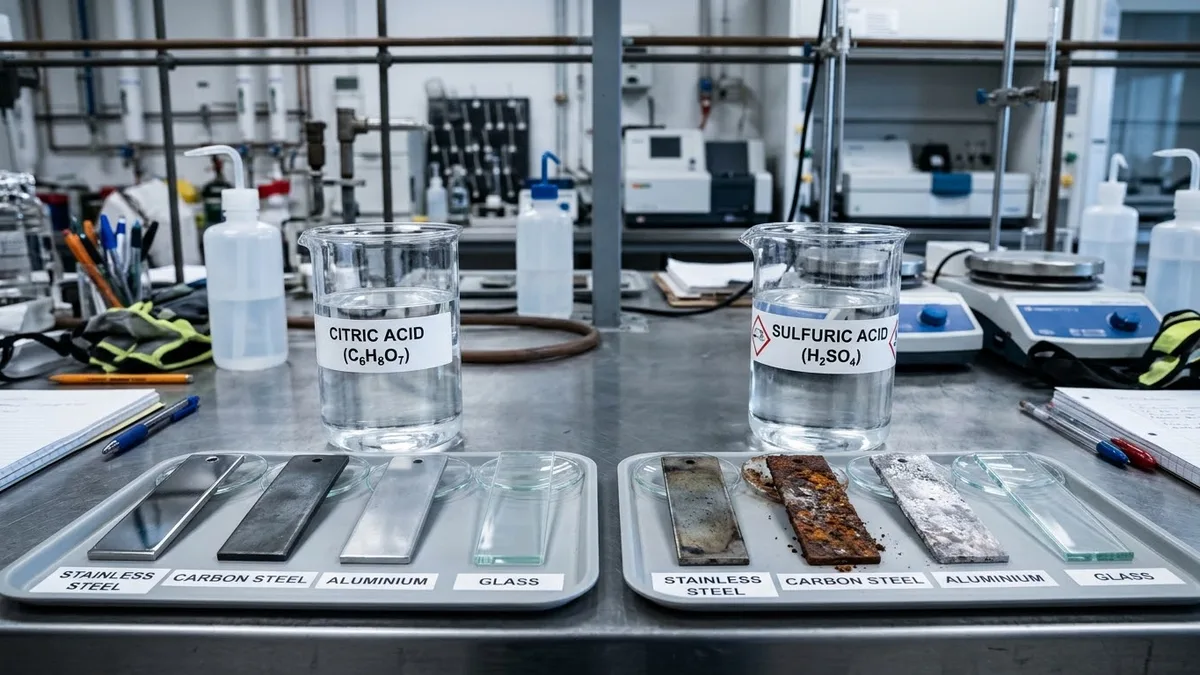
Material damage is a separate question from acid strength. Concentrated sulfuric acid dehydrates organic matter, so it chars sugar, paper and wood. Even dilute sulfuric acid dissolves carbon steel and releases flammable hydrogen gas, while hot concentrated acid also acts as an oxidizer. Tanks and piping must be chosen for the exact strength and temperature in use.
Citric acid is far gentler, yet hot solutions still etch several metals. On stainless steel the picture reverses, because citric acid is an accepted passivation treatment under ASTM A967. Sulfuric acid, by contrast, can attack many stainless grades when warm. The table gives general guidance, so always check a compatibility chart for your exact concentration and temperature.
| Material | Citric Acid | Sulfuric Acid |
|---|---|---|
| Carbon steel | Slow etching, faster when hot | Rapid attack when dilute, hydrogen released |
| Stainless steel (304, 316) | Good, used for passivation | Attacked when warm or at mid strengths |
| Aluminum | Slowly attacked | Attacked |
| Zinc and galvanized coatings | Attacked | Rapidly attacked |
| Copper and brass | Mild attack, removes tarnish | Attacked when hot or oxidizing |
| Concrete and limestone | Surface dissolution | Severe, expansive sulfate damage |
| HDPE and polypropylene | Resistant | Resistant at normal strengths, check hot or 98% |
| Borosilicate glass | Resistant | Resistant |
6. Chelation and Scale Removal
Citric acid is a chelating agent. Its three carboxyl groups and one hydroxyl group wrap around metal ions and hold them in solution. This is why it removes limescale and rust, and why it helps detergents work in hard water. Sulfuric acid cannot chelate, so it works only by lowering pH.
On limescale, citric acid reacts as follows:
2 C₆H₈O₇ + 3 CaCO₃ → Ca₃(C₆H₅O₇)₂ + 3 H₂O + 3 CO₂.
Heavy deposits may need fresh solution, gentle heat or agitation, because calcium citrate is only slightly soluble. Sulfuric acid is a poor scale remover for calcium deposits, since the gypsum it forms coats the scale and stops the reaction before the deposit is gone.
| Metal ion | With Citric Acid | With Sulfuric Acid |
|---|---|---|
| Ca²⁺ (limescale) | Calcium citrate, slightly soluble, chelated | Calcium sulfate (gypsum), barely soluble |
| Mg²⁺ | Soluble citrate complex | Soluble magnesium sulfate |
| Fe³⁺ (rust) | Soluble iron citrate complex | Dissolves rust but also attacks the steel |
| Cu²⁺ | Soluble complex, cleans tarnish | Soluble copper sulfate |
7. Industrial Uses
The two acids rarely compete head to head. Citric acid fits where safety, taste or gentleness matter, while sulfuric acid fits where raw strength and low cost matter. The table below shows where each one typically appears.
| Industry | Citric Acid | Sulfuric Acid |
|---|---|---|
| Food and beverage | Acidulant, preservative, flavor | Limited processing aid |
| Pharmaceutical | Buffer, effervescent tablets, anticoagulant solutions | Reagent and synthesis |
| Cosmetics | pH adjuster, chelating agent | Rare |
| Cleaning | Descaler, rust remover, detergent builder | Drain and industrial cleaners |
| Water treatment | Membrane cleaning, scale control | pH reduction |
| Metal treatment | Passivation, mild pickling | Steel pickling, anodizing, electroplating |
| Batteries | Selective leaching aid in some recycling routes | Lead-acid electrolyte, strong metal leaching |
| Agriculture | Chelated micronutrients | Fertilizer production, soil acidification |
Citric acid is being studied as a replacement for sulfuric acid in anodizing aluminum alloys, where it can give good corrosion protection. In lithium battery recycling, however, sulfuric acid still recovers far more lithium in a single leaching step. Each acid wins in the jobs that suit its chemistry.
8. Health Hazards and Exposure Limits
Sulfuric acid causes severe skin burns and permanent eye damage, even from short contact with a strong solution. Its mist is also harmful when inhaled, which is why workplace exposure limits exist. Splashes need immediate and prolonged flushing with water, followed by medical care.
Citric acid is much milder and mainly irritates the eyes. Its dust can also irritate the nose and throat when handled in bulk. Normal care with powder, such as limiting dust and rinsing splashes, is usually enough for routine work.
| Item | Citric Acid | Sulfuric Acid |
|---|---|---|
| GHS hazard | Serious eye irritation (H319) | Severe burns and eye damage (H314), corrosive to metals (H290) |
| Exposure limit | No specific limit (nuisance dust rules apply) | OSHA PEL 1 mg/m³; ACGIH TLV 0.2 mg/m³ (thoracic) |
| Contact response | Rinse with water for 15 minutes | Flush with water for at least 15 minutes, remove clothing, get medical help |
| Swallowed | Rinse mouth, seek advice | Do not induce vomiting, seek emergency help |
Always keep the SDS at hand and follow your site’s procedures.
9. Personal Protective Equipment
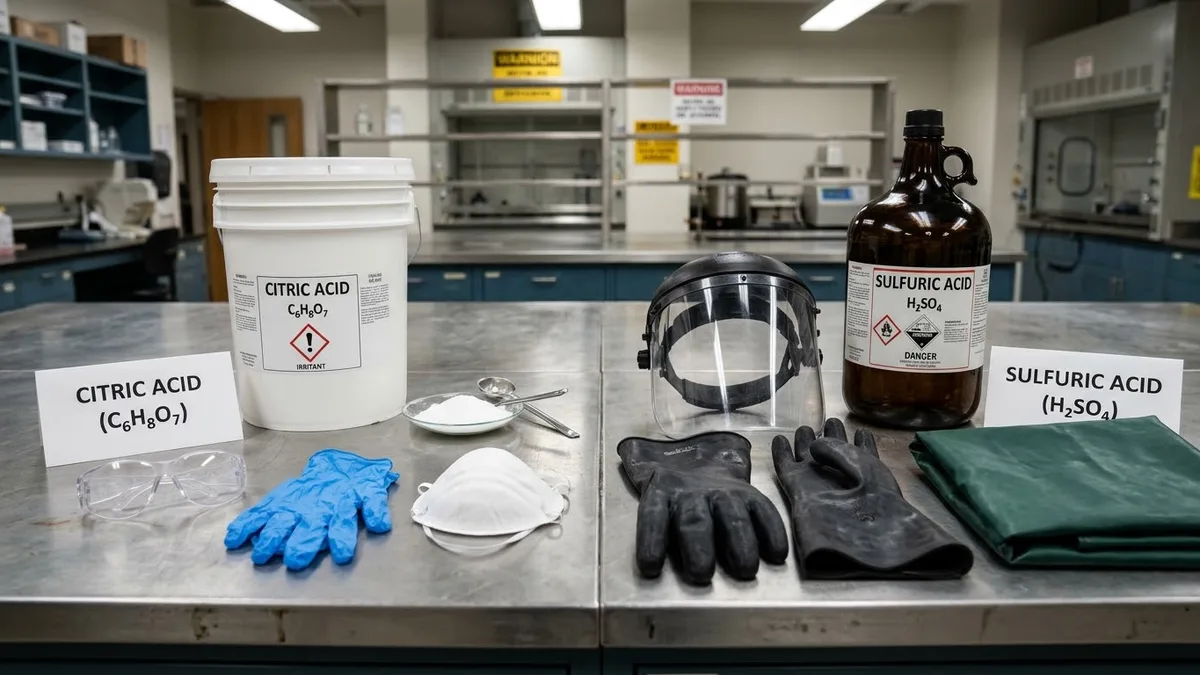
PPE should match the hazard, so the two acids call for very different kits. Citric acid needs basic chemical hygiene, while sulfuric acid needs full splash protection and good ventilation. Choose gloves and body protection from the SDS and the manufacturer’s glove chemical resistance charts for your concentration.
- Citric acid: Safety goggles, nitrile gloves and a dust mask when handling powder.
- Sulfuric acid: Goggles plus a full face shield, butyl or neoprene gloves, an acid-resistant apron or suit, and ventilation or mist protection.
- Both acids: An eyewash station within quick reach of the work area.
10. Dilution, Storage and Incompatibilities
Citric acid dissolves quietly and with little heat. Sulfuric acid releases intense heat when it meets water, sometimes enough to boil the mixture and spit acid. The two need different procedures, laid out below.
Dissolving citric acid:
- Add the crystals to water while stirring.
- Use warm water to speed up dissolving.
- Keep the container sealed and dry afterward.
Diluting sulfuric acid:
- Put the required water in an HDPE or borosilicate glass vessel.
- Wear the full PPE kit listed above.
- Add the acid slowly to the water, never the reverse.
- Stir steadily and let the mix cool between additions.
- Label the container with the final concentration.
Store both acids in sealed, compatible containers. Sulfuric acid also needs secondary containment, and both belong away from the materials below.
| Incompatible with | Citric Acid | Sulfuric Acid |
|---|---|---|
| Bleach (hypochlorite) | Releases chlorine | Releases chlorine |
| Strong bases | Violent neutralization heat | Violent neutralization heat |
| Oxidizers (nitrates, chlorates) | Yes | Yes |
| Metals | Slow etching (Al, Zn) | Releases hydrogen gas |
| Organics, carbides | Not typical | Yes |
11. Environmental Impact and Disposal
Citric acid is readily biodegradable and breaks down in wastewater treatment. Its main environmental concern is chelation, because it can keep metals dissolved and mobile in treated water. Sulfuric acid does not biodegrade, and it adds sulfate to the water it enters. Both must meet your local discharge permit.
| Factor | Citric Acid | Sulfuric Acid |
|---|---|---|
| Biodegradability | Readily biodegradable | Not biodegradable |
| Main water concern | Metal mobilization | Low pH, added sulfate |
| Waste treatment | pH adjustment, usually | Neutralize with soda ash, sodium bicarbonate or lime |
| Before discharge | Check pH | Check pH and confirm limits |
12. Cost, Grades and Transport
Per kg, bulk sulfuric acid usually costs a small fraction of citric acid, because it is produced at huge scale from sulfur. Citric acid needs fermentation and purification, which adds cost. Job cost can still favor citric acid when it avoids expensive safety controls and equipment damage.
| Item | Citric Acid | Sulfuric Acid |
|---|---|---|
| Common grades | Food (FCC), USP, ACS, technical | Technical (about 93 to 98%), battery grade, USP, ACS |
| Forms | Anhydrous, monohydrate, granular, fine | Liquid at set concentrations |
| US transport | Not regulated as hazardous | DOT Class 8, UN1830 above 51% |
13. Substituting One Acid for the Other
Never swap one acid for the other by equal weight. Compare acid equivalents instead, which account for how many protons each molecule can release. The equivalent weight is the molar mass divided by the number of protons.
| Acid | Equivalent weight |
|---|---|
| Sulfuric acid (100%) | 49.04 g/eq |
| Citric acid, anhydrous | 64.04 g/eq |
| Citric acid monohydrate | 70.05 g/eq |
To neutralize the same amount of base, use about 1.3 g of anhydrous citric acid (or 1.4 g of monohydrate) per 1 g of pure sulfuric acid. This assumes all three citric protons react, which needs a final pH near 7. Test small batches first for foaming, residue and metal compatibility.
The citric acid vs sulfuric acid decision comes down to the strength you need, the materials you work with and the safety controls you can support. Citric acid covers food, personal care, descaling and gentle cleaning. Sulfuric acid covers strong-acid industrial jobs where proper handling is in place.
Getting that choice right starts with verified data on both acids, which is what Chemvexa is built to provide: a chemical platform whose catalog carries each chemical with its formula, specifications, grades and safety notes, backed by guides like this one.
FAQs
1. Is citric acid stronger than sulfuric acid?
No. Sulfuric acid is a strong acid, while citric acid is weak, with a pKa₁ of 3.13. At equal concentration, sulfuric acid gives a much lower pH and carries far higher hazard.
2. Is sulfuric acid allowed in food?
In the US, the FDA lists sulfuric acid as generally recognized as safe for limited uses such as pH control (21 CFR 184.1095). Citric acid has much wider use as a food acidulant. Always check the rules for your specific product and process.
3. Can I mix citric acid with sulfuric acid?
Not casually. Adding concentrated sulfuric acid to citric acid generates heat, and hot concentrated sulfuric acid breaks citric acid down and releases carbon monoxide. Some leaching processes use controlled mixtures, but only with engineered ventilation and written procedures.
4. Why is sulfuric acid used to make citric acid?
After fermentation, citric acid is precipitated as calcium citrate. Sulfuric acid then converts it back into free citric acid and forms insoluble calcium sulfate, which is filtered off.