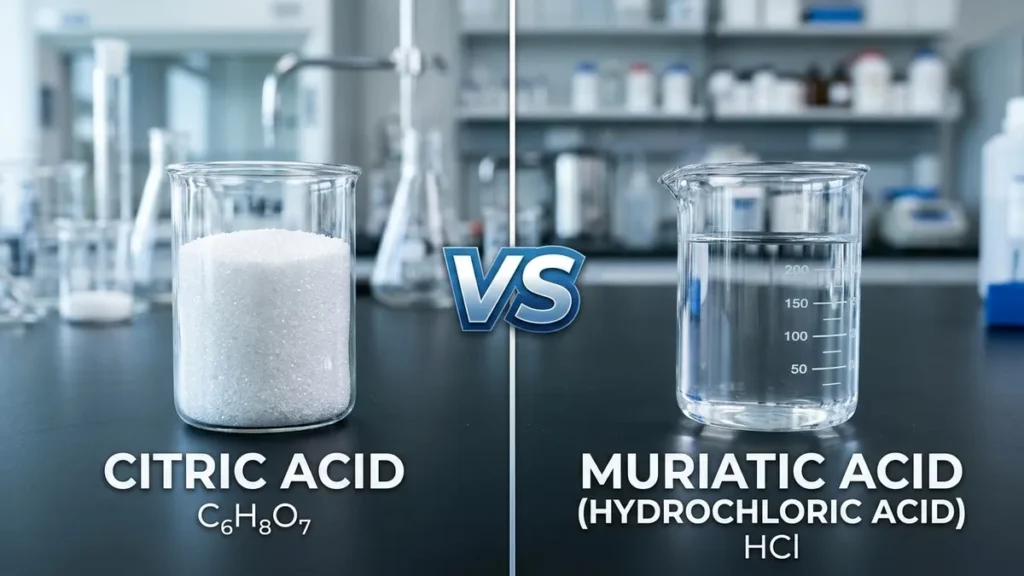
Citric acid vs muriatic acid is a choice between a mild organic acid and one of the strongest, cheapest mineral acids sold over the counter. Both dissolve scale, rust and mineral deposits, yet they work in very different ways and carry very different risks. This guide compares them factor by factor, so you can match the right acid to your material, your job and your safety setup.
1. Chemical Nature and Composition
Citric Acid
Citric acid (C₆H₈O₇) is a tricarboxylic organic acid found naturally in citrus fruit. Commercial supply comes from fermenting sugars with Aspergillus niger, then purifying and crystallizing the acid. It is sold as anhydrous powder or as monohydrate (C₆H₈O₇·H₂O), which holds about 8.6% water, so you need about 9% more of it to match the anhydrous form. Food, USP and technical grades are common.
Muriatic Acid
Muriatic acid is the trade name for technical-grade hydrochloric acid, a solution of hydrogen chloride gas (HCl) in water. US hardware stores usually sell it at 14.5% to 31.45% HCl, and 31.45% equals 20° Baumé. It often looks pale yellow because of trace iron, which is harmless for cleaning but rules it out for food or pharma use. Purer reagent, ACS and food-grade (FCC) hydrochloric acid are separate products for lab and processing work.
| Property | Citric acid | Muriatic acid |
|---|---|---|
| CAS number | 77-92-9 (anhydrous), 5949-29-1 (monohydrate) | 7647-01-0 |
| Molar mass | 192.12 g/mol (anhydrous), 210.14 g/mol (monohydrate) | 36.46 g/mol (HCl) |
| Appearance | White crystals or powder | Clear to pale yellow, fuming liquid |
| Typical strength | Sold as a 100% solid | 14.5% to 31.45% in water |
2. Acid Strength and pH
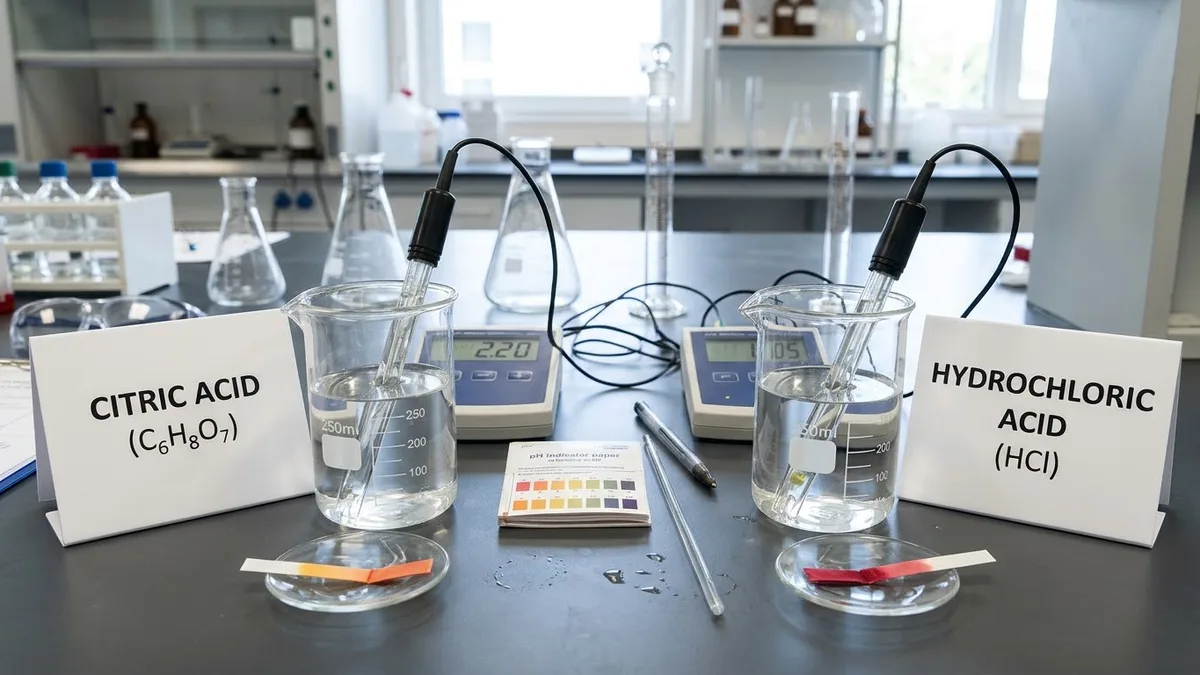
| Measure | Citric acid | Muriatic acid |
|---|---|---|
| Dissociation | Partial, in three steps | Complete |
| pKa | 3.13, 4.76, 6.40 | About -6 |
| pH of a 5% (w/v) solution | About 1.9 | About 0 |
| Total H⁺ per gram | 0.0156 mol (anhydrous powder) | 0.0086 mol (31.45% solution) |
Citric Acid
Citric acid is a weak, triprotic acid, so most of it stays intact in water at low pH. Its three protons are released step by step as the pH climbs. That is why a gram of it holds more total acid than a gram of muriatic acid solution, yet acts slowly and stays mild on the surface.
Muriatic Acid
Hydrochloric acid splits apart completely, so every HCl molecule gives up its proton at once. At equal 5% strength it holds roughly 100 times more free hydrogen ions than citric acid. That is why it burns skin and attacks metal so much faster, even though its total acid per gram is lower.
3. Cleaning Action and Speed
| Reaction | Citric acid | Muriatic acid |
|---|---|---|
| Limescale | 3CaCO₃ + 2C₆H₈O₇ → Ca₃(C₆H₅O₇)₂ + 3H₂O + 3CO₂ | CaCO₃ + 2HCl → CaCl₂ + H₂O + CO₂ |
| Calcium salt formed | Calcium citrate, poorly soluble | Calcium chloride, highly soluble |
| Rust (iron oxide) | Forms soluble iron(III) citrate complexes | Fe₂O₃ + 6HCl → 2FeCl₃ + 3H₂O |
| Bare steel | Little attack | Fe + 2HCl → FeCl₂ + H₂ |
Citric Acid
Citric acid combines mild acidity with chelation: it binds Ca²⁺, Fe³⁺ and Cu²⁺ and holds them in solution. Jobs usually take minutes to hours, depending on temperature and deposit thickness. Because calcium citrate can precipitate in hot or heavily loaded solutions, keep the pH low with enough acid and rinse well afterward.
Muriatic Acid
Muriatic acid attacks by brute proton force and finishes most jobs within minutes, leaving no calcium residue. Once the rust or scale is gone, it keeps attacking bare steel and releases hydrogen gas. That gas can embrittle high-strength steel, so timing matters more than strength.
4. Material Compatibility
Material damage is where the two acids differ most in daily use. Test any acid on a hidden spot first, and rinse thoroughly afterward, because leftover acid keeps working.
| Property | Citric acid | Muriatic acid |
|---|---|---|
| Stainless steel (304, 316) | Safe at working strength; used for passivation | Chloride causes pitting and stress corrosion, avoid |
| Aluminum | Gentle, but long soaks can dull it | Dissolves it quickly, avoid |
| Galvanized steel and zinc | Slowly removes zinc | Strips the zinc coating fast |
| Brass and copper | Brightens in short soaks | Can strip the surface and cause pitting |
| Carbon steel | Removes rust with little attack on base metal | Pickles fast, risk of over-etching |
| Concrete, mortar, cement grout | Etches mildly | Etches aggressively |
| Marble, limestone, travertine | Etches, do not use | Etches heavily, do not use |
| Glazed tile, porcelain, glass | Safe | Safe with short contact and rinsing |
5. Best Applications
Citric Acid
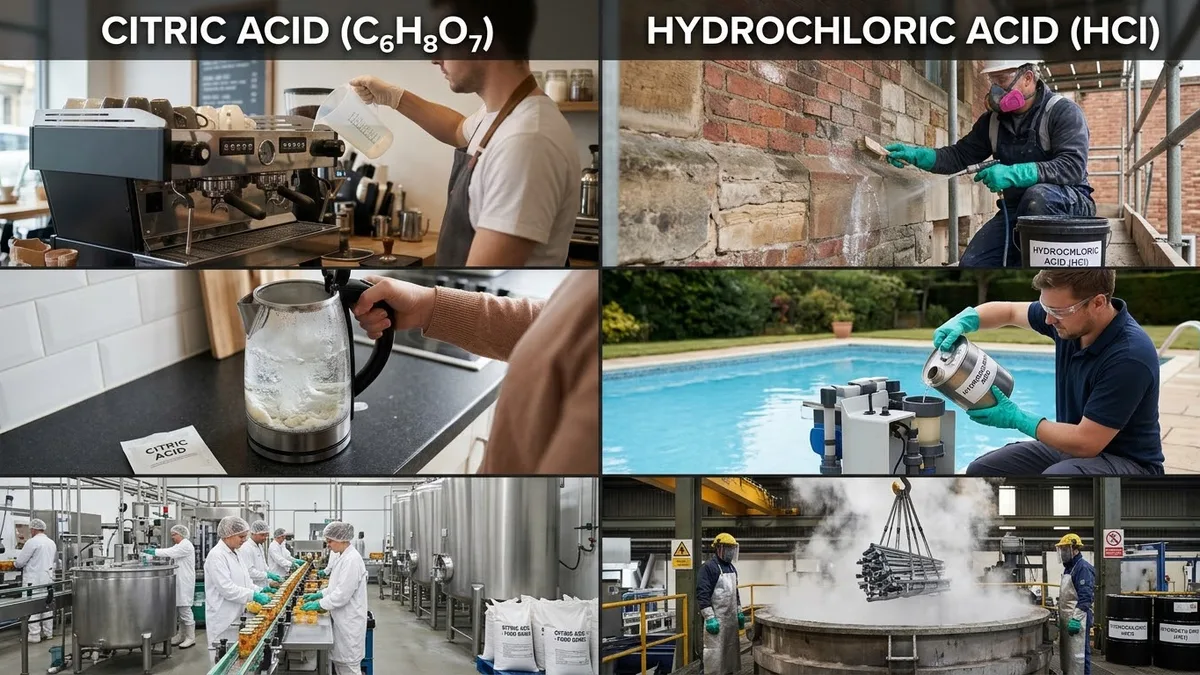
In the US, citric acid is generally recognized as safe (GRAS) for food use, which makes it a standard acidulant and preservative in food and beverages. Pharmaceutical makers use it as a buffer, cosmetic formulators as a pH adjuster, and detergent makers as a builder that softens water. At home and in small shops, it descales kettles and coffee machines and removes light rust from tools.
Muriatic Acid
Muriatic acid and its higher-purity grades serve steel pickling, oil well acidizing, water treatment pH control, ion-exchange resin regeneration and chemical manufacturing. Trades use it to clean masonry and prepare concrete. Pool owners use it to lower pH and total alkalinity, and it adds chloride, which is already present from chlorine sanitizers.
Pick by Job
| Job | Better pick | Reason |
|---|---|---|
| Kettles and coffee machines | Citric acid | Dissolves scale without harming heating elements or seals |
| Light rust on tools | Citric acid | Slow chelation keeps part dimensions intact |
| Concrete etching, indoors | Citric acid | No fumes in a closed space |
| Heavy masonry scale and efflorescence | Muriatic acid | Dissolves thick deposits in minutes |
| Concrete etching, outdoors | Muriatic acid | Gives an even profile quickly |
| Routine pool pH and alkalinity | Muriatic acid | Citric acid is organic, so chlorine oxidizes it and adds chlorine demand |
| Steel pickling | Muriatic acid | Fast, usually with corrosion inhibitors |
6. Dilution and Dosage
Always add acid to water, never water to acid. These are common working ranges, so follow your product label and SDS.
| Job | Citric acid | Muriatic acid (31.45%) |
|---|---|---|
| Kettle or coffee machine descaling | 5% to 10% (about 6.7 to 13 oz of powder per gallon), 50 to 60 °C (120 to 140 °F), 20 to 60 min | Not recommended |
| Rust soak | 5% to 10%, 40 to 60 °C (104 to 140 °F), 2 to 24 h | 1 part acid to 3 to 5 parts water (about 5% to 8% HCl), 5 to 30 min |
| Concrete etching | About 5% to 10%, longer dwell | 1 part acid to 10 parts water (about 3% HCl), until fizzing stops |
| Stainless passivation | 4% to 10% at 40 to 70 °C (100 to 160 °F), per ASTM A967 citric methods | Not used |
| Pool total alkalinity | Not standard | About 25 fl oz (750 mL) per 10,000 gal (38,000 L) lowers alkalinity roughly 10 ppm |
To swap one acid for the other on carbonate scale, 1 kg of 31.45% muriatic acid matches about 0.55 kg of anhydrous citric acid, or about 0.60 kg of monohydrate. The figure comes from reaction ratios: 1 g of anhydrous citric acid can dissolve about 0.78 g of calcium carbonate, against about 0.43 g for 1 g of 31.45% muriatic acid. Because citric acid reacts more slowly, plan for extra product and a longer dwell.
7. Health Hazards and PPE
Citric Acid
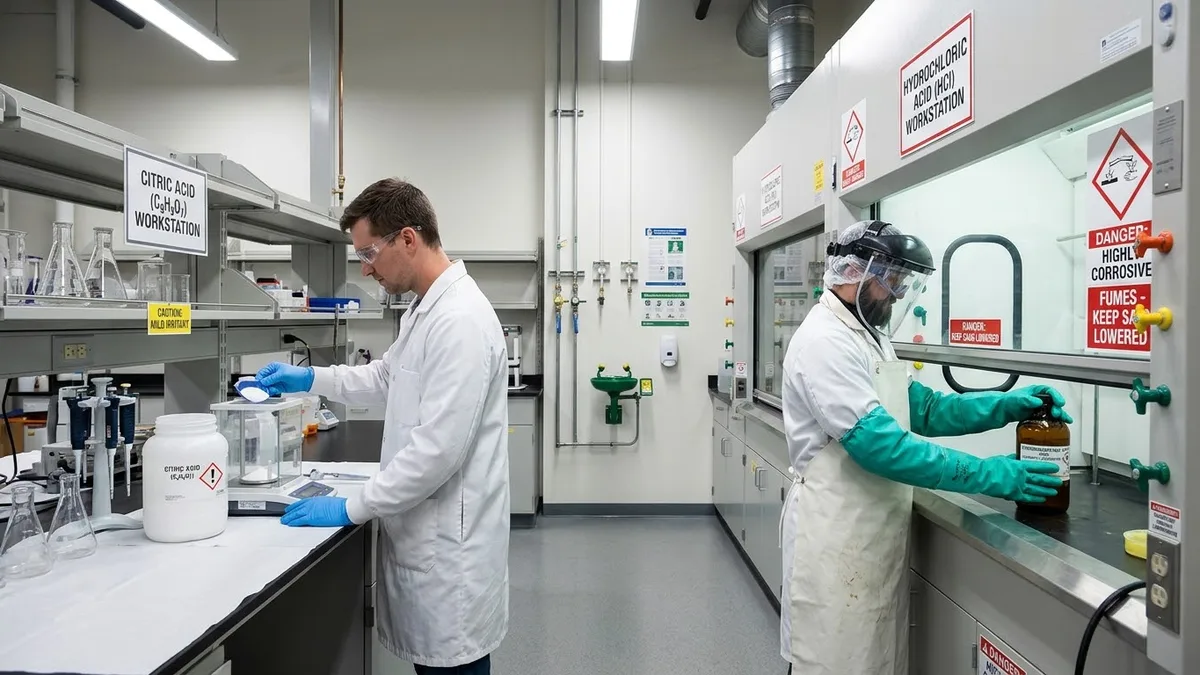
Citric acid is mainly an eye irritant (GHS H319), and the powder irritates the nose and throat. Dilute solutions are usually mild on skin, but concentrated solutions and dust still deserve care.
- Safety glasses or splash goggles
- Chemical-resistant gloves
- Dust mask when pouring powder
Muriatic Acid
Muriatic acid causes severe skin burns and eye damage (H314), and its fumes irritate the lungs. OSHA sets a ceiling limit of 5 ppm for hydrogen chloride in air, so ventilation is not optional. Work outdoors or with strong airflow.
- Splash goggles or a face shield
- Neoprene or butyl gloves for concentrated acid
- Acid-resistant apron and boots
- Acid-gas respirator when ventilation is poor
First Response
For either acid, flush skin or eyes with water for at least 15 minutes and remove contaminated clothing. After inhaling fumes or dust, move to fresh air. Call US Poison Control at 1-800-222-1222 and keep the SDS on hand.
8. Mixing Risks and Incompatibilities
Citric Acid
Citric acid lowers the pH of bleach solutions and can release chlorine, so keep it away from hypochlorite. It is also incompatible with strong oxidizers, strong bases and nitrates. The full list of what not to mix with citric acid runs to several more pairings.
Muriatic Acid
Never mix muriatic acid with bleach (sodium hypochlorite), because the mix releases toxic chlorine gas (Cl₂). Other dangerous combinations include:
- Ammonia products: irritating chloramine mists
- Sulfides and cyanides: toxic hydrogen sulfide or hydrogen cyanide gas
- Aluminum, zinc and other active metals: flammable hydrogen gas
9. Storage, Handling and Shipping
Citric Acid
Keep citric acid dry and sealed, because anhydrous powder absorbs moisture and cakes. Store it apart from incompatible materials. It is not regulated as a hazardous material for US ground transport, which keeps shipping simple.
Muriatic Acid
Store muriatic acid in its original HDPE or polypropylene container, tightly closed, in a cool, ventilated spot. Its fumes rust nearby tools and shelving, so a metal garage is a poor location. In transport it ships as UN1789, a Class 8 corrosive.
10. Environmental Impact and Disposal
Citric Acid
Citric acid is readily biodegradable. Its catch is chelation: spent solutions can carry dissolved copper, lead or nickel from pipes and parts, so check the metals before drain disposal. The same metals check decides small-scale disposal too, including citric acid and septic tanks.
Muriatic Acid
Neutralize muriatic acid slowly with sodium bicarbonate or soda ash until the pH is near neutral, expecting foaming from CO₂. Many US wastewater systems accept discharge between pH 5 and 9, but local limits vary. The same neutralizers work on small spills, applied slowly until fizzing stops. Citric acid cannot do this job, because it is itself an acid.
11. Cost and Availability
| Cost factor | Citric acid | Muriatic acid |
|---|---|---|
| Price per unit of acid | Higher | Low |
| Where sold | Chemical suppliers, grocery and online | Hardware, pool and building supply stores |
| Hidden costs | Longer dwell times and more labor | PPE, ventilation and corroded equipment |
Citric acid costs more per unit of acid, but it can cut spending on protective gear and damaged equipment. Price varies with grade, form and pack size. Business buyers usually specify a certificate of analysis (COA) and SDS with each lot.
The strongest acid is not automatically the right acid. The real decision is the match between the acid, the material under it and the person holding the container, and that call gets easier with the specifications in front of you. Chemvexa‘s chemical catalog carries each acid in this comparison with its formula, specifications, grades and safety notes, backed by guides that put those numbers to work.
FAQs
1. Is muriatic acid stronger than vinegar or lemon juice?
Yes, by a wide margin. Vinegar is about 5% acetic acid with a pH near 2.5, and lemon juice holds about 5% to 6% citric acid with a pH of roughly 2 to 2.6. Muriatic acid at 31.45% has a pH below 0, and even a 1:10 dilution stays far more acidic than either.
2. Can you mix citric acid and muriatic acid?
They do not react dangerously with each other, but mixing them gains nothing and gives a more hazardous solution than citric acid alone. Choose one acid per job. If you switch acids, rinse the surface thoroughly between steps.
3. How long do these acids last in storage?
Muriatic acid loses strength slowly if the container is not sealed, because HCl gas escapes. Dry, sealed citric acid stays usable for years. Your supplier’s COA and SDS give the retest date for each lot.
4. How do you know when the acid is spent?
On scale jobs, the solution is largely used up when fizzing stops and a pH strip reads closer to neutral than when you started. If deposits remain, refresh with new solution. Treat spent solution under the disposal steps in Factor 10.