You have probably met sodium citrate without noticing. It sits on the ingredient list of processed cheese, soft drinks and shampoos, and it sits inside the blood collection tubes used for clotting tests. So, what is sodium citrate, and why do so many industries buy it?
This guide covers the formula, the key properties, how it is made, what it does and where it is used. It ends with the safety basics every buyer and user should know.
What Is Sodium Citrate?
Citric acid has three acidic –COOH groups. When sodium replaces the acidic hydrogen atoms, the result is a sodium citrate. The more hydrogens that are replaced, the less acidic the salt becomes. Sodium is not the only metal that forms such a salt: swap it for potassium and you get potassium citrate, a close relative with its own uses in food and medicine.
That gives three forms:
| Form | Formula | CAS number | Acidity | Typical role |
| Monosodium citrate | NaH₂C₆H₅O₇ | 18996-35-5 | Acidic | pH adjustment, anticoagulant solutions |
| Disodium citrate | Na₂HC₆H₅O₇ | 144-33-2 | Mildly acidic | pH adjuster in food and cosmetics |
| Trisodium citrate | Na₃C₆H₅O₇ | 68-04-2 (anhydrous) | Mildly alkaline | Buffer, emulsifying salt, chelating agent |
When a recipe, label or supplier says “sodium citrate”, it almost always means trisodium citrate. The mono and di forms show up when a formula needs a lower pH. Always confirm the formula and CAS number on the SDS before you order.
You will also see these names:
- Trisodium citrate: the precise chemical name for the common form.
- Citric acid trisodium salt: a name often used in catalogs and lab supply lists.
- E331: the food additive code. E331(i), (ii) and (iii) mean mono-, di- and trisodium citrate.
Sodium Citrate Formula and Structure
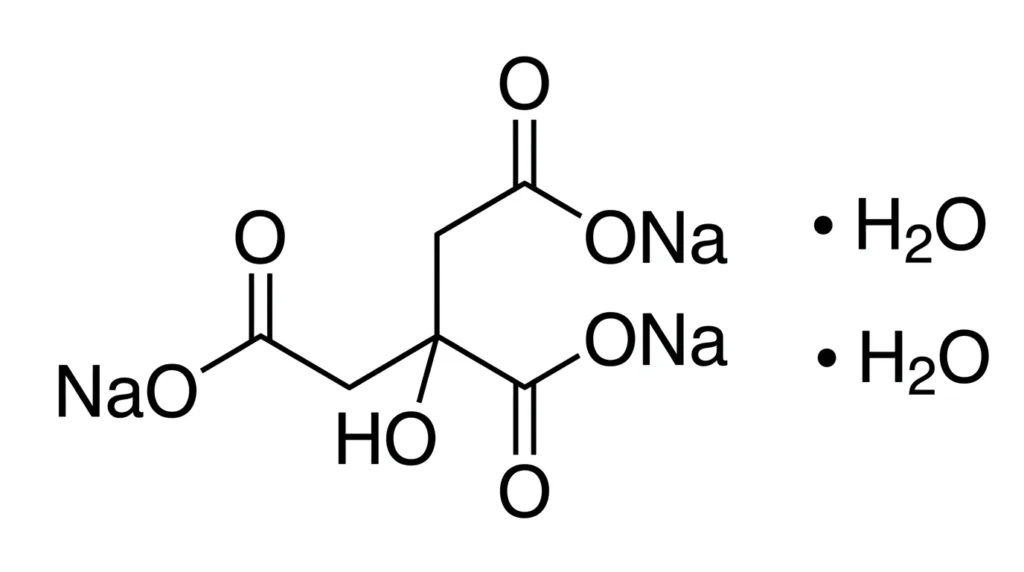
The formula of trisodium citrate is Na₃C₆H₅O₇. The citrate ion (C₆H₅O₇³⁻) has a central carbon carrying one hydroxyl (–OH) group, plus three carboxylate (–COO⁻) groups. Three sodium ions (Na⁺) balance the charge.
Those carboxylate and hydroxyl groups explain most of its behavior. They let the ion hold on to metal ions and soak up extra acid or base.
Suppliers sell two common forms. The dihydrate is the one you will see most often.
| Property | Anhydrous | Dihydrate |
| Formula | Na₃C₆H₅O₇ | Na₃C₆H₅O₇·2H₂O |
| CAS number | 68-04-2 | 6132-04-3 |
| Molecular weight | 258.07 g/mol | 294.10 g/mol |
| Water content | None | About 12% by weight |
Check which form your process calls for. Weighing the dihydrate when a recipe assumes anhydrous means you add about 12% less actual citrate.
Properties of Sodium Citrate
Physical properties
| Property | Value |
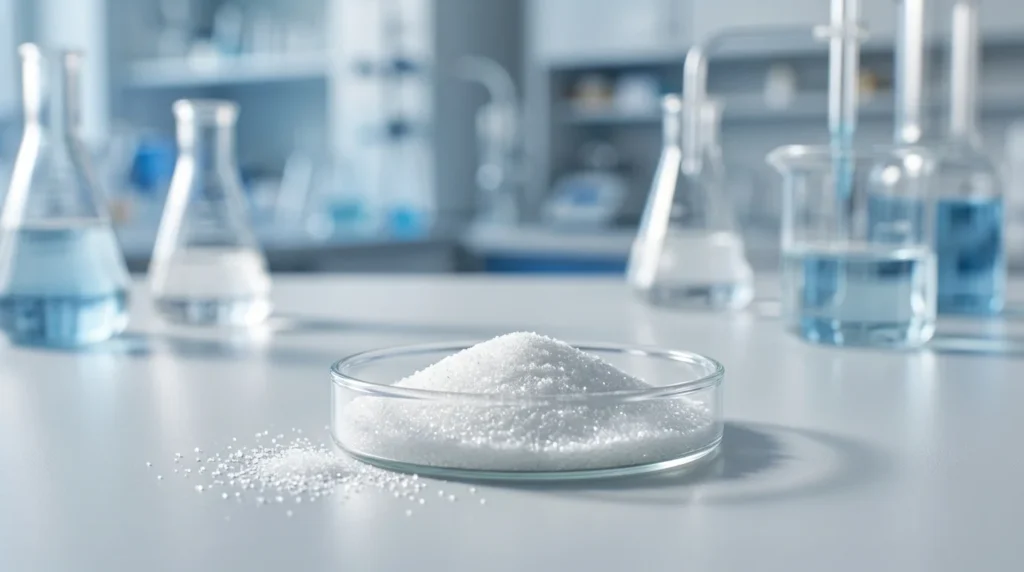
| Appearance | White crystalline powder or granules. |
| Odor | Odorless |
| Taste | Salty, mildly tart. |
| Solubility in water | Freely soluble, roughly 425 g/L at 25 °C (77 °F) for the dihydrate. |
| Solubility in ethanol | Practically insoluble. |
| pH of a 5% solution | Mildly alkaline, about 7.5 to 9. |
| Thermal behavior | Decomposes above about 300 °C (572 °F) rather than melting cleanly. |
Chemical properties
Sodium citrate is the salt partner of citric acid, which has pKa values of about 3.13, 4.76 and 6.40. Mix the two and you get a citrate buffer. It holds pH steadily between roughly 3.0 and 6.2.
The citrate ion also acts as a chelating agent. It wraps around metal ions such as calcium (Ca²⁺), magnesium (Mg²⁺) and iron (Fe³⁺), forming stable, water-soluble complexes. This is the property behind most of its industrial value.
How Sodium Citrate Is Made
Production starts with citric acid. Manufacturers make it by fermenting sugars from corn or molasses with the mold Aspergillus niger. The acid is then purified.
Next, the citric acid is neutralized with a sodium base. Sodium hydroxide is the simplest route:
C₆H₈O₇ + 3NaOH → Na₃C₆H₅O₇ + 3H₂O
Sodium carbonate or sodium bicarbonate also works. With bicarbonate, carbon dioxide bubbles off:
C₆H₈O₇ + 3NaHCO₃ → Na₃C₆H₅O₇ + 3H₂O + 3CO₂
The solution is then filtered, crystallized and dried. Food and pharmaceutical grades go through extra purification and testing against their grade specifications.
How Sodium Citrate Works
1. Buffer
A buffer resists pH changes. Citrate absorbs small amounts of added acid or base, so a drink keeps the same tartness, a cream stays at skin-friendly pH and a lab solution stays within range.
2. Chelating agent
Calcium, magnesium and iron ions cause scale, cloudiness and unwanted reactions. Citrate ties them up so they stop interfering. This is also why it softens hard water in cleaning formulas.
3. Emulsifying salt
In cheese, calcium links the casein proteins into a tight network. Citrate pulls calcium away, so the proteins loosen and grab fat droplets. The cheese melts smoothly without turning greasy or grainy.
4. Anticoagulant
Blood needs calcium to clot. Citrate binds that calcium, so a blood sample stays liquid for testing. Adding calcium back reverses the effect, which is how labs run clotting tests such as PT/INR and APTT.
What Is Sodium Citrate Used For?
1. Food and beverage
- Acidity regulator: keeps soft drinks, sports drinks, jams and gelatin desserts at a steady pH and flavor.
- Cheese melting salt: the key ingredient in processed cheese slices and smooth nacho-style sauces.
- Stabilizer: helps ice cream and dairy drinks resist separation.
- Spherification: raises the pH of acidic liquids so they gel properly with alginate.
2. Pharmaceutical and medical
- Alkalinizing agent: used in oral solutions that make blood or urine less acidic, under medical direction.
- Oral rehydration salts: it is an ingredient in the WHO reduced-osmolarity formula, at about 2.9 g/L.
- Blood collection: it is the anticoagulant in light-blue-top tubes, typically at about 3.2%.
- Antacid: given before anesthesia to neutralize stomach acid.
Medical uses need professional supervision. Nothing here is dosing advice.
3. Cosmetics and personal care
Formulators add it to shampoos, creams and lotions as a pH adjuster and buffer. It also binds trace metals that could discolor a product or break down its preservatives. On ingredient lists it appears as “Sodium Citrate”.
4. Cleaning and water treatment
In detergents, citrate works as a builder. It binds hardness ions so surfactants clean better, and it offers a biodegradable alternative to phosphates. It can also dissolve carbonate scale in boilers and other water systems.
5. Laboratory use
- Buffers: citrate buffers are standard in biochemistry and cell work.
- Reagents: Benedict’s reagent for sugar testing contains sodium citrate.
- Nanoparticles: the Turkevich method uses it to reduce gold salts and stabilize gold nanoparticles.
Is Sodium Citrate Safe?
Regulatory status
The FDA classifies sodium citrate as GRAS (Generally Recognized as Safe) for food use, and it is an approved additive as E331 in the EU. At normal food levels it is considered safe.
Watch the sodium. The dihydrate is about 23% sodium by weight, which matters for anyone on a sodium-restricted diet. Large oral doses can upset the stomach and alter blood electrolytes, so medical use belongs with a doctor.
Handling and storage basics
- Hazard level: most SDS documents list it as non-hazardous, but dust can irritate eyes and airways.
- PPE: wear safety glasses and gloves, and use a dust mask when pouring bulk powder.
- Storage: keep it in a cool, dry place in a tightly closed container, away from strong oxidizers.
- Disposal: follow your SDS and local rules, even though small quantities are low risk.
Whether in commercial food processing or medical diagnostic tests, sodium citrate performs vital functions across diverse commercial and scientific fields. Knowing its core properties, key uses and basic handling rules ensures you choose and manage this multi-purpose compound effectively.
FAQs
1. Is sodium citrate the same as citric acid?
No, citric acid (C₆H₈O₇) is an organic acid, while sodium citrate is its sodium salt. Citric acid tastes sour, whereas sodium citrate has a mild, salty taste. Both can be combined to create buffer solutions that help control pH.
2. Is sodium citrate the same as trisodium citrate?
Yes, sodium citrate usually refers to trisodium citrate in food, laboratory and industrial applications. Trisodium citrate has the chemical formula Na₃C₆H₅O₇. However, sodium citrate can also refer to other sodium salts of citric acid, so check the product specifications.
3. Is sodium citrate safe to eat?
Yes, sodium citrate is generally considered safe when used within permitted levels in food. In the United States, it has GRAS status for its intended uses. People monitoring their sodium intake should also consider the sodium contributed by sodium citrate.
4. What is sodium citrate made from?
Sodium citrate is produced by neutralising citric acid with a sodium base, such as sodium hydroxide, sodium carbonate or sodium bicarbonate. The citric acid is commonly manufactured through the fermentation of sugars. The resulting salt is then processed and purified for its intended application.
5. Does sodium citrate dissolve in water?
Yes, sodium citrate dissolves readily in water, making it useful for preparing solutions and controlling acidity. Its aqueous solutions are generally mildly alkaline, depending on concentration and conditions. Sodium citrate has limited solubility in ethanol compared with water.