Citric acid is widely used in food processing, household cleaning, pharmaceuticals and industrial applications. It occurs naturally in citrus fruits such as lemons, but commercial production mainly relies on fermentation. Understanding how citric acid is extracted, purified and produced helps explain the chemistry behind this versatile compound. This guide explores home methods, laboratory techniques and industrial manufacturing processes.
How Much Citric Acid Will You Get from Lemons?
Lemon juice is about 5-6% citric acid, so 1 liter of juice holds roughly 50-60 g. One lemon gives 30-45 ml of juice, which works out to about 2 g of acid. That is a small amount per fruit, so the numbers add up slowly.
You will not recover all of it at home. Filtering, washing, and transferring between containers leave you with around 50-70% of the acid in the juice. The table below shows realistic yields for common batch sizes.
| Lemons | Juice (approx.) | Citric acid in juice | Realistic yield |
| 5 | 200 ml | 10-12 g | 5-8 g |
| 10 | 400 ml | 20-24 g | 10-16 g |
| 25 | 1 liter | 50-60 g | 25-40 g |
Safety Precautions Before You Start
Two of the chemicals are hazardous. Slaked lime burns skin and eyes, and sulfuric acid causes serious chemical burns. Read these rules before you buy anything, and follow them every time you work, not just on the first batch.
- Wear protective gear: Use splash goggles, nitrile gloves, long sleeves, and closed-toe shoes.
- Ensure ventilation: Work outdoors or near an open window, well away from children and pets.
- Add acid to water: Never pour water into acid, as doing so can cause boiling liquid to splatter violently.
- Keep baking soda nearby: Use it to neutralize accidental acid spills, and rinse exposed skin or eyes with water for 15 minutes.
- Select suitable containers: Use glass or heat-safe plastics like HDPE or polypropylene, and avoid aluminum.
- Label chemical containers: Clearly mark all items and avoid reusing lab utensils for food preparation.
Ingredients and Equipment Needed
The quantities below are for 1 liter of lemon juice, which takes about 25 lemons. If you want a smaller or larger batch, scale every chemical amount from the juice volume. Getting the ratios right matters more than the exact brand of any item.
| Item | Amount / Spec | Purpose |
| Fresh lemons | ~25 | Source of citric acid |
| Calcium hydroxide (slaked or pickling lime) | ~30 g | Binds citrate as calcium citrate |
| Sulfuric acid, 98% (drain-cleaner grade) | ~20 ml | Releases citric acid |
| Distilled water | 3-4 liters | Washing and dilution |
| pH strips (range 1-14) | 1 pack | Checking neutralization |
| Coffee filters or filter cloth, funnel | Several | Filtering |
| Large glass or HDPE bowls | 2-3 | Mixing and heating |
| Pot with a smaller heat-safe bowl on top | 1 | Gentle water-bath heating |
| Kitchen scale, measuring cylinder, thermometer | 1 each | Accuracy |
How to Make Citric Acid at Home (9 Steps)
Part A: Get the Juice
Step 1: Choose and prepare the lemons.
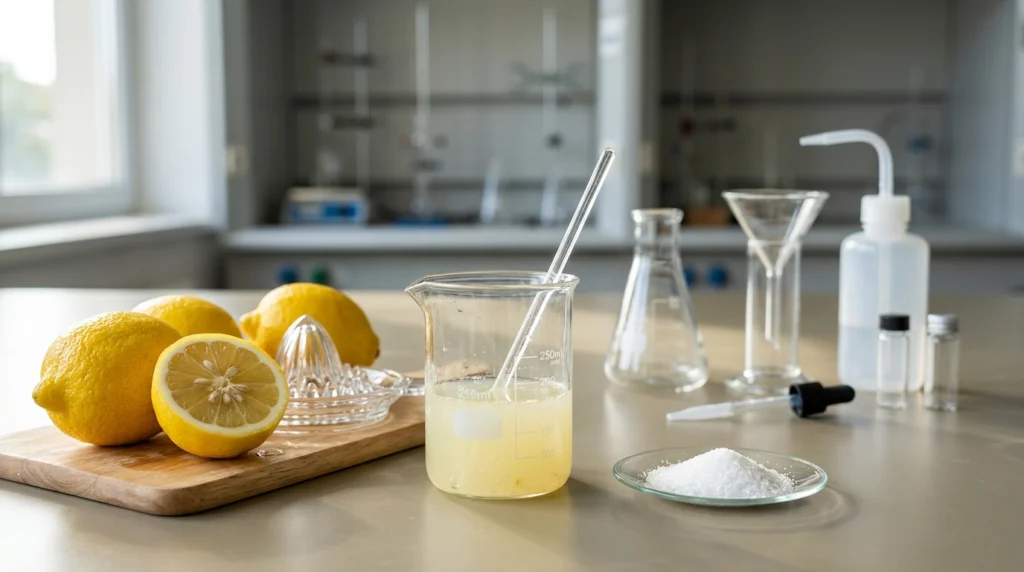
Pick ripe, heavy lemons because they hold more juice and more acid. Wash them in warm water, then roll each one on the counter before cutting it in half. Rolling breaks the inner membranes, so you get noticeably more juice from every lemon.
Step 2: Extract and strain the juice.
Squeeze the lemons into a bowl and pour the juice through a fine cloth or coffee filter to remove pulp and seeds. Pulp left in the juice clogs your filters later and traps impurities inside the crystals. Measure the final volume, because every chemical amount in the next steps is scaled from it.
Part B: Capture the Citrate
Step 3: Neutralize the juice with calcium hydroxide.
Heat the juice to about 80°C (176°F) without boiling it hard. Then add the lime slurry a little at a time while stirring, checking the pH as you go.
- Mix 30 g of calcium hydroxide into 100 ml of water.
- Add the slurry slowly. It will fizz and thicken as white calcium citrate forms.
- Check the pH after each addition and stop at pH 7-8.
Too little lime leaves citrate dissolved in the juice, and too much contaminates the final product. Hot water is key here because calcium citrate dissolves less in hot water than in cold, so more of it drops out as a solid.
Step 4: Filter and wash the calcium citrate.
Filter the hot mixture through cloth or coffee filters and collect the white solid. Wash it 3 times with hot distilled water, using about 200 ml each time. This removes sugars, pectin, and color, which would otherwise turn your final crystals brown and sticky.
Part C: Release the Acid
Step 5: Add sulfuric acid to release the citric acid.
Put the washed calcium citrate in a clean bowl with 300 ml of distilled water. Prepare the diluted acid separately, then combine the two while stirring.
- Add 20 ml of 98% sulfuric acid slowly to 100 ml of cold water.
- Pour the diluted acid into the calcium citrate while stirring.
- Stir for 30 minutes.
Two things happen in this step. Citric acid goes into solution, and white calcium sulfate (gypsum) forms as a solid. The reaction is 2 calcium citrate + 3 sulfuric acid giving citric acid + gypsum. Use only the amount needed, because leftover sulfuric acid will contaminate the crystals.
Step 6: Filter out the calcium sulfate (gypsum).
Filter the mixture through a coffee filter and keep the clear liquid, which is now your citric acid solution. Rinse the gypsum on the filter with 50-100 ml of distilled water and add that rinse to your solution. The rinse recovers acid that stuck to the gypsum, and a second filtering fixes any cloudiness.
Part D: Crystallize
Step 7: Concentrate the solution by gentle heating.
Pour the solution into a heat-safe bowl set over a pot of simmering water, and keep it at 70-80°C. Let it evaporate for 3-6 hours, until it is thick and syrupy and down to about one-fifth of the starting volume. Never heat it directly on the flame or let it boil hard, because high heat browns and degrades the acid.
Step 8: Crystallize the citric acid.
Let the syrup cool to room temperature, cover it loosely, and leave it somewhere cool and undisturbed for 1-3 days. Dropping in a tiny seed crystal of store-bought citric acid speeds this up. Crystals grow slowly, and stirring or moving the bowl only makes them smaller.
Step 9: Dry and store the crystals.
Pour off the leftover liquid and spread the crystals on a clean plate lined with filter paper. Dry them for 1-2 days at room temperature, or in an oven at 40-50°C. Store them in a labeled, airtight glass jar, because citric acid absorbs moisture and clumps. Mark the jar “not for eating.”
How to Make Citric Acid in a School Lab
The lab version uses 100 ml of juice, so every amount is 10 times smaller and easier to control. It follows the same chemistry as the home method, which makes it a good classroom demonstration. A teacher should handle the acid and heating steps.
Materials
| Material or Equipment | Quantity / Specification | Purpose |
| Filtered lemon juice | 100 ml | Natural source of citric acid. |
| Calcium hydroxide | 3 g | Converts citric acid into calcium citrate. |
| Sulfuric acid | Approximately 40 ml of 1 M solution, prepared by a teacher | Releases citric acid from calcium citrate. |
| Beakers | 250 ml | Holding and mixing solutions. |
| Glass rod | 1 | Stirring the mixture. |
| Funnel and filter paper | 1 set | Separating solid precipitates from liquid. |
| Hot plate or water bath | Temperature-controlled | Heating the solution. |
| Thermometer | Suitable laboratory range | Monitoring temperature. |
| pH paper | Range suitable for the experiment | Checking acidity and neutralisation. |
| Watch glass or evaporating dish | 1 | Evaporating the solution and allowing crystallisation. |
| Safety goggles, gloves and lab coat | 1 set per person | Protecting against chemical splashes. |
Procedure
- Heat the juice to 80°C in a beaker.
- Add 3 g of calcium hydroxide in small portions, stirring, until the pH is 7-8.
- Filter the white precipitate and wash it with 3 portions of hot distilled water.
- Move the solid to a clean beaker and slowly add 40 ml of 1 M sulfuric acid, stirring for 20 minutes.
- Filter off the gypsum and collect the clear filtrate.
- Evaporate the filtrate in a water bath to about 10 ml, then leave it on a watch glass to crystallize.
- Record the mass of the dried crystals and calculate percentage yield against about 5 g of acid in the juice.
Check your product. Dissolve a pinch in water and test the pH, which should be around 2-3. You can also mix a pinch with baking soda, which should fizz.
Lab safety and waste disposal
- Never pour acid or lime slurry into a sink without neutralizing it first.
- Neutralize leftover acid with baking soda or sodium carbonate until the pH is 6-8, then dilute and dispose as your lab instructs.
- Collect gypsum and filter papers in a labeled solid-waste container.
- Wash hands and wipe benches at the end, and keep food and drinks out of the lab.
How Citric Acid Is Made in a Factory
Raw Materials: Molasses, Sucrose, and Starch
Factories do not use lemons because they are too expensive and their acid content is too low. They feed sugar to a fungus instead, using cheap carbon sources such as beet or cane molasses, sucrose, or corn and tapioca starch. Molasses is the most common choice because it is cheap and holds 45-50% sugar. Starch must first be broken down into glucose with enzymes.
Aspergillus niger Fermentation Process
The fungus Aspergillus niger eats the sugar and releases citric acid as a by-product. The process runs in stainless steel tanks under tightly controlled conditions, and about 70-90% of the sugar is converted to acid. This submerged fermentation method produces most of the world’s supply. Inside the fungus, that citric acid is an overflow product of the citric acid cycle, the same metabolic loop that powers human cells.
- Vessel: Stainless steel tanks with a constant air supply.
- Temperature: 28–35°C.
- Duration: 5–10 days.
- pH: About 2.
- Minerals: Limited iron and manganese.
- Sugar level: High.
Recovery, Purification, and Drying
After fermentation, the fungus is filtered out and the same lime and sulfuric acid steps from the home method are used at scale. The liquid is then cleaned to remove color and unwanted ions. This long purification chain is what makes factory citric acid food-grade, at 99%+ purity.
- Filter out the fungus.
- Apply the lime and sulfuric acid steps at scale.
- Clean the liquid with activated carbon and ion-exchange resins.
- Concentrate on evaporators and crystallize.
- Centrifuge, dry, and sieve by grain size.
- Pack the finished product.
Cost, Yield, and Plant Requirements
Factory production gives far more output per unit of cost than any home method. Large plants make tens of thousands of tonnes a year, and global output is around 2 million tonnes. Running a plant takes serious infrastructure.
- Large fermenters.
- Sterile air systems.
- Heat and power supply.
- Wastewater systems for gypsum and spent biomass.
- Quality-control labs.
Home vs Lab vs Industrial Method
| Factor | Home | School Lab | Factory |
| Raw material | Lemons | Lemon juice | Molasses, sucrose, or starch |
| Batch size | 1 liter juice | 100 ml juice | Hundreds of thousands of liters |
| Method | Lime precipitation + sulfuric acid | Same, in small controlled steps | A. niger fermentation + recovery |
| Time | 3-5 days | 1-2 days | 5-10 days fermentation + processing |
| Yield | About 50-70% of acid in juice | About 50-70% | 70-90% of sugar converted |
| Purity | Low, not food-grade | Moderate, not food-grade | 99%+, food-grade |
| Cost per kg | Very high | Not practical | Very low |
| Main risk | Acid and lime burns | Same, lower with supervision | Controlled by plant systems |
Should You Make Citric Acid or Buy It?
Making citric acid at home requires time, specialised chemicals, and several processing steps, while the final product may not achieve commercial purity standards. Buying ready-made citric acid is a more convenient option for consistent quality and reliable results. ChemVexa helps you source citric acid for your chemical, laboratory, and industrial needs.
Contact ChemVexa today to enquire about availability, product specifications, and suitable quantities for your requirements.
FAQs
1. Can you make citric acid without lemons?
Yes, but the method depends on the available raw material. Commercial citric acid is commonly produced through microbial fermentation using sugars such as glucose or sucrose. Other citrus fruits also contain citric acid, although their concentrations vary.
2. Is homemade citric acid safe to use in food?
Homemade citric acid should not be used in food or drinks unless its purity and safety have been verified. Home extraction can leave impurities or chemical residues, so food-grade citric acid from a reliable supplier is the safer choice.
3. How can you tell if a substance is citric acid?
Citric acid can be identified through laboratory analysis, including methods such as chromatography and titration. Appearance and taste alone cannot confirm its identity or purity, especially when the substance has been extracted at home.
4. What is the difference between citric acid and lemon juice?
Lemon juice is a mixture containing water, citric acid, sugars, and other natural compounds. Citric acid is a specific chemical compound with the formula C₆H₈O₇, which can be separated and purified from a suitable source.