
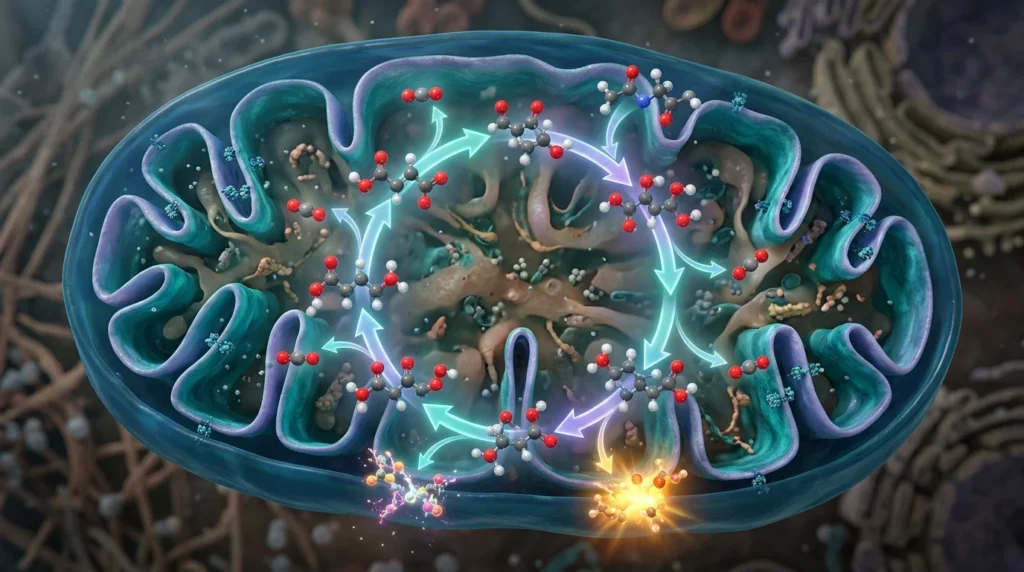
The human body is more or less a biochemical reactor. All of the breathing that you do, all of the muscle contractions, all of the neurological impulses, everything is powered by energy that begins at the cellular level. But what is the source of that energy? The solution is within your cells, there is a strictly regulated group of chemical reactions called the citric acid cycle or the Krebs cycle or the TCA cycle (tricarboxylic acid cycle).
To chemical engineers, biochemists, educators, and industrial professionals, the Krebs cycle is not a luxury; it is a fundamental tool in understanding biological systems operating on the molecular scale in terms of energy.
What Is the Citric Acid Cycle?
The citric acid cycle is a chain of eight chemical reactions involving enzymes found in living cells to obtain energy in acetyl-CoA, a two-carbon molecule obtained by carbohydrates, fats and proteins. The cycle successively deprives carbon based intermediates of their electrons and passes them on to the electron carriers, which in turn drive the electron transport chain to generate ATP, the universal currency of energy in life.
The Krebs cycle was originally proposed in a 1937 paper by British-German biochemist Sir Hans Krebs, after experiments with pigeon breast muscle tissue. It was an important discovery that earned him the Nobel Prize in Physiology or Medicine in 1953.
Process engineering perspective The citric acid cycle can be viewed as a continuous-flow reactor: raw material feeds into the system, stage reactions draw off useful energy, and the intermediate products are automatically regenerated so that the cycle is maintained continuously, a near-perfect example of a closed-loop industrial system.
Fact: It is named after citric acid, a six-carbon tricarboxylic acid, the first intermediate to be generated when acetyl-CoA enters the cycle. It is a commercial grade of citric acid, which is also a common food preservative and flavoring additive, industrially made by fermenting sugars by fungi.
Where Does the Citric Acid Cycle Occur?
A question that has been one of the most studied in biochemistry and cell biology is the following: where is the citric acid cycle?
In eukaryotic cells, which comprise all animal, plant and fungal cells the citric acid cycle occurs fully within the mitochondrial matrix, the innermost aqueous compartment of the mitochondria.
This place is specifically engineered in nature: the dual-membrane structure of the mitochondria forms the electrochemical gradient which is necessary in the production of the ATP, whereas the matrix supplies the concentration of enzyme and the material necessary to the efficient activity of the TCA cycle.
In prokaryotic cells (like bacteria) that do not have organelles enclosed in membranes, all reactions of the Krebs cycle take place in the cytoplasm.
Engineering-wise, the mitochondria functions as an autonomous chemical processing unit with the raw feedstock entering the system, energy is stored in staged reaction compartments, and metabolic waste products (CO 2 and water) are released into the environment in a safe manner.
Citric Acid Cycle Steps A Full Breakdown
The citric acid cycle is a series of steps that are enzyme guided. All the eight reactions are catalyzed by a specific enzyme and yield a certain number of intermediate compounds. It is very important that students, educators, and professionals in the field of metabolic engineering or bioprocess design are aware of each step.
| Step | Reaction | Enzyme | Key Output |
| 1 | Acetyl-CoA + Oxaloacetate → Citrate | Citrate synthase | Citrate (6C) |
| 2 | Citrate → Isocitrate | Aconitase | Isocitrate |
| 3 | Isocitrate → α-Ketoglutarate | Isocitrate dehydrogenase | CO₂, NADH |
| 4 | α-Ketoglutarate → Succinyl-CoA | α-Ketoglutarate dehydrogenase | CO₂, NADH |
| 5 | Succinyl-CoA → Succinate | Succinyl-CoA synthetase | GTP (or ATP) |
| 6 | Succinate → Fumarate | Succinate dehydrogenase | FADH₂ |
| 7 | Fumarate → Malate | Fumarase | Malate |
| 8 | Malate → Oxaloacetate | Malate dehydrogenase | NADH |
Each complete rotation of the Krebs cycle processes one acetyl-CoA molecule and yields:
- 3 NADH molecules
- 1 FADH₂ molecule
- 1 GTP (functionally equivalent to ATP)
- 2 CO₂ molecules (released as waste)
Since one glucose molecule generates two acetyl-CoA units through glycolysis, the citric acid cycle runs twice per glucose, effectively doubling all outputs listed above.
Fact: The citric acid cycle does not directly produce large amounts of ATP. Its primary output is electron carriers NADH and FADH₂. These molecules donate their electrons to the electron transport chain, which generates approximately 24 to 28 ATP molecules per glucose through oxidative phosphorylation. The Krebs cycle is, in essence, the preparation stage for the cell’s largest energy harvest.
Functions of the Citric Acid Cycle
The functions of the citric acid cycle extend well beyond simple energy production. It serves as the central metabolic hub of the cell, connecting energy metabolism with biosynthesis, macronutrient processing, and regulatory control.
1. Energy Extraction
The primary function of the Krebs cycle is to extract chemical energy from acetyl-CoA by generating NADH and FADH₂ high-energy electron carriers that feed into oxidative phosphorylation and drive the majority of cellular ATP production.
2. Biosynthetic Precursor Supply
Several citric acid cycle intermediates are directly channeled into the synthesis of essential biomolecules:
- α-Ketoglutarate precursor for glutamate and other amino acids
- Oxaloacetate feeds gluconeogenesis (glucose synthesis from non-carbohydrate sources)
- Succinyl-CoA essential for heme synthesis, a component of hemoglobin
- Citrate exported to the cytoplasm for fatty acid and cholesterol synthesis
This makes the Krebs cycle a dual-function pathway: it extracts energy while simultaneously supplying the raw materials cells need to grow and repair. Citrate exported for fat synthesis is also the step targeted by hydroxycitric acid, the Garcinia compound sold for weight management.
3. Integration of All Three Macronutrients
The most industrially important aspect of the citric acid cycle is that it is the general meeting place of carbohydrates, fats, and proteins. The three macronutrients are first broken down to acetyl-CoA or directly to TCA cycle intermediates and then acted upon. This is the reason why the citric acid cycle plays a major role in the study of clinical nutrition and industrial fermentation biochemistry.
4. Metabolic Rate Regulation
Cellular energy status tightly controls the Krebs cycle. The enzymes especially the isocitrate dehydrogenase and alpha-ketoglutarate dehydrogenase are checkpoints that limit the rate. These enzymes are inhibited and the cycle is slowed down when there is an excess of ATP. Increase in energy demand leads to release of inhibition and the cycle speeds up. This feedback action corresponds to the proportional control principle applied to the automation of industrial processes.
Industrial Applications of the Krebs Cycle
For professionals in the chemical, pharmaceutical, and bioprocess industries, the citric acid cycle is not merely academic; it has direct commercial relevance.
| Industrial Application | Connection to the Krebs Cycle |
| Citric acid manufacturing | Aspergillus niger fermentation exploits TCA flux to accumulate citrate at industrial scale |
| Amino acid production | Glutamate and lysine biosynthesis is engineered by redirecting Krebs cycle carbon flow |
| Pharmaceutical R&D | TCA enzyme inhibitors are investigated as anti-cancer and anti-infective drug targets |
| Bioreactor optimization | TCA cycle kinetics directly inform oxygen demand, heat generation, and yield modeling |
| Metabolic engineering | Synthetic biology modifies TCA flux to produce bio-based chemicals and biofuels |
The global citric acid market worth over $3.5 billion annually is almost entirely produced through fermentation processes that directly manipulate the Krebs cycle flux in fungal and bacterial systems.
Conclusion
Citric acid cycle, also known as Krebs cycle, tricarboxylic acid cycle, or TCA cycle, is one of the most impactful biochemical pathways that have ever been discovered. Its eight strictly sequenced steps tap energy in all types of nutrient, provide precursors to the biosynthesis of life essential molecules, and control themselves with a level of feedback complexity that continues to be examined by chemical engineers as an example of process control.
In the case of students, the metabolic basis that links glycolysis to oxidative phosphorylation is the one connecting the two. To teachers, it is the perfect pedagogical model of enzyme kinetics, stoichiometry of reactions, and systems thinking. To the industry professionals, it is a living bioprocess that is making billions of dollars in commercial production annually.
It is insight into the engine of life itself to learn what the citric acid cycle is and what it does.
FAQs
1. How is the citric acid cycle regulated inside the cell?
The citric acid cycle is regulated mainly by feedback mechanisms involving ATP, NADH, and key enzymes like isocitrate dehydrogenase. When energy levels are high, these molecules inhibit the cycle to prevent excess ATP production. Conversely, low energy levels activate the cycle, ensuring the cell produces sufficient energy to meet its needs.
2. Why is oxygen indirectly essential for the citric acid cycle?
Oxygen is not directly used in the citric acid cycle, but it is crucial for the electron transport chain to function properly. Without oxygen, NADH and FADH₂ cannot be oxidized back to NAD⁺ and FAD, which are required for the cycle to continue. As a result, the entire process slows down or stops in anaerobic conditions.
3. What happens to the citric acid cycle during starvation or fasting?
During starvation, the body shifts to using fats and proteins as primary energy sources, which still feed into the cycle as acetyl-CoA or intermediates. However, oxaloacetate may be diverted for glucose production, which can slow down the cycle. This metabolic adjustment ensures vital organs like the brain continue receiving energy.
4. How do genetic mutations affect the citric acid cycle?
Mutations in genes encoding citric acid cycle enzymes can disrupt normal metabolic function and lead to serious diseases. These defects may reduce energy production or cause harmful accumulation of intermediates. In some cases, such mutations are linked to metabolic disorders and certain types of cancer.
5. How is the citric acid cycle studied in modern biotechnology?
Scientists study the citric acid cycle using advanced tools like metabolic flux analysis and isotope labeling techniques. These methods help track how carbon flows through the cycle under different conditions. This research is essential for improving industrial fermentation, drug development, and metabolic engineering applications.