

Citric acid monohydrate is the crystalline form of citric acid that carries one water molecule per molecule of acid. It crystallizes from water below about 36.6 °C, and it is the most widely used acidulant in food and beverage manufacturing, canning, cleaning and pharmaceutical processing. It helps to know how citric acid works before separating its two crystal forms.
Quick Answer: Key Specs at a Glance
| Property | Citric Acid Monohydrate |
|---|---|
| Chemical name | 2-Hydroxypropane-1,2,3-tricarboxylic acid monohydrate |
| Formula | C₆H₈O₇·H₂O |
| CAS number | 5949-29-1 |
| EC number | 200-662-2 |
| Molar mass | 210.14 g/mol |
| Water of crystallization | About 8.6% |
| Active citric acid | About 91.4% |
| Appearance | White crystals, granules or powder |
| Food additive code | E330 |
| Crystallizes below | About 36.6 °C |
| pKa values (25 °C) | 3.13, 4.76, 6.40 |
| pH of 1% solution | About 2.2 |
| Dehydration | Softens around 75 °C; melts around 100 °C as it loses its crystal water |
Citric Acid Monohydrate Formula and Structure

The citric acid monohydrate formula is C₆H₈O₇·H₂O. The dot means the water molecule sits inside the crystal lattice as water of crystallization, held by hydrogen bonds to the carboxyl and hydroxyl groups of the acid. It is not surface moisture.
Citric acid is a tricarboxylic acid with one hydroxyl group on the central carbon. That gives it three dissociation steps (pKa 3.13, 4.76 and 6.40), which is why it works so well as a buffer between roughly pH 3 and 6.2. It also chelates calcium, magnesium and iron, which drives its use in descaling and water treatment.
The anhydrous form has the formula C₆H₈O₇ (CAS 77-92-9, 192.12 g/mol). The difference of 18.02 g/mol is exactly one water molecule, and almost everything about citric acid anhydrous, from its moisture sensitivity to its storage caking, follows from that missing water.
Monohydrate vs Anhydrous: Two Crystal Forms of the Same Acid

Both forms are the same molecule, the same E330 additive and the same acid once dissolved. The difference is the crystal. Below the transition temperature of about 36.6 °C, citric acid crystallizes from water as the monohydrate. Above it, it crystallizes as the anhydrous form.
That single temperature decides which product a plant makes. Everything else in the table below follows from the water in the lattice.
| Parameter | Citric Acid Monohydrate | Citric Acid Anhydrous |
|---|---|---|
| Formula | C₆H₈O₇·H₂O | C₆H₈O₇ |
| CAS number | 5949-29-1 | 77-92-9 |
| Molar mass | 210.14 g/mol | 192.12 g/mol |
| Water content | About 8.6% (crystal water) | Below 0.5% free moisture |
| Crystallizes | Below about 36.6 °C | Above about 36.6 °C |
| Stability in normal storage | Stable form at room conditions | Absorbs moisture, may cake, can revert to monohydrate |
| Behavior in very dry air | Can effloresce (lose crystal water) | Stable |
| Active acid per kg | About 0.914 kg | 1.000 kg |
| Typical best uses | Food, beverages, canning, cleaning, general pharma | Moisture-sensitive dry blends, effervescents, tablets |
What the Active Acid Difference Means for Cost
Monohydrate is cheaper per kilogram in most markets, but it carries less acid. 100 kg of monohydrate delivers the same acid as about 91.4 kg of anhydrous. To replace 100 kg of anhydrous you need about 109.4 kg of monohydrate.
Compare suppliers on price per kilogram of active acid, not price per bag:
- Effective price per kg of active acid = quoted price ÷ 0.914 (monohydrate)
- Effective price per kg of active acid = quoted price ÷ 1.000 (anhydrous)
If anhydrous costs less than about 9.4% more than monohydrate, it is the cheaper source of acid. Freight also matters, because you ship 8.6% water in every monohydrate pallet.
When to Choose Each Form
Pick monohydrate when the product is stable in normal humidity and the water is harmless. Pick anhydrous when any free moisture would trigger a reaction or clump a blend. Many food and beverage plants run on monohydrate because it flows well and handles cleanly in ordinary warehouses.
How Citric Acid Monohydrate Is Made
Commercial citric acid is made by fermentation. The crystal form is chosen at the very last step.
- Fermentation: Aspergillus niger converts sugar (molasses, glucose syrup from corn or cassava) into citric acid in aerated tanks.
- Separation: The broth is filtered to remove biomass. Citric acid is precipitated as calcium citrate with lime.
- Acidulation: Sulfuric acid frees citric acid from the calcium salt, leaving gypsum as a by-product.
- Purification: Activated carbon and ion exchange remove color, sugars and metal ions.
- Concentration: The purified liquor is evaporated to a supersaturated syrup.
- Crystallization: The syrup is cooled to below 36.6 °C, and monohydrate crystals form. Above that temperature, anhydrous crystals form instead.
- Centrifuging, drying and sieving: Crystals are spun dry, gently dried at low temperature to avoid driving off crystal water, then screened to mesh grades.
Some producers also run solvent extraction or membrane steps. The principle stays the same: temperature during crystallization sets the form.
Properties of Citric Acid Monohydrate
Physical Properties
- Appearance: Colorless to white crystals, granules or powder, odorless
- Density: About 1.54 g/cm³
- Bulk density: About 0.8 to 0.9 g/cm³ depending on mesh
- Taste: Strongly sour, clean, without bitterness
Solubility
Citric acid monohydrate is very soluble in water, at about 59 g per 100 mL at 20 °C. Solubility rises sharply with temperature. It is also soluble in ethanol and only sparingly soluble in diethyl ether.
Finer mesh dissolves faster. For quick dissolution in cold water, choose a fine grade, and stir as you add it.
Acidity and pH
A 1% solution has a pH of about 2.2. Because citric acid is a weak, polyprotic acid, it buffers well rather than swinging pH sharply. That is why it is the standard choice for adjusting pH in beverages, jams and cosmetic formulations.
Thermal Behavior: Melting and Decomposition
Monohydrate does not have a clean melting point like a simple salt. When heated, it begins to lose its water of crystallization, softens at about 75 °C and melts at about 100 °C in its own crystal water. The resulting anhydrous acid melts at about 153 °C, and decomposition begins above roughly 175 °C.
For processing, this means drying or hot-blending monohydrate can change its water content. Keep heated steps below the dehydration range if you need it to stay a monohydrate.
Citric Acid Monohydrate Uses by Sector

The citric acid monohydrate uses below reflect why it is the dominant commercial form.
Food and Beverage
This is the largest market. Monohydrate citric acid works as an acidulant, flavor enhancer, preservative aid and antioxidant synergist.
- Soft drinks, juices and powdered drink mixes
- Jams, jellies, confectionery and sour sanding
- Dairy, processed cheese (as an emulsifying salt precursor) and sauces
- Fats and oils, where it chelates trace metals that drive rancidity
In the United States it is affirmed as GRAS under 21 CFR 184.1033. Always confirm the grade carries food-grade certification.
Canning and Preserving
Citric acid lowers pH to keep low-acid foods such as tomatoes in a safe range for water-bath canning. Follow tested recipes exactly, such as USDA or NCHFP guidance, and do not substitute lemon juice, vinegar or a different acid by feel. The 9.4% weight difference between monohydrate and anhydrous is small, but tested recipes are written for a specific acid level, so stay on the published amount.
Effervescent Products
Citric acid reacts with sodium bicarbonate to release CO₂, which powers effervescent tablets, bath bombs and instant drink powders. Monohydrate is common in bath bombs and less sensitive blends. For tightly moisture-controlled effervescent tablets, formulators usually prefer anhydrous, because free water starts the reaction early.
Cleaning and Descaling
Citric acid dissolves limescale (calcium and magnesium carbonate) and chelates metal ions in detergents and rinse aids. A typical descaling solution is 5 to 10% w/v in warm water. Do not use it on marble, limestone or natural stone, and check compatibility with aluminum and soft metals before use.
Pharmaceuticals and Personal Care
Pharmaceutical use includes pH adjustment, buffering, anticoagulant citrate solutions, and as an excipient in syrups, lozenges and effervescent granules. Personal care formulators use it to adjust pH and chelate metals in creams, shampoos and exfoliating products. Pharma-grade material must meet USP or BP/EP monograph limits.
Laboratory and Buffer Preparation
Citrate buffers cover pH 3.0 to 6.2. Use the correct molar mass: 210.14 g/mol for monohydrate. A 0.1 M stock needs 21.01 g/L. Using the anhydrous value (192.12 g/mol) by mistake gives a stock that is about 9% too weak.
Mesh Sizes and Grade Selection
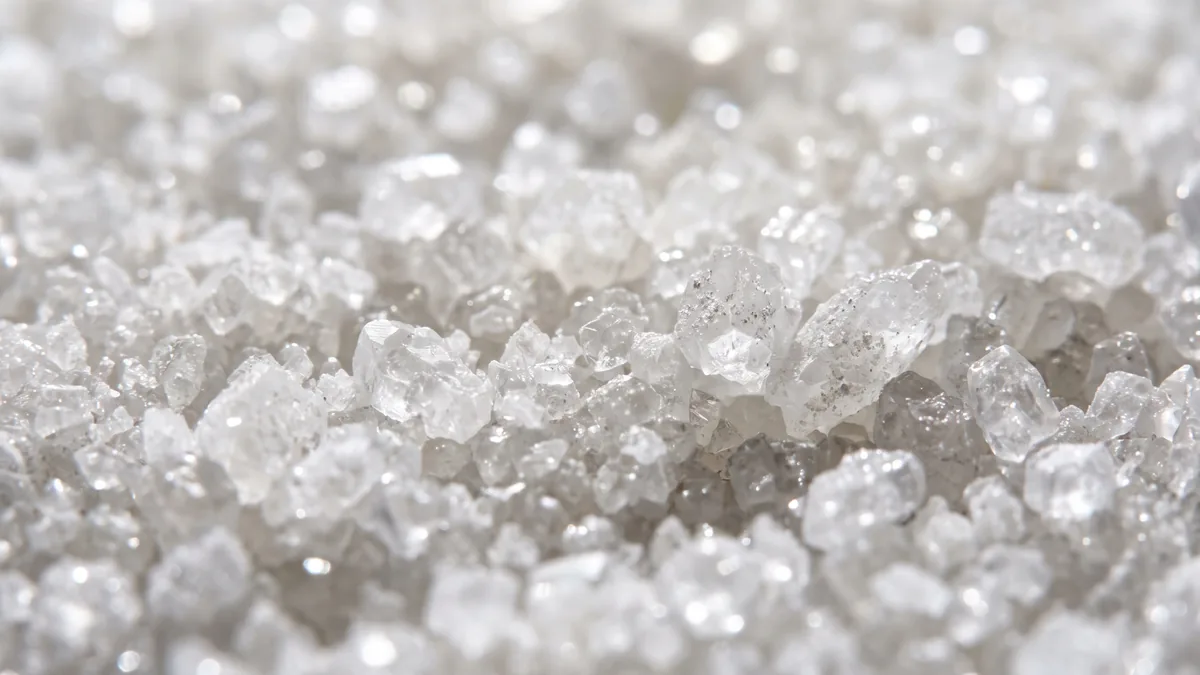
Mesh Sizes
Monohydrate is sold in a range of particle sizes. Typical commercial grades include:
| Mesh range | Description | Typical use |
|---|---|---|
| 8-40 | Coarse granular | Dry blends needing slow dissolution, sour coatings |
| 12-40 | Medium granular | General food use, free-flowing blends |
| 30-100 | Fine crystals | Beverage powders, fast dissolving |
| Fine powder (100 mesh and finer) | Powder | Tablets, cosmetics, rapid dissolution |
Coarse grades flow well and resist caking. Fine grades dissolve faster but pack tighter and can dust. Confirm the exact range against the supplier’s spec sheet.
Grades
- Food grade (FCC): Meets Food Chemicals Codex purity for human consumption
- BP / EP: British or European Pharmacopoeia monograph grade
- USP: United States Pharmacopeia grade for pharmaceutical manufacture
- Technical / industrial: Used in cleaning, water treatment and construction chemistry
Buy the grade the end use requires. A technical grade can be fine for descaling, but it must never go into food or drugs.
COA and SDS Checks Before You Buy
Every shipment should come with a Certificate of Analysis (COA) and a current Safety Data Sheet (SDS). Check these points:
- Assay: Typically 99.5% to 100.5% on the anhydrous basis
- Water content: For monohydrate, roughly 7.5% to 9.0%
- Heavy metals, lead and arsenic limits for your grade
- Sulfate, oxalate and readily carbonizable substances
- Particle size distribution that matches your mesh requirement
- Lot number and manufacture or retest date
You can see our full specification and sourcing notes on the citric acid profile.
Safety, Handling and Storage
Hazards
Citric acid is low in toxicity, but it is not harmless. The main hazards are serious eye irritation (GHS category 2A) and mild skin and respiratory irritation from dust. Fine powder can form combustible dust clouds, so control dust in bulk handling.
PPE
- Safety glasses or goggles
- Nitrile gloves
- Dust mask or respirator when handling fine powder in volume
- Good ventilation or local exhaust at transfer points
First Response
- Eyes: Rinse with water for at least 15 minutes, remove contact lenses, seek medical attention if irritation persists.
- Skin: Wash with soap and water.
- Inhalation: Move to fresh air.
- Ingestion: Rinse the mouth and drink water. Do not induce vomiting. Call poison control or a physician if a large amount was swallowed.
Incompatibilities
Keep citric acid away from strong oxidizers, strong bases, nitrates, reducing agents and some metals. Concentrated solutions can corrode aluminum, zinc and carbon steel over time.
Storage
Monohydrate is the stable form at normal room temperature and humidity. Store it in sealed, original packaging in a cool, dry place away from heat sources.
Two edge cases matter:
- Very dry air or heated storage can make monohydrate effloresce, losing crystal water and shifting its assay.
- Very high humidity can still cause clumping, even though monohydrate is more forgiving than anhydrous.
Reseal partly used bags and rotate stock first in, first out. Typical shelf life is 2 to 3 years when stored properly; confirm the exact period against the supplier retest date.
Disposal
Small amounts of dilute citric acid can usually go to drain with plenty of water where local regulations allow. Bulk quantities should be handled per local environmental rules and your SDS Section 13.
The monohydrate-versus-anhydrous choice looks small on a spec sheet and large in a warehouse, where one humid season can undo a careless pick. Decide on storage reality first, and the cheaper kilogram usually prices itself. Both forms sit side by side on Chemvexa for exactly that decision: a chemical platform where each product’s specifications, grades and safety details live in one catalog, with guides that explain what the numbers mean in the warehouse and not just on paper.
FAQs
1. Is citric acid monohydrate the same as citric acid?
Citric acid is the molecule, and monohydrate is one of its two commercial crystal forms. If a recipe or spec just says “citric acid,” check whether it means anhydrous or monohydrate, because the acid content differs by about 9%.
2. Can I substitute citric acid monohydrate for anhydrous?
Yes, with a weight correction. Multiply the anhydrous amount by 1.094 to get the monohydrate amount. For canning or any tested recipe, stay with the form the recipe specifies.
3. Is citric acid monohydrate safe to eat?
Food-grade citric acid monohydrate is safe at normal use levels and is GRAS in the United States and approved as E330 in the EU. Industrial or technical grades are not intended for food. Handle the dry powder with eye protection.
4. Which dissolves faster, monohydrate or anhydrous?
Both dissolve quickly, and particle size usually matters more than form. A fine mesh monohydrate will dissolve faster than a coarse anhydrous grade. Sources vary on small differences between forms, so test with your own mesh and temperature.
5. Is citric acid the same as vitamin C?
No. Citric acid (C₆H₈O₇) is an organic acid, while vitamin C is ascorbic acid (C₆H₈O₆). They are different compounds with different functions, even though both appear in citrus fruit.