

Citric acid anhydrous is the water-free solid form of citric acid. It is one of two solid forms of the same molecule, the other being citric acid monohydrate. Many buyers choose it because it delivers more acid per kilogram and stays dry in blends.
This post covers where the anhydrous form fits inside the citric acid family, how it compares to the monohydrate, and how to buy the right grade. If the parent compound itself is new to you, begin with citric acid first.
Citric Acid Anhydrous at a Glance: Quick Answer and Key Specs
Citric acid anhydrous (C₆H₈O₇, CAS 77-92-9) is citric acid with no water of crystallization. It is about 100% active acid, versus about 91.4% for the monohydrate (C₆H₈O₇·H₂O). Use it in dry mixes, effervescent products and precise formulas. Weigh 100 kg anhydrous = 109.4 kg monohydrate when switching forms.
| Property | Citric acid anhydrous |
|---|---|
| Chemical name | 2-hydroxypropane-1,2,3-tricarboxylic acid |
| Formula | C₆H₈O₇ |
| Molecular weight | 192.12 g/mol |
| CAS number | 77-92-9 |
| Food additive code | E330 |
| Appearance | White, odorless crystals or granules, sharply sour |
| Melting point | About 153 °C (307 °F) |
| Water solubility | About 590 g/L at 20 °C |
| pKa values (25 °C) | 3.13, 4.76, 6.40 |
| pH of a 1% solution | About 2.2 to 2.4 |
| US food status | GRAS, 21 CFR 184.1033 |
These are standard reference values. Always confirm them against the spec sheet and SDS for your lot.
Citric Acid Anhydrous Chemistry: Formula, Structure and Properties
Formula and CAS Numbers: 77-92-9 vs 5949-29-1
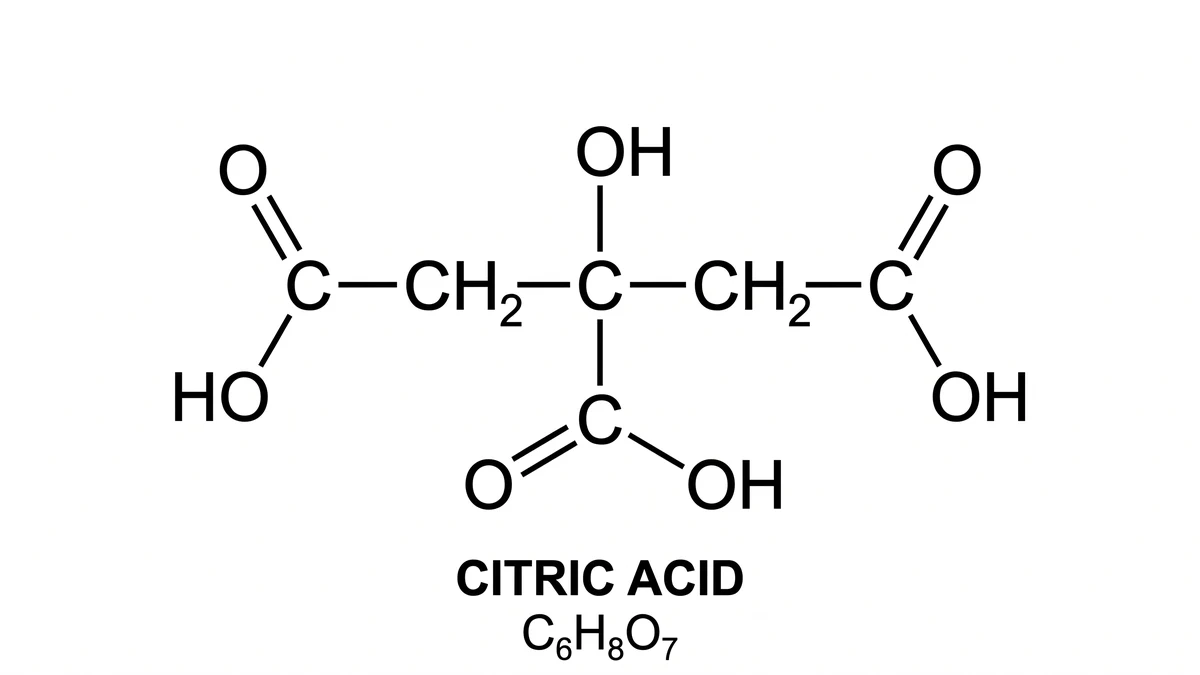
Citric acid is a tricarboxylic acid. Its three-carbon backbone carries three carboxyl groups (-COOH) and one hydroxyl group (-OH). Because each carboxyl group can release one proton, it is also a triprotic acid.
The anhydrous form has no water of crystallization, so its formula is plain C₆H₈O₇. The monohydrate keeps one water molecule per acid molecule in the crystal lattice, written C₆H₈O₇·H₂O.
Citric acid is also the parent of the citrate family, including sodium citrate (E331), potassium citrate and calcium citrate. Neutralize the acid with sodium hydroxide or sodium carbonate and you get sodium citrate.
Read the paperwork before you buy. CAS 77-92-9 is the registry number for the acid, and many suppliers list both solid forms under it. The monohydrate also has its own number, CAS 5949-29-1, so check the product name and SDS, not just the CAS.
Key Properties: pKa, Buffering and Chelation
These are the properties that drive most industrial uses:
- Three-step acidity: Three carboxyl groups give three pKa values (3.13, 4.76, 6.40), so the acid works across roughly pH 2 to 7.
- Buffering: Overlapping pKa values make citric acid and its citrate salts effective buffers, which is why sodium citrate is paired with the acid in buffer solutions.
- Chelation: The citrate ion binds Ca²⁺, Mg²⁺, Fe³⁺ and Cu²⁺ into soluble complexes. This powers descaling, water softening and browning control.
- High solubility: It dissolves quickly in water and is also soluble in ethanol.
- Low toxicity: It occurs naturally in citrus fruit and in human metabolism, which is why regulators allow it in food as E330.
How Citric Acid Anhydrous Is Made: Fermentation and Crystallization
Commercial citric acid comes from fermentation. The mold Aspergillus niger converts sugar feedstocks such as molasses or dextrose into the acid. Producers precipitate it as calcium citrate, release the free acid with sulfuric acid, purify it and crystallize it.
Crystallization temperature decides the form. The transition temperature sits at about 36 to 37 °C:
- Above the transition temperature: Crystals form without water, giving the anhydrous form.
- Below it: Each acid molecule traps one water molecule, giving the monohydrate.
So anhydrous is not a different chemical. It is the same acid, crystallized hot and dried.
Citric Acid Anhydrous vs Monohydrate: Key Differences
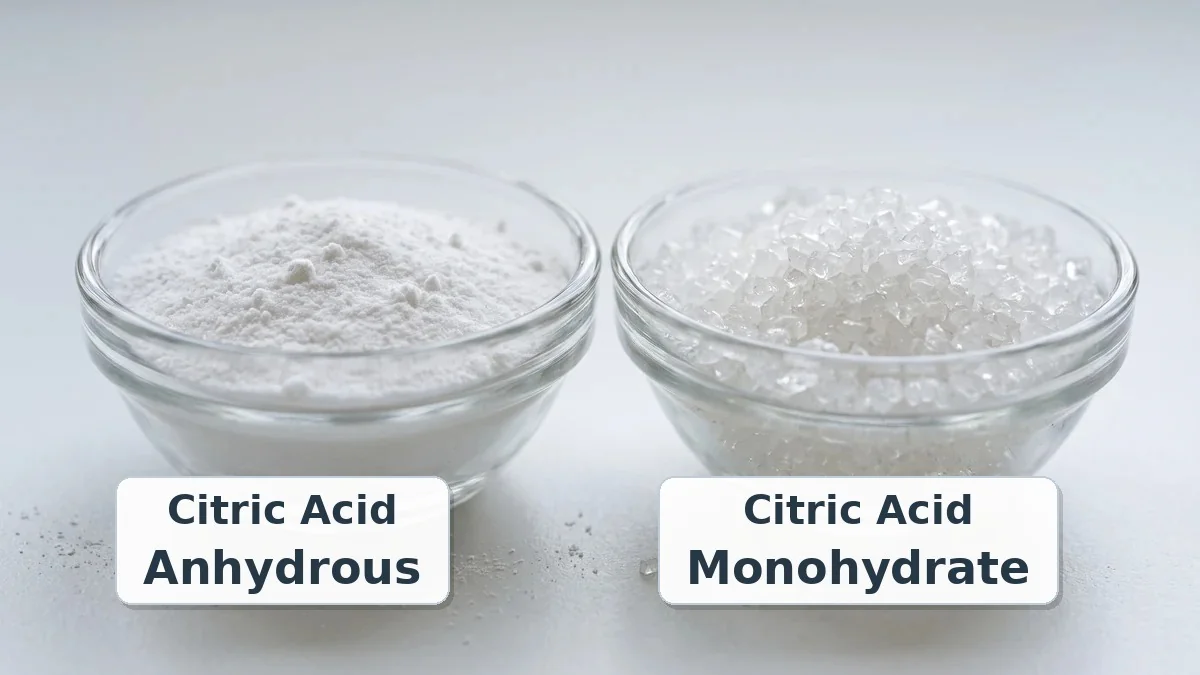
Both forms give the same acid in solution, with the same pKa values and the same taste. The differences are water content, handling and price per unit of acid.
| Feature | Anhydrous | Monohydrate |
|---|---|---|
| Formula | C₆H₈O₇ | C₆H₈O₇·H₂O |
| Molecular weight | 192.12 g/mol | 210.14 g/mol |
| Active acid content | About 100% | About 91.4% (about 8.6% water of crystallization) |
| CAS number | 77-92-9 | 5949-29-1 |
| Appearance | Colorless to white crystals or granules | Colorless to white crystals or granules |
| Heat behavior | Melts at about 153 °C | Loses its water from about 70 to 75 °C, melts near 100 °C |
| Hygroscopicity | Hygroscopic above roughly 65% relative humidity, can cake | Already hydrated, usually steadier at normal humidity |
| Best fit | Dry mixes, effervescents, bath bombs, tablets | General food, cleaning, home and bulk use |
| Price logic | Higher price per kg, no water paid for | Lower price per kg, about 9% water by weight |
| Grades available | USP, FCC, BP/EP, technical | USP, FCC, BP/EP, technical |
Conversion Formula: 100 kg Anhydrous = 109.4 kg Monohydrate
Divide 210.14 by 192.12 and you get 1.094. So 100 kg of anhydrous delivers the same acid as 109.4 kg of monohydrate. In the other direction, 100 kg of monohydrate equals about 91.4 kg of anhydrous.
A worked example: a formula calls for 25 kg of anhydrous. Use 27.35 kg of monohydrate to match it. A 1:1 swap leaves you about 9% short on acid. If your formula runs on the hydrated form instead, the full breakdown of citric acid monohydrate covers its formula, properties and uses in the same depth.
Can You Substitute Anhydrous for Monohydrate?
Yes, but weigh by acid content, never by habit. For lab work, think in moles. A 0.1 M stock needs 19.21 g/L of anhydrous or 21.01 g/L of monohydrate. That weighing is exactly what making a citric acid buffer comes down to: miss the moles and you miss the pH target.
Volume measures add a second trap. A scoop of fine powder, coarse granules and hydrated crystals each weighs a different amount. Weigh on a scale whenever precision matters.
Anhydrous Citric Acid Uses by Industry
The acid does far more than this one form can show. Its full range of citric acid powder uses covers food, pharma, cleaning and industry in depth. The table below shows where the anhydrous form specifically earns its place.

| Industry | Main role | Why anhydrous fits |
|---|---|---|
| Food and beverage | Acidulant, flavor, pH control | Free-flowing in dry mixes, no added water |
| Pharmaceuticals | Effervescent base, pH adjuster | Stays inert next to bicarbonate until wetted |
| Cosmetics and bath products | pH adjuster, fizzing agent | Dry, so products don’t fizz early |
| Cleaning and descaling | Scale remover, chelant | Highest acid per kg |
| Water and metal treatment | Chelation, passivation | Predictable dose |
| Home preserving | Acidity control | Consistent acid content |
1. Food and Beverage: Acidulant and pH Control
As E330, it sharpens flavor in drinks, candies, gummies and sour sanding sugars. It also chelates trace metals that speed up browning and rancidity, and it lowers pH so preservatives work better.
Sourness is usually specified as titratable acidity, reported as percent citric acid after titration with sodium hydroxide. Because anhydrous is about 100% acid, it hits a titratable acidity target with less mass than the monohydrate.
Dry beverage powders favor the anhydrous form. Even small moisture uptake ruins powder flow.
2. Pharmaceuticals and Effervescent Tablets
Effervescence comes from pairing citric acid with sodium bicarbonate. Free water starts the reaction inside the container, so manufacturers avoid hydrate water where they can.
Citrate also appears in oral solutions and anticoagulant solutions, where pharmacopeia grades (USP, BP/EP) are required.
3. Cosmetics, Personal Care and Bath Bombs
Formulators use the acid to bring toners, shampoos and creams to a skin-friendly pH, often around 4 to 5.5. In bath bombs, the full effervescence reaction is:
C₆H₈O₇ + 3 NaHCO₃ → Na₃C₆H₅O₇ + 3 H₂O + 3 CO₂
That works out to about 1.31 g of bicarbonate per 1 g of acid. The product is sodium citrate, a member of the citrate family. Many recipes run closer to 2:1 by weight and keep the mix completely dry.
4. Cleaning and Descaling
Limescale is mostly calcium carbonate, and descaling with citric acid dissolves it:
2 C₆H₈O₇ + 3 CaCO₃ → Ca₃(C₆H₅O₇)₂ + 3 H₂O + 3 CO₂
Calcium citrate is only slightly soluble, and less so when hot, so rinse well. When you are mixing the citric acid for descaling, the concentration decides how much scale actually dissolves.
Keep these cautions in mind:
- Bleach: Never mix it with citric acid, because chlorine gas can form.
- Natural stone: Keep it off marble and limestone.
- Aluminum: Limit contact time.
5. Water Treatment and Metal Passivation
In boilers, cooling loops and membranes, the acid dissolves scale and holds iron and copper in solution through chelation. In metal finishing, citric acid baths passivate stainless steel by removing free iron from the surface, a method covered by standards such as ASTM A967.
Detergent makers also use it as a builder to soften water.
6. Canning and Home Preserving
Tested recipes add citric acid to tomatoes and some fruits to keep pH in the safe range for boiling water canning. Use the exact amount the tested recipe gives. Never replace it with vinegar or another acid unless the recipe says so.
Form matters here:
- Anhydrous in place of monohydrate (same weight): About 9% more acid, which is the safe direction.
- Monohydrate in place of anhydrous (same weight): About 9% less acid, which is not safe.
When in doubt, use the form the recipe names.
Citric Acid Anhydrous Food Grade: USP, FCC, BP/EP and Technical Grades
Food grade is a quality standard, not a different form. Both anhydrous and monohydrate are sold in food grade. The grade tells you how pure the lot is and what testing stands behind it.
| Grade | Standard | Typical use | Key point |
|---|---|---|---|
| Food grade | FCC (Food Chemicals Codex) | Foods, beverages, supplements | Meets food additive purity limits |
| USP | United States Pharmacopeia | Drugs, medical solutions | Tighter limits plus full documentation |
| BP/EP | British and European Pharmacopoeia | Export pharma | Needed for UK and EU markets |
| Technical | Supplier spec | Cleaning, water and metal treatment | Not for consumption |
How to Read a COA and SDS Before Buying
A certificate of analysis (COA) shows what is really in the bag. Pair it with the SDS for handling data. Check these lines:
- Assay: Commonly 99.5% to 100.5% on the anhydrous basis for FCC and USP. This is measured by titration with sodium hydroxide, the same method behind titratable acidity.
- Water content: Anhydrous is typically capped near 0.5%. A much higher figure means hydrate has formed.
- Heavy metals and lead: Must meet the limits of the grade you ordered.
- Sulfated ash and oxalate: Small impurity limits that matter most in pharma.
- Particle size: The mesh range, so the lot matches your equipment.
- Lot number and date: Needed for traceability.
Citric Acid Mesh Size: Choosing the Right Particle Size
Particle size changes dissolving speed, blending and caking. Fine grades dissolve fast but pack tight and absorb moisture quickly. Coarse grades flow well and resist caking but dissolve more slowly.
| Granulation | Typical mesh range | Best for | Behavior |
|---|---|---|---|
| Coarse granular | About 8 to 20 mesh | Sanding, slow-dissolve cleaning products | Flows well, lowest caking risk |
| Medium granular | About 16 to 40 mesh | General food and cleaning use | Balanced dissolving and flow |
| Fine granular | About 30 to 100 mesh | Dry drink mixes, tablets, bath bombs | Fast dissolving, blends evenly |
| Powder | Finer than about 100 mesh | Direct compression, fine cosmetics | Fastest dissolving, highest caking risk |

Match the mesh to your blend. If your other powders are fine, a coarse acid will separate in transit. If you simply dissolve it in water, medium granular is usually enough.
Which Citric Acid to Buy: Buyer’s Decision Guide
Best Citric Acid Form, Grade and Mesh by Use Case
| Use case | Form | Grade | Mesh |
|---|---|---|---|
| Dry beverage mix, sour candy | Anhydrous | FCC | Fine granular |
| Effervescent tablets and powders | Anhydrous | USP or FCC | Fine granular to powder |
| Bath bombs and bath salts | Anhydrous | Food or cosmetic grade | Fine granular |
| Household and light industrial descaling | Either, usually monohydrate for cost | Technical or food grade | Medium granular |
| Home canning | The form your tested recipe names | Food grade | Any |
| Lab buffers and standards | Either, weighed by moles | USP or ACS | Fine granular |
| Boiler, membrane and metal treatment | Either, whichever costs less per kg of acid | Technical | Medium granular |
What to Ask Your Supplier Before Ordering
Before you order, ask for the current COA, SDS and spec sheet for the exact grade and mesh. Then confirm these points in writing:
- Form: Anhydrous or monohydrate, with the CAS number on the paperwork.
- Pack size: Bag or drum net weight and liner type.
- Traceability: Lot numbers for regulated products.
How to Store Citric Acid Anhydrous and Prevent Caking
Why Anhydrous Citric Acid Cakes: Hygroscopicity
Anhydrous citric acid shows strong hygroscopicity. In humid air, crystal surfaces pick up water and partly convert to the monohydrate. When the damp surface dries, tiny crystal bridges form and the powder hardens into lumps. Stacking pressure and temperature swings make caking worse.
Storage Conditions, Shelf Life and Container Choice
- Location: A cool, dry place, away from heat sources and off bare floors and outer walls.
- Container: Sealed, lined bags or drums.
- Humidity: Below about 60% relative humidity.
- Shelf life: Commonly 24 to 36 months in intact packaging. Follow the date on your COA.
How to Fix and Prevent Clumped Citric Acid
Light lumps can be broken up and sieved. Heavily caked product has gained water, so its real acid content has dropped. Run a quick sodium hydroxide titration to confirm the assay before using it in a precise formula.
To prevent repeat problems:
- Reseal after every use: Squeeze out the air and tie the liner.
- Rotate stock: Use the oldest lots first.
- Control humidity: Add a dehumidifier or desiccant packs in damp rooms.
- Pick the right mesh: Coarser grades cake less in humid warehouses.
Safety and Handling
Citric acid dust irritates the eyes and airways, and the solid can cause serious eye irritation. Check the current SDS for exact hazard wording.
- PPE: Safety goggles, gloves and a dust mask for bulk powder.
- Incompatible with: Strong bases, oxidizers, reducing agents and some metals.
- Eye contact: Rinse with water for at least 15 minutes and get medical help.
- Skin contact: Wash with water.
- Spills and disposal: Neutralize small spills with sodium bicarbonate, then dispose of waste under local regulations.
How to Choose Citric Acid Anhydrous with Confidence
Citric acid anhydrous is the dry, water-free member of the citric acid family. It suits blends and formulas where every gram of acid and every drop of moisture counts. Match the form, grade and mesh to your process, and price it by cost per unit of acid, not cost per bag.
Chemvexa’s chemical directory carries a full citric acid profile covering its forms, grades and specifications. The Chemvexa blog is also building a complete citric acid guide series, so each topic around this acid gets its own detailed page. Explore the citric acid profile in the directory and the related guides to go deeper on each form.
FAQs
1. Is citric acid anhydrous the same as regular citric acid?
It is the same molecule without the water of crystallization. Retail “citric acid” can be either form, so read the label for the word anhydrous or monohydrate.
2. Is anhydrous citric acid stronger than monohydrate?
Not in acid strength, since both have identical pKa values (3.13, 4.76, 6.40). It delivers more acid per gram because it carries no water.
3. Can I use citric acid anhydrous for canning?
Yes, as long as you follow a tested recipe and use the amount it specifies. Do not swap it for vinegar or lemon juice unless the recipe says so.
4. What is the difference between citric acid anhydrous and food grade citric acid?
One describes the form and the other describes quality. A bag can be anhydrous and food grade at the same time.
5. Why does my citric acid turn hard or clump?
It absorbed moisture from the air and began forming hydrate. Better sealing, lower humidity and a coarser mesh all help.