

Citric acid (C₆H₈O₇, CAS 77-92-9) is one of the safer acids you can buy. It is also easy to misuse, because many people treat it as a harmless “natural” cleaner and stir it into whatever is nearby. Knowing what not to mix with citric acid protects your health, your surfaces and your money.
This guide covers every major group, ordered from most dangerous to least. Each entry explains what happens, how serious it is and what to use instead. Home users, formulators and plant staff can all use the same list, with industrial notes marked where they apply.
The Six Risk Groups at a Glance
| Group | What happens | Risk |
|---|---|---|
| Chlorine products | Bleach, pool shock and trichlor release chlorine gas | Severe |
| Sulfur, nitrogen and cyanide salts | Sulfites, sulfides, nitrites and cyanides release toxic gases | Severe to high |
| Oxidizers | Permanganates and strong peroxide bring fire and reaction risk | High |
| Alkalis and salts | Lye, baking soda, ammonia and soap use up the acid | Low to moderate |
| Materials | Marble, aluminum, copper and lead crystal take surface damage | Moderate |
| Formulation ingredients | Enzymes, carbomer and dairy lose performance | Low |
Why Citric Acid Reacts With So Many Things
Citric acid is a weak organic acid with three acidic hydrogens. A typical 1 to 5% cleaning solution has a pH of roughly 2, which is acidic enough to push many salts into gas form. It also acts as a chelating agent, meaning it grabs metal ions and holds them in solution.
That chelating action explains most surface damage. It is the reason citric acid dissolves limescale so well, and the reason it can harm stone and metals.
- Calcium: Dissolves limescale and etches marble and grout.
- Iron: Lifts rust stains and strips cast iron seasoning.
- Copper: Removes patina from copper and brass.
- Aluminum: Dulls and pits aluminum surfaces.
| Property | Value |
|---|---|
| Formula | C₆H₈O₇ |
| CAS number | 77-92-9 (anhydrous), 5949-29-1 (monohydrate) |
| Molecular weight | 192.12 g/mol (anhydrous), 210.14 g/mol (monohydrate) |
| pKa values | About 3.13, 4.76 and 6.40 |
1. Chlorine Products: Never Mix
Acid turns chlorine-based chemicals into chlorine gas, which makes this the mix most likely to cause serious harm. The danger often comes from leftovers, such as bleach residue in a tub that is then sprayed with citric acid descaler. Rinse thoroughly and wait before switching products.
| Product | Active chemical | Where it is found |
|---|---|---|
| Household bleach | Sodium hypochlorite (NaOCl) | Laundry and disinfecting |
| Pool shock | Calcium hypochlorite | Pools and spas |
| Trichlor and dichlor tablets | Chlorinated isocyanurates | Pool sanitizing |
| Sodium chlorite | NaClO₂ | Disinfectant and water treatment systems |
Bleach (sodium hypochlorite)
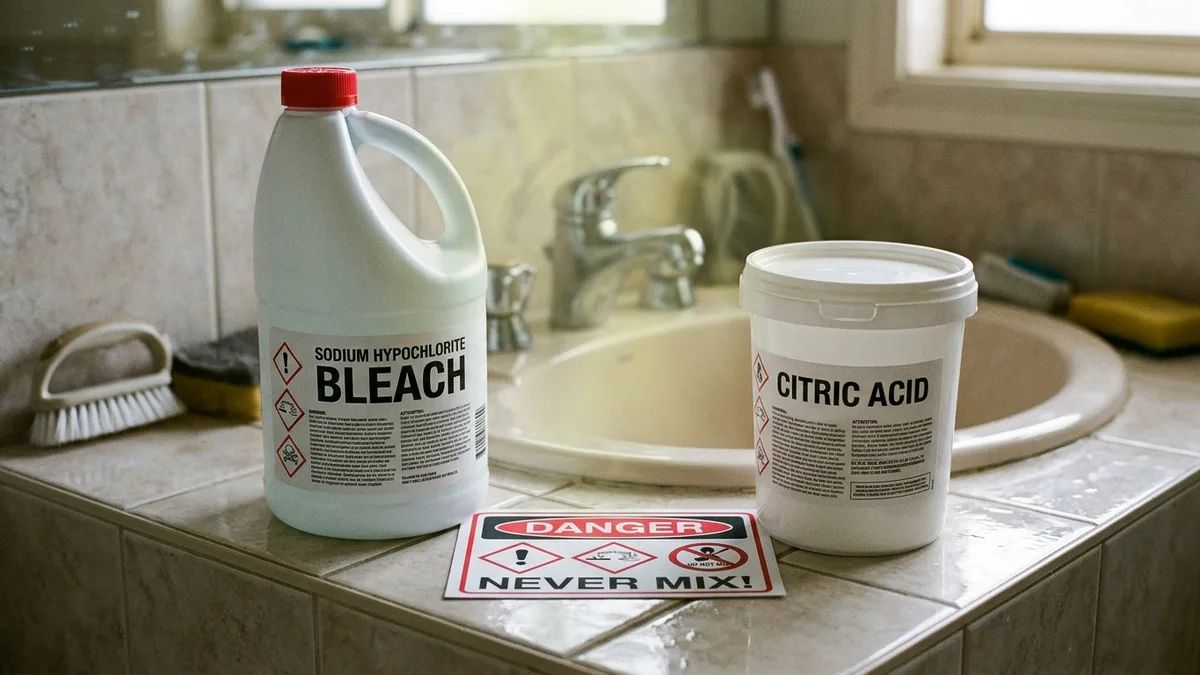
Household bleach is sodium hypochlorite at about 5 to 8%, held in an alkaline solution. Acid converts hypochlorite into hypochlorous acid (HOCl, pKa about 7.5), and below a pH of roughly 5 it reacts with chloride to form chlorine gas:
HOCl + Cl⁻ + H⁺ → Cl₂ + H₂O.
Chlorine burns the eyes, nose and lungs, and a mix in a small bathroom can become dangerous quickly.
Risk: Severe. Do instead: Rinse bleach away completely and wait before using any acid.
Pool shock and chlorinated tablets
Calcium hypochlorite and chlorinated isocyanurates release chlorine gas on contact with acid, just like bleach. These products are strong solids, so even a small spill near stored citric acid powder can start a reaction, especially in a damp shed. Store them in separate, labeled containers on opposite sides of the room.
Risk: Severe. Do instead: Keep pool chemicals and citric acid in different storage areas.
Sodium chlorite
Acid converts sodium chlorite into chlorine dioxide (ClO₂), a toxic and unstable gas. Sodium chlorite appears in some disinfectant and water treatment processes, where acid activation is intentional and tightly controlled. Outside a designed process, mixing it with citric acid is a serious hazard.
Risk: Severe. Do instead: Use it only in a process designed for it and follow the SDS.
2. Sulfur, Nitrogen and Cyanide Salts: Never Mix
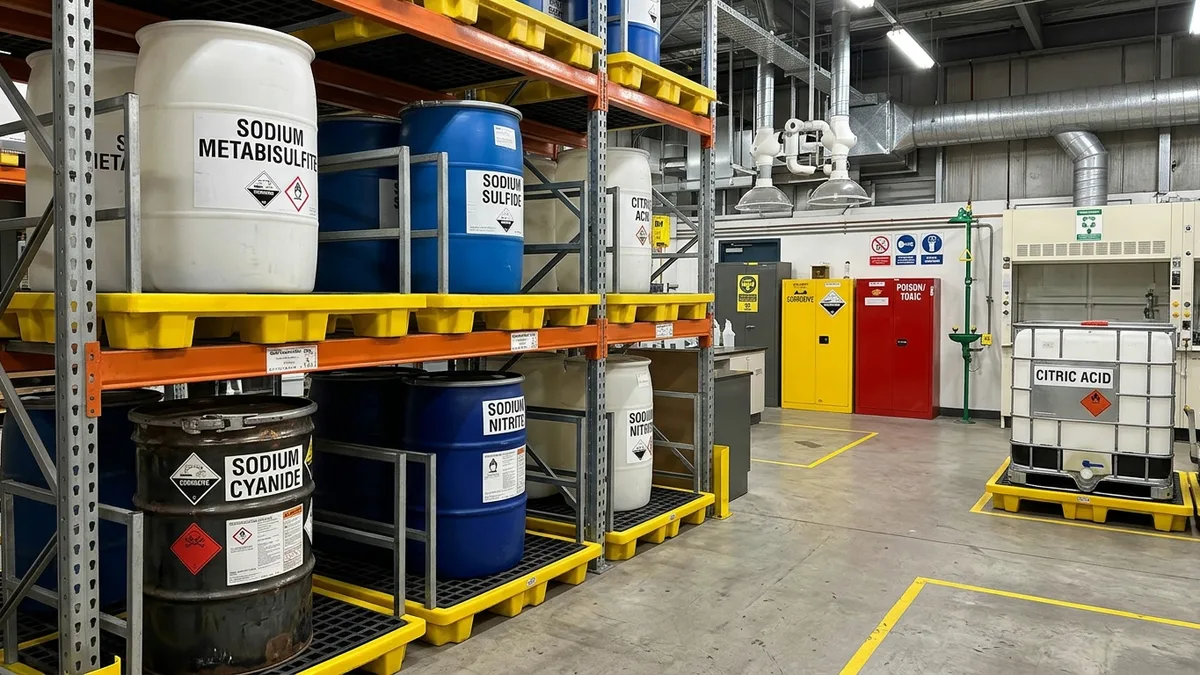
Acid pushes salts of weak acids into their gas forms. These appear in food plants, labs and metal finishing more than in homes. The table shows what each one releases.
| Salt | Gas released | Where it appears |
|---|---|---|
| Sulfites, metabisulfite | Sulfur dioxide (SO₂) | Beverage and food preservative blends |
| Thiosulfate | Sulfur dioxide and sulfur | Dechlorination and photo chemicals |
| Sulfides | Hydrogen sulfide (H₂S) | Odor and metal treatment products |
| Nitrites | Nitrogen oxides | Curing premixes |
| Cyanides | Hydrogen cyanide (HCN) | Metal plating and finishing baths |
Sulfites and thiosulfate
Acid releases sulfur dioxide from sulfites and metabisulfite, and thiosulfate gives SO₂ plus yellow sulfur. The effect is strongest in moist blends, where acid and salt meet in a damp powder. Sulfur dioxide irritates the airways, and people with asthma are especially sensitive.
Risk: High. Do instead: Keep dry blends separate until the moment of use.
Sulfides
Acid releases hydrogen sulfide, which smells like rotten eggs at low levels. At higher levels it dulls your sense of smell, so the odor stops warning you even as the danger rises. This is why you should never judge safety by smell alone.
Risk: Severe. Do instead: Keep sulfides completely separate from all acids.
Nitrites
Acid converts nitrites into nitrous acid, which breaks down into nitrogen oxide gases. This matters in curing premixes, particularly when moisture is present. A damp, acidic blend can release gas inside a closed container, and pressure can build.
Risk: High in moist, acidic conditions. Do instead: Store curing salts and acidulants separately.
Cyanides
Acid releases hydrogen cyanide, a fast-acting toxic gas. Cyanides appear in some metal plating and finishing baths, where acid control is part of the process design. Citric acid should never be stored or used near cyanide salts.
Risk: Severe. Do instead: Follow your facility’s chemical segregation rules.
3. Oxidizers: Industrial Hazard
Citric acid is organic, so it can act as fuel when a strong oxidizer is present. These mixes matter in plants and labs more than in homes. Fine citric acid dust can also form combustible clouds in air, so keep powder handling closed and away from ignition sources.
Permanganates, chlorates and nitric acid
Permanganates oxidize citric acid vigorously and can generate heat quickly. Chlorates and nitric acid create reaction and fire risk when they meet organic material. Reducing agents are also listed as incompatible on SDS sheets, so store them away from citric acid too.
Risk: High. Do instead: Store oxidizers in a separate, labeled area.
Hydrogen peroxide
At 3% household strength, no hazardous gas forms, and some cleaners combine peroxide with citric acid. Peroxide slowly breaks down into oxygen and water, so a mixed solution in a sealed bottle can build pressure. At 30% and above, peroxide is a strong oxidizer and should never be blended with organic compounds.
Risk: Low at 3%, high at 30% and above. Do instead: Mix small batches and use them right away.
4. Alkalis and Salts That Use Up Citric Acid
Anything alkaline uses up the acid. These mixes are not toxic in themselves, but you lose the cleaning power and sometimes create heat or pressure. The table shows how much of each base 10 g of anhydrous citric acid uses up. Monohydrate uses about 9% less per gram.
| Base | Products | Used up by 10 g of citric acid |
|---|---|---|
| Baking soda (NaHCO₃) | Sodium citrate, CO₂, water | About 13.1 g |
| Washing soda (Na₂CO₃) | Sodium citrate, CO₂, water | About 8.3 g |
| Lye (NaOH) | Sodium citrate, water, heat | About 6.25 g |
| Potash (KOH) | Potassium citrate, water, heat | About 8.8 g |
Lye and drain cleaners
Citric acid neutralizes lye completely, and the reaction releases heat that can splash hot liquid. This is useful in soap making and pH adjustment, where the ratios are calculated in advance. In a cleaning bucket it wastes both products and adds a burn risk.
Risk: Moderate, from heat. Do instead: Use each product separately with a rinse in between.
Baking soda and washing soda
Citric acid and baking soda neutralize each other:
C₆H₈O₇ + 3 NaHCO₃ → Na₃C₆H₅O₇ + 3 CO₂ + 3 H₂O.
The fizz is carbon dioxide, which is useful in bath bombs and effervescent tablets. For cleaning, the acid is spent before it can dissolve scale, and a sealed bottle can build pressure.
Risk: Low. Do instead: Use them one after the other with a rinse between.
Ammonia
On its own, ammonia and citric acid simply form ammonium citrate, a mild neutralization. The real danger is bleach plus ammonia, which makes toxic chloramines. Because bleach residue is common, keep all three products apart.
Risk: Low alone, severe if bleach is present. Do instead: Never combine household cleaners without checking labels.
Borax
Citric acid and borax partly neutralize each other, and the boric acid formed in the mix weakens descaling power. Borax is mildly alkaline, so the mix lowers the acidity you rely on. The two are better used for separate jobs.
Risk: Low. Do instead: Use borax for laundry boosting and citric acid for descaling.
True soap
True soap, such as castile or bar soap, is the salt of a fatty acid. Acid strips off the metal and leaves oily free fatty acids that do not lather or rinse well. Synthetic detergents, like most dish liquids, tolerate mild acid.
Risk: Low. Do instead: Use a synthetic detergent if you need both.
Sodium silicate and sodium percarbonate
Acid precipitates silica gel from sodium silicate, which can block lines and spray nozzles. Sodium percarbonate releases CO₂ and hydrogen peroxide on acidification, and damp mixes can build pressure. Both are common in detergent powders and cleaning blends.
Risk: Low to moderate. Do instead: Add citric acid in a controlled step and keep powders dry.
Antacids
Antacids neutralize citric acid, so taking them together cancels both effects. Citrate can also increase absorption of aluminum from aluminum-containing antacids, which is why labels advise caution. Ask a pharmacist before combining them.
Risk: Low. Do instead: Check the medicine label and ask a pharmacist.
5. Materials and Surfaces Citric Acid Damages
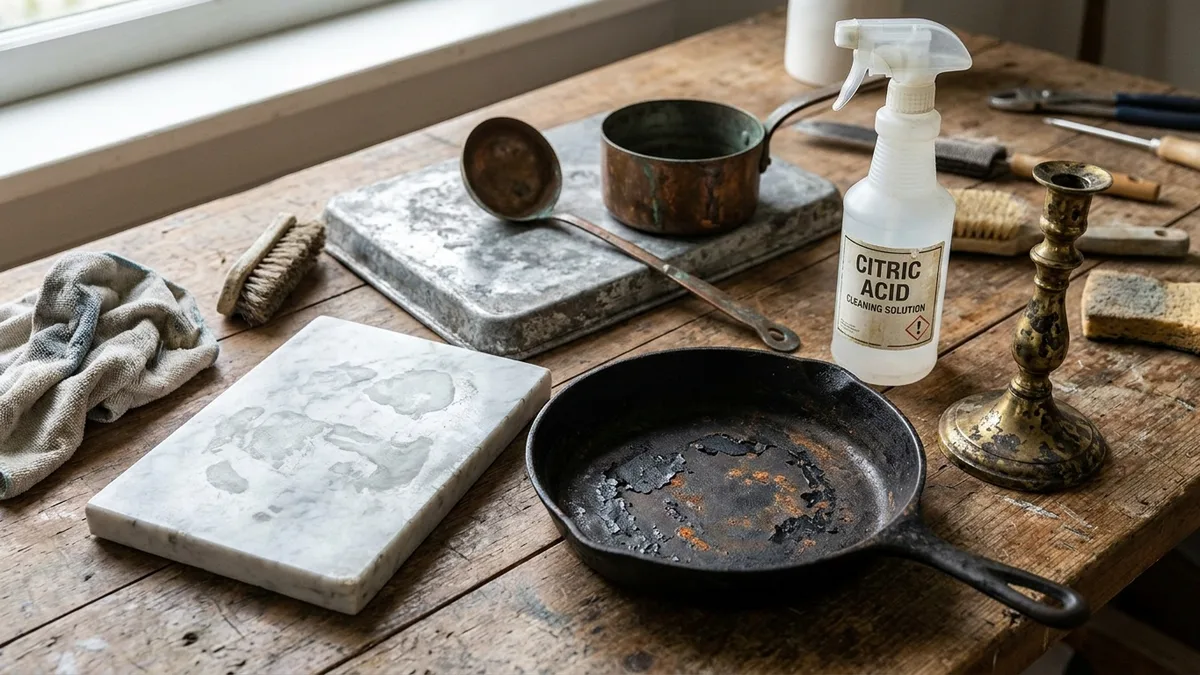
Damage shows up as dull spots, pitting or stripped finishes. Contact time and heat make it worse, and the harm is often permanent. Always treat an unfamiliar surface with care.
Natural stone, grout and concrete
Marble, limestone, travertine and onyx are made of calcium carbonate, which dissolves in acid and leaves dull etched spots. Unsealed grout, cement and concrete lose calcium compounds the same way, and the surface becomes rough. Sealed granite resists brief contact, but the sealer and grout lines can still wear away.
Risk: Moderate. Do instead: Use a pH-neutral stone cleaner.
Aluminum, zinc and galvanized steel
Aluminum forms soluble aluminum citrate, which causes pitting and a dull, chalky look. Citric acid also attacks the zinc coating on galvanized steel, leaving the base metal exposed. Anodized finishes can fade with repeated contact.
Risk: Moderate. Do instead: Use a mild detergent.
Copper, brass and bronze
Citric acid strips patina and dissolves copper ions, which changes the color and finish of decorative pieces. It can brighten tarnished metal in a controlled soak, but uncontrolled contact leaves uneven spots. Rinse and dry the item quickly.
Risk: Moderate. Do instead: Use a dedicated metal cleaner.
Cast iron
Acid strips the seasoning from cast iron, and bare iron can rust soon after. This ruins the non-stick surface that took many cooking sessions to build. Re-seasoning is needed after any acid exposure.
Risk: Moderate. Do instead: Use warm water and a scraper.
Lead crystal and glazed ceramics
Acid can leach lead from lead crystal and from some glazes, especially on older or imported ceramics. Food contact with leached lead is a health concern. Avoid using acidic solutions in these items.
Risk: Moderate. Do instead: Use plain water and mild soap.
Silk, wool and leather
Acid weakens protein-based fibers and can shift dye colors. Silk and wool lose strength and luster, and leather can dry out and stiffen. A small amount of acidic rinse may be fine on some fabrics, but only with a label that allows it.
Risk: Moderate. Do instead: Use a fabric-safe cleaner.
The stainless steel exception
Stainless steel tolerates citric acid well, and citric solutions are widely used for stainless passivation. It is the safest metal for descaling kettles, pots and equipment. Rinse well afterward to remove any residue.
Before treating any unfamiliar surface:
- Pick a hidden spot: Use the underside or back.
- Start weak: Use 1% and limit contact time.
- Rinse and dry: Check for dulling or color change.
6. Formulation Ingredients for Food, Cosmetic and Detergent Blends
Citric acid is often used to adjust pH, so these problems appear when too much is added. They are performance issues, not safety hazards. A pH meter and small test batches prevent most of them.
Enzymes
Most laundry and cleaning enzymes lose activity at low pH, so a low-pH formula can stop the enzymes from working. Too much citric acid can wipe out the cleaning benefit you paid for. Check the enzyme supplier’s pH range before setting your target.
Risk: Low. Do instead: Add citric acid first, check pH, then add enzymes.
Carbomer thickeners
Carbomer gels thin out as pH drops, and the product can lose its body. This shows up in gels, creams and thickened cleaners. Small additions let you stay within the thickener’s working range.
Risk: Low. Do instead: Adjust pH in small steps and check viscosity.
Milk and dairy proteins
Dairy proteins curdle near pH 4.6, which is useful in cheesemaking and a defect in drinks. Citric acid added to milk-based products can cause graininess and separation. Buffering systems help keep the product smooth.
Risk: Low. Do instead: Use a buffered system if you need stability.
7. What Is Safe to Mix With Citric Acid
Not everything is a problem, and knowing the safe list helps you avoid wasting effort on worry. These combinations are generally fine at normal strengths. Check each product label if you are unsure.
| Mixed with | Result | Verdict |
|---|---|---|
| Water | Clear solution | Safe, the standard base |
| Vinegar | Two acids, no reaction | Safe, adds smell only |
| Salt (NaCl) | No reaction | Safe |
| Glycerin | No meaningful reaction | Safe |
| Isopropyl alcohol or ethanol | No meaningful reaction at room temperature | Safe for short storage |
| Most dish liquids | Generally compatible | Safe, check the label |
| Hydrochloric or sulfuric acid | No reaction with citric acid | Pointless and more corrosive |
8. How to Mix Citric Acid Safely
Most accidents come from habit, not ignorance. A fixed routine prevents the usual mistakes, such as mixing in a cluttered cleaning cupboard or skipping a rinse. Follow the same steps every time.
- Clear the area: Remove bleach, ammonia, drain cleaner and pool chemicals.
- Start with water: Add the powder to water while stirring.
- Use warm water: Around 40 to 50 °C (104 to 122 °F) dissolves it faster.
- Protect yourself: Wear safety glasses and gloves.
- Rinse between products: Flush surfaces with clean water before using another cleaner.
- Label the container: Mark it with contents and date.
| Task | Strength | Citric acid per liter of water |
|---|---|---|
| Light cleaning, rinse aid | 1% | 10 g |
| Kettle, showerhead, coffee maker descaling | 2 to 5% | 20 to 50 g |
| Heavy scale soak | Up to 5% | Up to 50 g |
Industrial processes may use other strengths, so follow the SDS and your process specification.
9. What to Do After a Bad Mix
If you smell chlorine, sulfur or a sharp irritating gas, act quickly and do not stay to investigate. The first priority is getting everyone to fresh air. Cleaning up the spill comes last, after the area has ventilated.
- Leave the area: Move to fresh air at once and keep others out.
- Call for help: Contact Poison Control at 1-800-222-1222, or 911 if breathing is difficult.
- Flush exposed skin or eyes: Use clean water for at least 15 minutes.
- Do not clean up: Let the area ventilate before anyone returns.
10. How to Store Citric Acid
Store citric acid in a sealed, dry container in a cool place. The powder absorbs moisture, which causes caking and early reactions in blends. Do not leave diluted solutions for weeks, because weak citric solutions can grow mold.
| Keep it away from | Reason |
|---|---|
| Hypochlorites, pool shock | Chlorine gas |
| Sulfites, sulfides, nitrites, cyanides | Toxic gas |
| Strong bases | Neutralization and heat |
| Oxidizers | Fire risk |
| Ammonia | Keeps cleaning products apart |
What not to mix with citric acid falls into six groups: chlorine products, sulfur, nitrogen and cyanide salts, oxidizers, alkalis, damaged materials and pH-sensitive formulation ingredients. Water, vinegar, salt and most dish liquids are safe partners.
Chemvexa is a chemical platform whose catalog carries citric acid with its formula, specifications, grades and safety notes, backed by guides that explain how chemicals are used, handled and stored safely.
FAQs
1. What chemical should you never mix with citric acid?
Bleach and other chlorine products, because they release chlorine gas. Sulfides, cyanides, sulfites and nitrites also release toxic gases. In industry, strong oxidizers belong on that list too.
2. Can you mix citric acid and vinegar?
Yes, but there is no benefit. Both are acids, so nothing reacts between them. Citric acid alone dissolves limescale better because it chelates calcium more effectively.
3. Can you mix citric acid and baking soda for cleaning?
You can, but they neutralize each other into sodium citrate, so you lose both cleaning actions. The fizz is just carbon dioxide leaving the liquid. Use them one after the other with a rinse between.
4. Is it safe to mix citric acid with hydrogen peroxide?
At 3% strength, no hazardous gas forms, and some commercial products combine them. Do not store the mix in a sealed bottle, because peroxide slowly releases oxygen. Never blend strong peroxide with citric acid.
5. Can you mix citric acid with dish soap?
Most dish liquids use synthetic detergents, which tolerate mild acid. True soap does not, because acid turns it back into fatty acids. Check the product label if you are unsure.