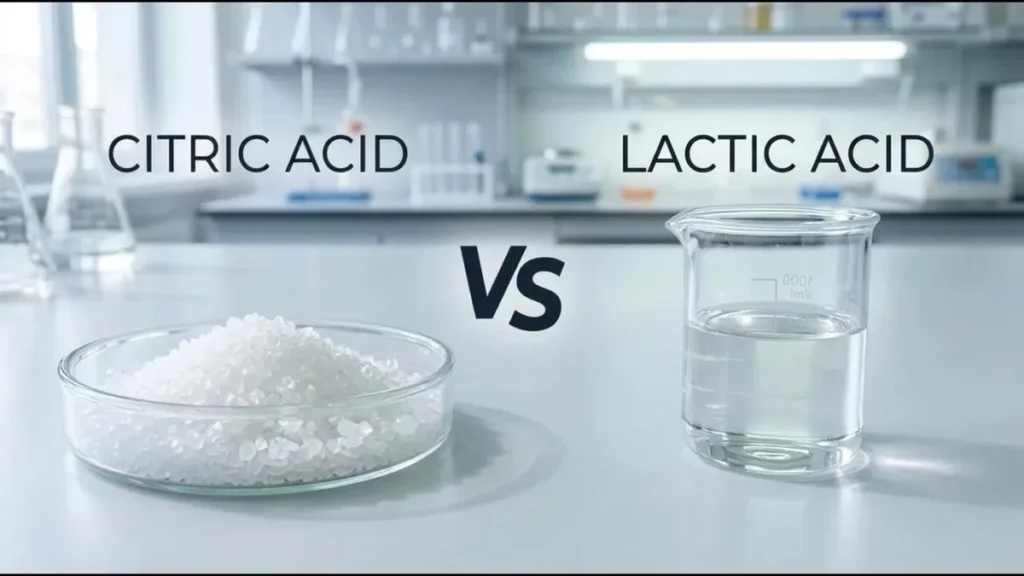
Citric acid and lactic acid are both widely used to control acidity, improve product stability and support different industrial processes. However, their chemical properties, acid strength and performance can vary considerably depending on the application. Understanding these differences helps you choose the right acid for food production, cleaning, cosmetics or pharmaceutical formulations.
What Is Each Acid?
Commercial citric acid is made by feeding sugars from corn or molasses to the mould Aspergillus niger. The acid is then separated, purified and crystallized. Lemons and limes contain it naturally, at roughly 5% to 6% of the juice, but fruit alone cannot meet industrial demand.
Lactic acid is made when bacteria such as Lactobacillus ferment sugars. The old name “milk acid” is historical, and most commercial lactic acid today starts from plant sugars. It exists in two mirror-image forms, L(+) and D(-). The L-form is the one preferred for food, pharma and skin care.
1. Chemical Structure and Formula
Citric acid has three carboxyl groups (–COOH) and one hydroxyl group (–OH) on a six-carbon chain. Lactic acid has one carboxyl group and one hydroxyl group on a three-carbon chain. This single difference drives most of the other differences below.
| Property | Citric acid | Lactic acid |
|---|---|---|
| Formula | C₆H₈O₇ | C₃H₆O₃ (CH₃CH(OH)COOH) |
| IUPAC name | 2-hydroxypropane-1,2,3-tricarboxylic acid | 2-hydroxypropanoic acid |
| CAS numbers | 77-92-9 (anhydrous), 5949-29-1 (monohydrate) | 50-21-5 (DL), 79-33-4 (L-form) |
| Molar mass | 192.12 g/mol | 90.08 g/mol |
| Acidic protons | 3 (triprotic) | 1 (monoprotic) |
| E number | E330 | E270 |
2. Acid Strength (pKa and pH)

The first pKa of citric acid is 3.13, against 3.86 for lactic acid. A lower pKa means a stronger acid, so citric acid is the stronger one in its first step. In a 1% solution the gap is small: about pH 2.2 for citric acid and about pH 2.4 for lactic acid.
| Measure | Citric acid | Lactic acid |
|---|---|---|
| pKa values | 3.13, 4.76, 6.40 | 3.86 |
| pH of 1% solution | About 2.2 | About 2.4 |
3. Titratable Acidity and Buffering
Because citric acid carries three acidic protons, one molecule can neutralize three units of base. Lactic acid neutralizes one. Weight for weight, citric acid supplies more titratable acidity, which is the total acid you must neutralize to reach a target pH.
Citric acid also buffers over a wide pH range thanks to its three pKa values. Paired with sodium citrate, it is the classic buffer for beverages and pharma solutions.
| Acid form | Grams per acid equivalent | Useful buffer range |
|---|---|---|
| Citric acid, anhydrous | 64.0 g | About pH 2.1 to 7.4 |
| Lactic acid, 100% basis | 90.1 g | About pH 2.9 to 4.9 |
4. Metal Binding (Chelation)
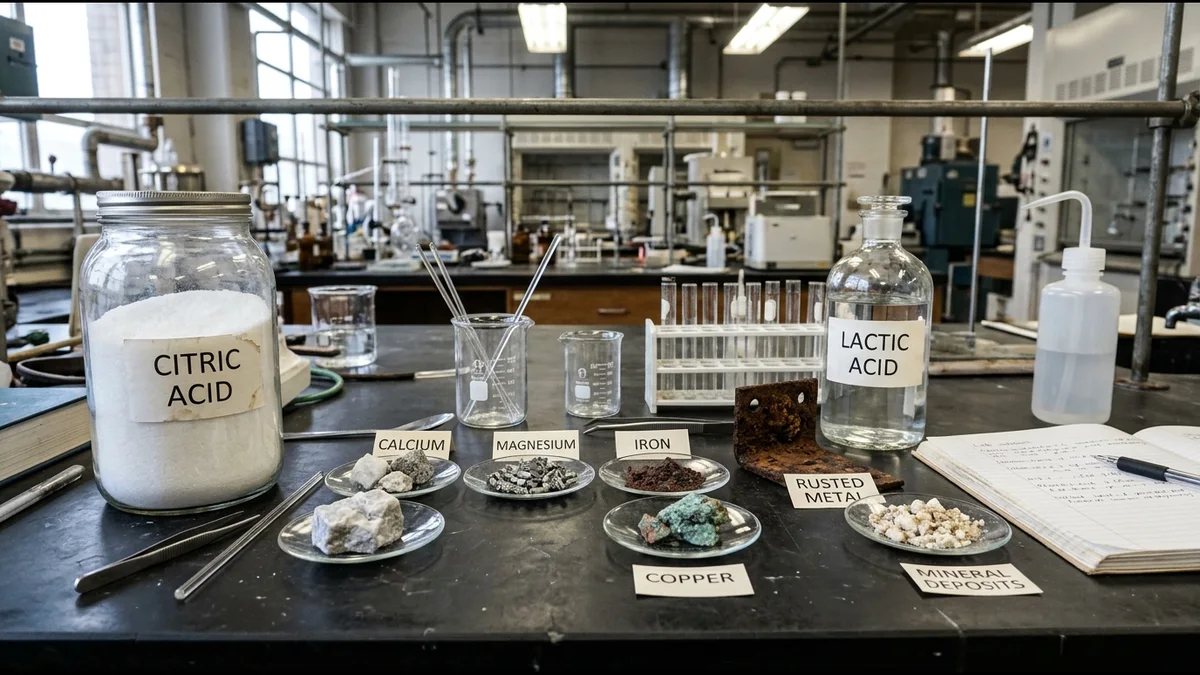
Citric acid is a strong chelating agent. Its three carboxyl groups grip metal ions such as calcium, magnesium, iron and copper together. That makes it useful for protecting oils and cut fruit from oxidation, softening water and lifting rust.
Lactic acid chelates only weakly. It can form soluble salts with metals, but it does not hold them the way citric acid does.
5. Taste and Flavor
Citric acid tastes sharp, clean and fruity. The sourness hits fast and fades fast, which suits soft drinks, candy and fruit flavors. Lactic acid tastes softer and rounder, with a lingering tang like yogurt, sourdough or pickles.
- Citric acid: Bright, quick onset, pairs with citrus and berry notes.
- Lactic acid: Mellow, slow fade, pairs with dairy, savory and fermented flavors.
Published sourness rankings differ by test method and pH, so always run a bench tasting before you lock in a recipe.
6. Preservation and Antimicrobial Effect
At low pH, more lactic acid stays in the uncharged form that can pass through bacterial cell walls. That gives it a stronger direct antimicrobial effect than citric acid. US meat and poultry processors spray carcasses and trim with lactic acid solutions, typically in the low single-digit percent range (about 2% to 5%), under USDA FSIS rules.
Citric acid is a weaker antimicrobial on its own. It works best as a partner, lowering pH and tying up trace metals so other preservatives work harder.
7. Physical Form and Handling
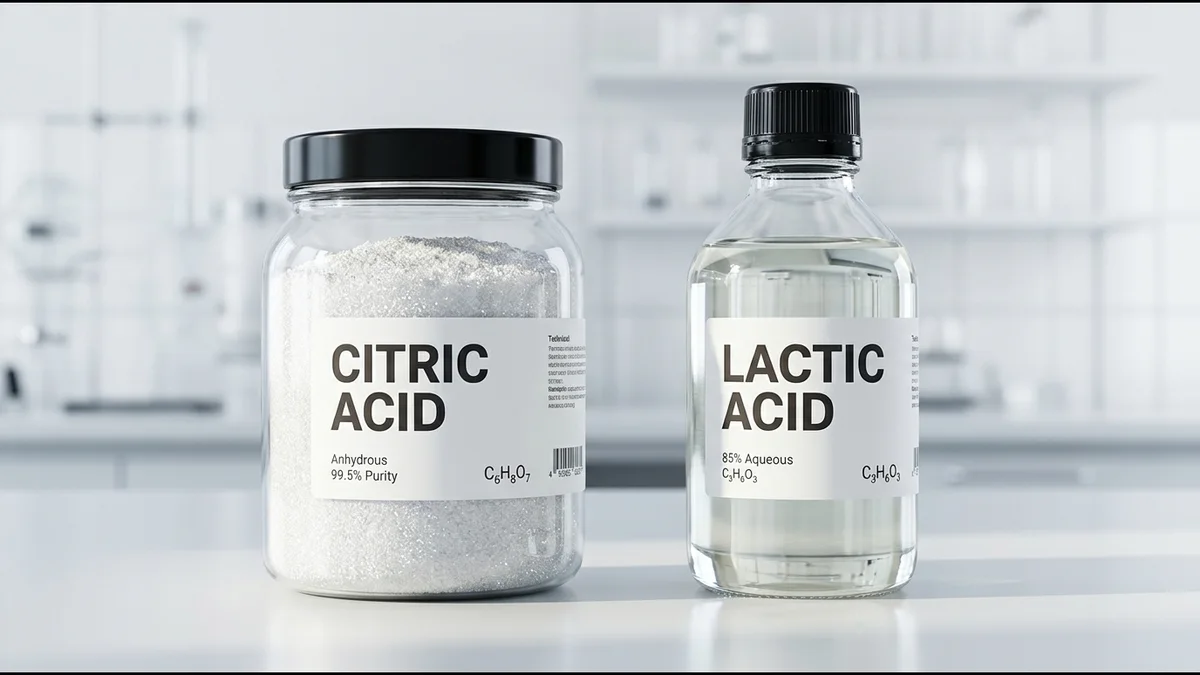
Citric acid is a dry, white crystalline powder. It is easy to weigh, store and ship, but it cakes if humidity gets in. Lactic acid is a clear pale yellow syrupy liquid, sold mostly as 50%, 80% or 88% solutions in water.
Concentrated lactic acid also contains dimers and short chains (lactoyllactic acid) that convert back to lactic acid when diluted. For accurate dosing, titrate after dilution, not before.
| Aspect | Citric acid | Lactic acid |
|---|---|---|
| Form | Crystalline powder | Syrupy liquid |
| Dosing | Weigh by mass | Pump or weigh, adjust for water content |
| Moisture issue | Caking | Absorbs water from air |
| Odor | None | Mild sour odor |
8. Food Uses
Both acids are generally recognized as safe (GRAS) by the US FDA under 21 CFR 184.1033 (citric) and 21 CFR 184.1061 (lactic). The better pick depends on the job.
| Application | Better choice | Why |
|---|---|---|
| Soft drinks, juices, fruit flavors | Citric acid | Clean tartness, dissolves fast |
| Hard candy and sour sanding | Citric acid | Dry crystals; liquid makes coatings sticky |
| Jams and jellies | Citric acid | Sets the pH needed for pectin gelling |
| Effervescent tablets | Citric acid | Solid acid reacts with sodium bicarbonate |
| Oils and cut fruit | Citric acid | Chelates trace iron and copper |
| Cheese, yogurt, dairy desserts | Lactic acid | Matches natural flavor |
| Pickles, olives, dressings, sauces | Lactic acid | Mellow tang |
| Meat and poultry washes | Lactic acid | Stronger antimicrobial effect |
| Brewing and mash pH | Lactic acid (88% food grade) | Smooth flavor impact |
Canning warning: Home canning follows tested recipes only. The National Center for Home Food Preservation, the main US source for tested home canning recipes, lists citric acid or bottled lemon juice for acidifying tomatoes, in set amounts per jar. Do not swap in lactic acid or change the amount, because that can change the acidity safety margin.
9. Cleaning and Descaling
Both acids dissolve limescale (calcium carbonate), which is a constant problem where hard water is common across much of the US. The difference is the calcium salt left behind.
Citric acid:
2 C₆H₈O₇ + 3 CaCO₃ → Ca₃(C₆H₅O₇)₂ + 3 CO₂ + 3 H₂O.
Calcium citrate is poorly soluble and can leave a film if the water is hot or you skip the rinse.
Lactic acid:
2 CH₃CH(OH)COOH + CaCO₃ → Ca(C₃H₅O₃)₂ + CO₂ + H₂O.
Calcium lactate is freely soluble and rinses away cleanly.
| Aspect | Citric acid | Lactic acid |
|---|---|---|
| Calcium salt | Poorly soluble | Soluble |
| Rust and iron stains | Excellent | Moderate |
| Typical strength | About 5% to 10% (50 to 100 g/L) | About 5% to 10% of an 80% to 88% liquid |
| Best temperature | Warm, below about 60°C (140°F) | Warm to room temperature |
Citric acid is also the standard choice for passivating stainless steel (see ASTM A967). For both acids, keep them off marble, limestone, travertine and grout, and limit contact time on aluminum, brass and galvanized metal. Never mix either with bleach, because that releases chlorine gas.
10. Skin Care and Cosmetics
Lactic acid is an alpha-hydroxy acid (AHA). It loosens bonds between dead skin cells for gentle exfoliation and acts as a humectant. Lactate is also part of the skin’s natural moisturizing factor, which helps explain its good tolerance.
As with any AHA, pH decides how well it works. At pH 3.86, half of the lactic acid is in the active free-acid form, so leave-on products are usually formulated at pH 3.5 to 4.0. The US Cosmetic Ingredient Review panel found AHAs safe in leave-on products at 10% or less and pH 3.5 or higher, with sun protection addressed.
Citric acid plays a supporting role. Formulators use it, often at 0.05% to 0.5%, to adjust pH and chelate metals that destabilize color and fragrance. Its three charges add more ionic strength per mole, which can thin some electrolyte-sensitive polymer gels and clash with cationic ingredients, so test viscosity and stability. Pair any AHA product with daily SPF.
11. Industrial and Pharmaceutical Uses
- Citric acid: Buffers, effervescent tablets, anticoagulant solutions (acid-citrate-dextrose), detergent builders, water treatment, metal cleaning and citrate ester plasticizers.
- Lactic acid: Pharmaceutical pH adjustment, topical products, leather deliming, ethyl lactate solvents and the raw material for polylactic acid (PLA) bioplastics.
12. Safety, Storage and Handling
| Item | Citric acid | Lactic acid (80% to 88%) |
|---|---|---|
| Typical hazard | Serious eye irritation | Skin irritation and serious eye damage |
| PPE | Splash goggles, nitrile gloves, dust mask if dusty | Splash goggles or face shield, nitrile gloves, apron |
| Storage | Cool, dry, sealed container | Tightly closed HDPE, glass or stainless steel |
| Incompatibles | Strong bases, oxidizers, reducing agents | Strong bases and oxidizers |
| Eye contact | Rinse with water for at least 15 minutes | Rinse for at least 15 minutes and get medical help |
Add acid to water, never water to concentrated acid. Neutralize small spills with sodium bicarbonate or soda ash, and follow local disposal rules. Hazard wording varies by supplier and concentration, so follow the SDS for your lot. In the US, workplaces handling these acids fall under OSHA’s Hazard Communication Standard, which requires an SDS on file and proper labeling.
13. Grades and Buying
- Citric acid: Choose anhydrous or monohydrate and a particle size that suits your process. Grades include FCC/food, USP, BP/EP and technical.
- Lactic acid: Choose a concentration (50%, 80% or 88%) and a grade (FCC/food, USP or technical). Confirm whether it is L(+), DL or a mix, and whether you need a heat-stable, low-color grade for baking or confectionery.
US food buyers usually specify FCC (Food Chemicals Codex) grade, and pharmaceutical buyers specify USP. For either acid, request a certificate of analysis covering assay, color, heavy metals, sulfate and chloride. Ask for kosher, halal, non-GMO or plant-origin statements if your market needs them.
Can You Swap Lactic Acid for Citric Acid?
Sometimes, but never by weight alone. Match acid equivalents (titratable acidity), then adjust by taste and pH. For example, 1 kg of 88% lactic acid replaces about 0.62 kg of anhydrous citric acid. The liquid carries water, so reduce water elsewhere in the batch.
| To replace 1 kg anhydrous citric acid, use | Amount |
|---|---|
| Citric acid monohydrate | 1.10 kg |
| Lactic acid, 100% basis | 1.41 kg |
| Lactic acid, 88% | 1.60 kg |
| Lactic acid, 80% | 1.76 kg |
After swapping, recheck final pH, flavor and preservation. Citric acid will not match lactic acid’s antimicrobial effect, and lactic acid will not match citric acid’s chelation. Labels may need updating, and acidified foods need a validated process.
Choosing between different acids often comes down to more than their ability to lower pH. Factors such as formulation stability, ingredient compatibility, handling requirements and final product quality can influence long-term results. A clear understanding of these practical considerations helps avoid unnecessary adjustments and makes chemical selection more reliable. The Chemvexa catalog carries each chemical with its formula, specifications, grades and safety notes, backed by guides like this one.
Frequently Asked Questions
Is lactic acid stronger than citric acid?
Citric acid is the stronger acid, with a first pKa of 3.13 versus 3.86 for lactic acid. It also has three acidic protons, while lactic acid has only one. This gives citric acid greater total neutralising capacity per molecule.
Can lactic acid replace citric acid?
Yes, lactic acid can replace citric acid in many industrial and formulation applications, provided the dosage is adjusted. You should match acid equivalents rather than simply replacing equal weights. Always test the final pH, flavour and product stability before making the change.
Which acid is better for removing limescale?
Both acids can dissolve limescale, but they leave different calcium salts behind. Lactic acid produces soluble calcium lactate, which rinses away easily, while citric acid can leave calcium citrate deposits. Citric acid is generally more effective for removing rust and iron stains.
Which acid is better for skin?
Lactic acid is commonly used as an alpha-hydroxy acid (AHA) for exfoliation and hydration. Citric acid is generally added in smaller amounts to adjust product pH and bind trace metals. Both require appropriate concentrations and formulation pH to minimise skin irritation.
Is lactic acid vegan?
Most commercially produced lactic acid comes from fermenting plant-based sugars such as corn or other carbohydrate sources. However, some manufacturers use lactose or other animal-derived starting materials. Check the supplier’s plant-origin declaration to confirm whether a particular product is suitable for vegan applications.