Citric acid is among the most common process chemicals found in food processing, pharmaceutical manufacturing, industrial cleaning and in the treatment of wastewater. This is an indispensable acidulant, chelating agent, pH modifier. However, in most process applications, its acidity must be closely regulated to achieve either product specifications, prevent downstream equipment, or environmental discharge requirements.
Learning to counteract citric acid in the right way is a practical engineering ability whose direct implication is on the quality of products, process safety, and regulatory compliance. Half neutralization results in off-spec batches. Over-neutralization will produce alkaline environments, which are just as destructive. The whole thing is about precision.
Understanding Citric Acid Chemistry Before You Neutralize
Before selecting a neutralization strategy, you must understand the chemical behavior of what you are working with. Citric acid (C₆H₈O₇) is a weak triprotic organic acid, carrying three ionizable protons one from each of its three carboxyl (–COOH) groups.
This triprotic character is the most crucial when it comes to calculations of neutralization. The number of moles of citric acid that need to be completely neutralized by a monovalent base such as NaOH is one mole. When they use citric acid as a single-protic acid, engineers continuously underestimate the base requirements and produce end products that are acidic.
Its stepwise dissociation constants are:
- pKa₁ = 3.13 — First proton released
- pKa₂ = 4.76 — Second proton released
- pKa₃ = 6.40 — Third proton released
Each pKa value marks a buffering zone where the solution resists pH change. This stepwise behavior is what gives citric acid its excellent buffering capacity and what makes neutralization require careful, incremental base addition rather than bulk dosing.
Citric Acid pH Profile: What You Are Starting With
The starting pH of a citric acid solution depends entirely on its concentration. Understanding this baseline is essential before any pH adjustment work begins.
| Citric Acid Concentration | Approximate pH |
| 0.1% w/v | 3.5 |
| 1% w/v | 2.2 |
| 5% w/v | 1.9 |
| 10% w/v | 1.7 |
| 50% w/v (concentrated) | ~1.4 |
To the industrial operators, this table is the direct way of informing the amount of base needed by each batch volume. A neutralization load of 1,000 liters of a 5% citric acid solution would give a significantly different load at 0.1%.
Citric acid is used in most food and beverage processes with a pH of 3.0 to 4.5. Pharmaceutical buffer systems are often focused on pH 5.0 to 6.5. The discharge of industrial wastewater usually needs a pH of 6.0-9.0 prior to discharge.
Fact: Citric acid is also an important intermediate in Krebs cycle, the central metabolic pathway found in aerobic organisms.. Citric acid is one of the few industrial chemicals and a basic biomolecule since it is produced and used in energy generation by all cells of your body.
What Base Neutralizes Citric Acid? Choosing the Right Agent
The choice of neutralizing base is an engineering decision driven by your target application, acceptable byproduct, safety constraints, and cost. Each base produces a different citrate salt with its own utility.
| Base | Byproduct Salt | Application | Key Consideration |
| Sodium hydroxide (NaOH) | Sodium citrate | Food, pharma, industrial | Strong base precise dosing required |
| Potassium hydroxide (KOH) | Potassium citrate | Pharma, sports nutrition | Used where sodium restriction applies |
| Sodium bicarbonate (NaHCO₃) | Sodium citrate + CO₂ + H₂O | Food, lab, home use | Mild, safe, CO₂ release must be managed |
| Sodium carbonate (Na₂CO₃) | Sodium citrate + CO₂ + H₂O | Industrial effluent, food | Gentler than NaOH, slower reaction |
| Calcium hydroxide (Ca(OH)₂) | Calcium citrate | Supplements, food fortification | Low solubility, slower kinetics |
| Magnesium hydroxide (Mg(OH)₂) | Magnesium citrate | Nutraceutical manufacturing | Produces a commercially valuable salt |
| Ammonia (NH₃) | Ammonium citrate | Industrial, electroplating | Not permitted in food applications |
Sodium hydroxide remains the dominant choice in large-scale industrial neutralization due to its availability, reaction speed, and the commercial value of sodium citrate as a byproduct. In food-grade applications, both NaOH and sodium bicarbonate carry full regulatory approval globally.
💡 Fact: Magnesium citrate produced by neutralizing citric acid with magnesium hydroxide is one of the most bioavailable forms of magnesium used in dietary supplements. Its superior absorption compared to magnesium oxide is well documented in clinical nutrition literature, making this neutralization reaction commercially significant in nutraceutical manufacturing.
Can Baking Soda Neutralize Citric Acid?
Yes, sodium bicarbonate is one of the safest and most practical neutralizing agents for citric acid, particularly in food-grade and small-scale settings. The balanced chemical equation is:
C₆H₈O₇ + 3 NaHCO₃ → Na₃C₆H₅O₇ + 3 H₂O + 3 CO₂↑
The visible fizzing is carbon dioxide gas escaping a non-toxic, predictable byproduct. This reaction is the same principle behind effervescent pharmaceutical tablets, bath bombs, and self-rising baking formulations.
From a process engineering standpoint, the CO₂ release requires attention in closed systems. In sealed reactors or pressurized vessels, adequate venting must be designed into the system before this reaction is run at scale. In open vessels, it is entirely manageable and requires no special provisions beyond standard mixing.
The Buffering Behavior of Citric Acid: What It Means for Operators
One of the most practically important and frequently misunderstood aspects of citric acid neutralization is its buffering behavior. Near each of its three pKa values, the solution strongly resists pH change. This means:
- Around pH 3.1, adding base produces very little pH movement
- Around pH 4.8, the same dose of base again produces minimal shift
- Around pH 6.4, a third buffering plateau slows progress once more
For plant operators running automated dosing systems, these buffering zones can appear as if the system has stalled or the pH probe is malfunctioning. It has not the chemistry is simply absorbing the base without releasing a visible pH response.
The practical implication is that dosing rate must be reduced near buffer zones and equilibration time must be allowed before adding further base. Rushing through a buffer zone by increasing base addition rate leads almost inevitably to overshooting the target pH.
Effect of Temperature on Citric Acid Neutralization
The temperature is a variable that cannot be overlooked in accuracy pH work with citric acid. Two different effects are involved.
To begin with, reaction kinetics increase in temperature. Neutralization reactions are faster at high temperatures, so the danger of localized overshooting is higher when a strong base, such as NaOH, is used. In sensitive formulations, controlled, cooled addition is preferred.
Second, pH is temperature-dependent. pH meters are used to measure the activity of hydrogen ions and this activity varies with temperature. The same solution with a pH of 5.0 at 25 C will have a different reading at 50 C or 10 C, without a temperature correction. Automatic temperature compensation (ATC) This is not optional in pharmaceutical or food-grade manufacturing and all precision pH works on citric acid systems must utilize a pH meter with automatic temperature compensation (ATC).
The citric acid monohydrate also loses its water of crystallization and becomes anhydrous at about 74 o C. Through thermal decomposition, the process starts above 175C. These transition points in equipment and process design should be considered in any process that requires the use of heat and neutralization of citric acid.
How to Dilute Citric Acid Safely Before Neutralization
When working with concentrated citric acid either as a solid or as a 50% solution dilution is the necessary first step before neutralization. Safe dilution follows established chemical handling protocol.
Safe Dilution Procedure:
- Always add acid to water, never the reverse this prevents exothermic splashing and localized concentration spikes
- Use cold or ambient temperature water to minimize heat generation
- Stir continuously during addition for uniform distribution
- Work in a well-ventilated space concentrated citric acid aerosols irritate mucous membranes
- Wear nitrile gloves, safety glasses, and a lab coat or chemical apron
- Use pH-resistant containers avoid uncoated carbon steel, zinc, or aluminum vessels
For industrial receiving and storage, citric acid monohydrate powder should be stored in cool, dry conditions away from strong oxidizers and strong bases. Bulk liquid citric acid (50% w/v) should be stored in lined or stainless steel tanks with appropriate secondary containment.
How to Neutralize Citric Acid: Step-by-Step Process
This procedure applies across food plant, pharmaceutical, and laboratory settings the engineering logic is identical regardless of scale.
Step 1 — Define your target pH:
Determine whether partial or complete neutralization is required. Food applications typically target pH 4.5 to 6.5. Pharmaceutical buffers often require tighter control such as pH 5.0 ± 0.2. Wastewater discharge requires pH 6.0 to 9.0.
Step 2 — Calculate stoichiometric base requirement:
Use the triprotic molar ratio. For complete neutralization with NaOH: 1 mol citric acid (192.12 g/mol) requires 3 mol NaOH (120.0 g total). For partial neutralization, titration curve data or process trial data should guide dosing.
Step 3 — Prepare base solution at working concentration:
For NaOH, a 10–20% w/v solution is standard in industrial pH adjustment. For sodium bicarbonate, a 5–10% w/v solution is practical for food and lab use.
Step 4 — Add base incrementally with continuous agitation:
Never bulk-dose. Add in controlled increments slow the addition rate significantly as you approach each buffering zone (pH 3.1, 4.8, 6.4).
Step 5 — Monitor pH with a calibrated meter:
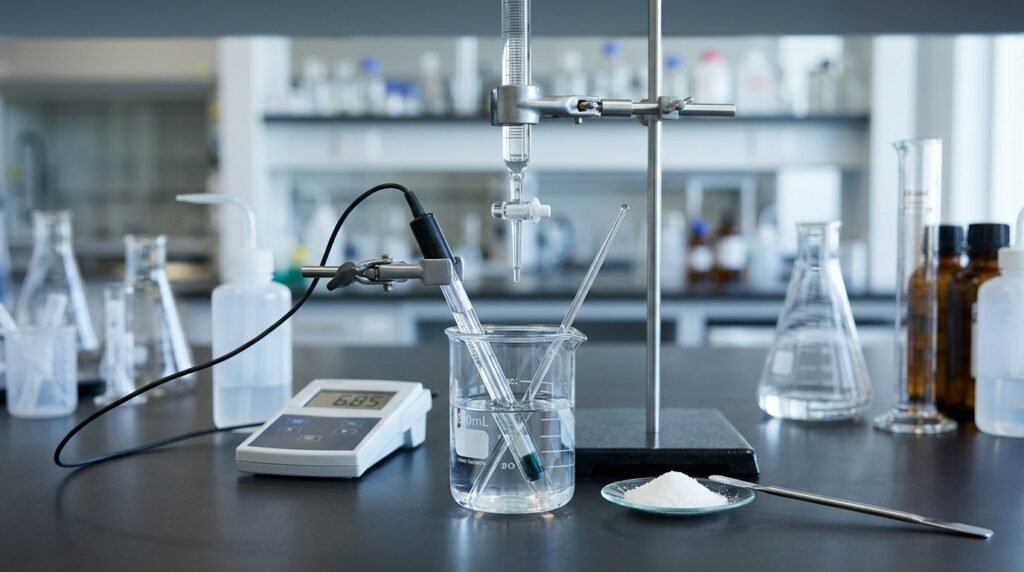
Use a calibrated pH meter with ATC not indicator paper for any process or formulation work. Calibrate against two buffer standards before each session.
Step 6 — Allow equilibration and re-verify:
After reaching target pH, allow 5 to 10 minutes of equilibration with continued mixing before taking a final reading and releasing the batch.
Neutralization in Industrial Wastewater and CIP Systems
Wastewater treatment and Clean-in-Place (CIP) system management are two of the largest uses of citric acid neutralization in industry.
Citric acid is also extensively employed in CIP operations as a mineral scale remover, and equipment sanitizer. Use a neutralizing solution to neutralise post-cleaning rinse water and used acid solutions prior to discharge. Neutralizing agents normally used in this case include sodium hydroxide or lime, which are selected depending on the volume, cost and the capacity to manage sludges.
Spent citric acid CIP streams are typically operated at pH 2.0 to 3.0 in food and beverage plants, in particular. To bring them to acceptable discharge pH of 6.0-9.0, a neutralization tank, base dosing by automated control and constant pH measurements are needed, all of which have to be justified and recorded to comply with the environmental audit requirements.
Common Mistakes to Avoid
Even experienced process engineers make avoidable errors in citric acid neutralization:
- Treating it as monoprotic the most common calculation error; always apply 3:1 base-to-acid molar ratio for complete neutralization
- Bulk dosing through buffer zones results in pH overshoot almost every time
- Skipping temperature compensation produces inaccurate pH readings that lead to under or over neutralization
- Using reactive metals citric acid corrodes uncoated iron, zinc, and aluminum; always use stainless steel or lined vessels
- Ignoring CO₂ pressure in closed systems when using bicarbonate or carbonate bases, gas venting is a process safety requirement
Diluting citric acid is an exact, clear-cut chemical procedure yet one that requires admiration of its triprotic structure, buffering characteristics within three pH ranges, and the particular requirements of your industrial/formulation background. What base you choose determines what byproduct salt you have, what reaction profile you have, and what regulatory status you will have. Calibration, temperature compensation and incremental addition are non-negotiable in any precision application.
When done properly, a citric acid neutralization is not merely one of the many chemistry problems that are solved, the resulting citrate salt is a commercially useful product in its own right.
FAQs
1. What is partial neutralization of citric acid and when is it used?
Partial neutralization occurs when only one or two of the three acidic protons of citric acid are neutralized instead of all three. This results in intermediate salts like monosodium or disodium citrate, which have specific buffering properties. It is commonly used in food and pharmaceutical formulations where controlled pH rather than full neutrality is required.
2. How does neutralization of citric acid affect solution conductivity?
As citric acid is neutralized, ions such as sodium or potassium citrate are formed, increasing the solution’s ionic strength. This leads to higher electrical conductivity, which can be measured in industrial processes. Conductivity monitoring is often used alongside pH to assess neutralization progress and consistency.
3. Why is mixing efficiency important during citric acid neutralization?
Proper mixing ensures that the base is evenly distributed throughout the solution, preventing localized high pH zones. Poor mixing can cause uneven neutralization, leading to inaccurate pH readings and inconsistent product quality. In industrial systems, agitator design and flow dynamics play a critical role in achieving uniform results.
4. Can citric acid neutralization produce solid precipitates?
Yes, when certain bases like calcium hydroxide are used, insoluble salts such as calcium citrate may form and precipitate out of solution. This can be desirable in some applications like supplement production but problematic in pipelines or reactors. Engineers must account for filtration or sedimentation when precipitation is expected.
5. How does scale formation relate to citric acid neutralization processes?
During neutralization, especially with hard water or calcium-based reagents, scale-forming compounds can develop on equipment surfaces. These deposits reduce heat transfer efficiency and may clog pipes or valves. Preventive measures include controlled dosing, proper material selection, and periodic cleaning cycles.