
Citric acid (C₆H₈O₇) is an acid with a pH near 2. It dissolves scale and binds metal ions. Borax (Na₂B₄O₇·10H₂O) is an alkaline salt with a pH near 9.2. It buffers, boosts detergents and crosslinks polymers. They are opposites, so they rarely swap one for one.
People compare citric acid vs borax because both are white powders that turn up in the same recipes, from laundry boosters to liquid soap and DIY cleaners. Many recipes list one as a “natural swap” for the other. Sometimes that works, but often it quietly breaks the formula.
This guide compares the two on the factors that really separate them: physical, chemical, functional, safety, environmental and handling differences. Each fact appears once, so you can scan straight to the factor you care about.
Citric Acid vs Borax at a Glance
Start with identity. These are two very different kinds of compound, and that shows up before you even dissolve them.
| Factor | Citric acid | Borax |
|---|---|---|
| Compound type | Organic tricarboxylic acid. | Inorganic sodium borate salt. |
| Formula | C₆H₈O₇ | Na₂B₄O₇·10H₂O (decahydrate). |
| CAS number | 77-92-9 (anhydrous), 5949-29-1 (monohydrate). | 1303-96-4 (decahydrate), 1330-43-4 (anhydrous). |
| Molecular weight | 192.12 g/mol. | 381.37 g/mol (decahydrate). |
| Common names | 2-hydroxypropane-1,2,3-tricarboxylic acid, E330. | Sodium tetraborate, sodium borate, E285. |
Physical Differences Between Citric Acid and Borax
In the bag the two look alike, since both are white crystals or powders. The gap shows up in water, under heat and in the air. Solubility is the biggest difference, because citric acid dissolves in large amounts while borax needs warm water and still holds far less.
| Property | Citric acid | Borax |
|---|---|---|
| Density | About 1.66 g/cm³ (anhydrous) | About 1.73 g/cm³ (decahydrate) |
| Water solubility at 20 °C (68 °F) | More than 50 g/100 mL | About 4 to 5 g/100 mL |
| Effect of hot water | Dissolves faster | Solubility rises sharply |
| Ethanol | Soluble | Practically insoluble |
| Taste | Sour | Mildly salty and bitter |
| Heat behavior | Melts near 153 °C (307 °F), breaks down above about 175 °C (347 °F) | Loses crystal water on heating, anhydrous form melts near 743 °C (1,369 °F) |
| Moisture in storage | Absorbs water and cakes | Stable, but can lose crystal water slowly |
These numbers decide how you prepare solutions. A 30 to 50% citric acid stock is easy to make at room temperature, which is handy for dosing pumps and lab work. Borax stock solutions stay at a few percent unless you heat the water, and they can crystallize again as they cool.
Chemical Differences Between Citric Acid and Borax

The deepest difference is how each one behaves as a chemical. Citric acid gives away hydrogen ions, while borax holds the pH steady in a mildly alkaline zone. This single split explains almost every use covered later in the guide.
Citric acid has three carboxylic acid groups, so it can release three protons in separate steps. The leftover citrate ion wraps around metal ions such as calcium, magnesium and iron and keeps them dissolved, which is called chelation. It also reacts with carbonate scale:
2 C₆H₈O₇ + 3 CaCO₃ → Ca₃(C₆H₅O₇)₂ + 3 H₂O + 3 CO₂.
Borax works through a different pair of species. In water it forms boric acid, B(OH)₃, and borate, B(OH)₄⁻, and together they resist pH changes near 9. Borate also forms reversible links between molecules that carry neighboring hydroxyl groups, such as polyvinyl alcohol (PVA). That crosslinking is why borax turns glue into slime.
| Chemical factor | Citric acid | Borax |
|---|---|---|
| pH in water (1% solution) | About 2.3 | About 9.2 |
| pKa values | 3.13, 4.76, 6.40. | About 9.24 (boric acid and borate pair). |
| Buffer range | Roughly pH 3 to 6.5. | Near pH 9. |
| Reaction with carbonate scale | Dissolves it | None |
| Chelation of Ca²⁺, Mg²⁺, Fe³⁺ | Strong | Weak |
| Crosslinking of PVA | None at room temperature. | Yes |
Functional Differences: What Each One Does in a Formula
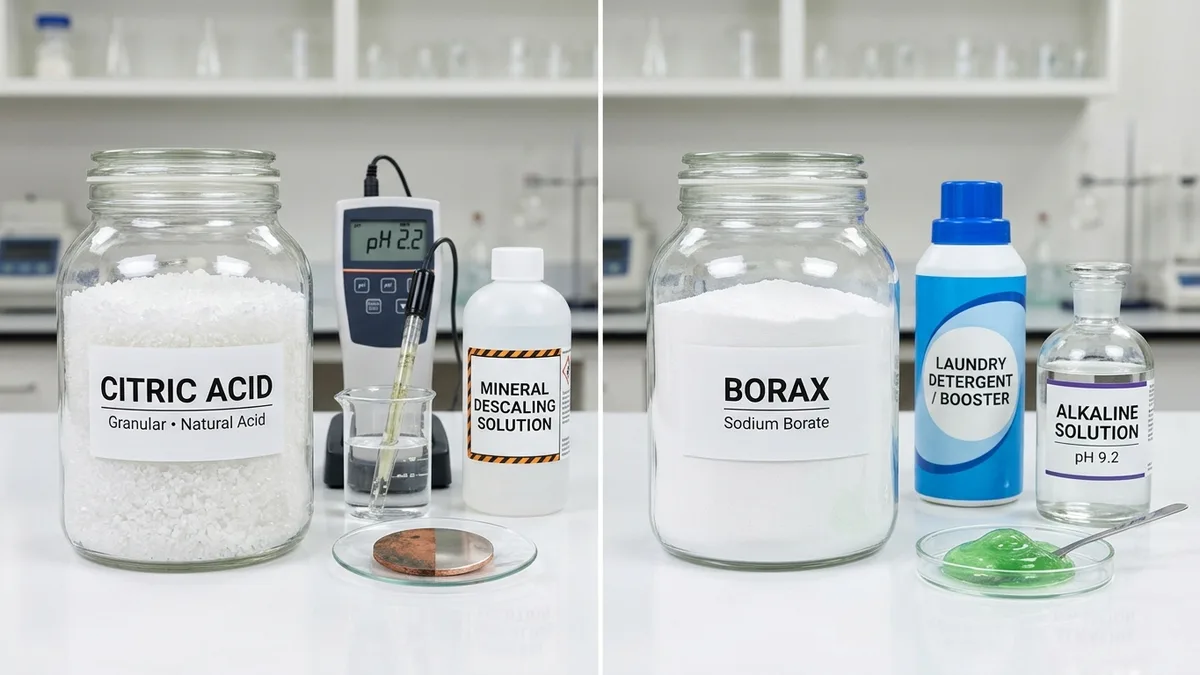
Function follows chemistry. Citric acid is the acid in a formula, and borax is the alkaline buffer. Formulators pick one or the other based on which pH direction they need and which side effect they can live with.
| Industry or task | Citric acid | Borax |
|---|---|---|
| Food and beverage | Acidulant, flavor, preservative. | Not permitted |
| Pharma and supplements | Excipient, effervescent tablets, buffer. | Buffer in some NF-grade uses. |
| Cosmetics | pH adjuster, chelator. | Restricted or banned in many regions. |
| Cleaning and detergents | Descaler, builder, rinse aid. | Laundry booster, alkalinity source. |
| Water treatment | Boiler and membrane cleaning. | Rarely used |
| Metal treatment | Stainless steel passivation. | Flux for welding and soldering. |
| Glass and ceramics | Not used | Borosilicate glass, glazes, enamel. |
| Adhesives and slime | Not a crosslinker | Crosslinks PVA |
Cement is the one area where both appear, though they slow setting in different ways. A patent on cement slurries describes pairing a lignosulfonate with borax at low to medium temperatures and switching to citric acid at high temperatures. The reason given is that citric acid dosing becomes hard to control in the cold. Dosing and temperature matter more than the choice of chemical here, so formulators run small trials first.
For home and small-business users, four jobs come up again and again:
Descaling: Use citric acid at about 5 to 10% (50 to 100 g per liter) in warm water, around 40 to 60 °C (104 to 140 °F). Rinse well, because calcium citrate has limited solubility and a cool, weak solution can leave a thin film. Keep it off marble and natural stone.
Laundry boosting: Use borax, which raises the wash pH so detergent lifts soil better. Consumer products usually call for about ½ cup per full load, so follow the label on your product.
Neutralizing liquid soap: Both work, but borax holds the soap near pH 9 while citric acid acts faster and can overshoot into clouding or separation. A common target is about pH 9 to 10, so check with a calibrated meter and add citric acid as a dilute solution in small steps.
Making slime: Use borax. Some pages call citric acid a replacement, but without borate nothing links the PVA chains, so the mixture never thickens.
Safety and Regulatory Differences
Both chemicals irritate the eyes and need basic PPE. The major difference is reproductive toxicity, because borax carries a classification that citric acid does not. Always follow the SDS from your supplier.
| Safety factor | Citric acid | Borax |
|---|---|---|
| Main hazard | Eye and dust irritant | Eye irritant, harmful if swallowed |
| Reproductive toxicity | Not classified | EU Category 1B (H360FD) |
| EU candidate list | No | Listed as an SVHC candidate |
| Skin contact | Mild irritation at high strength | Mild irritation, more on broken skin |
| PPE | Safety glasses, gloves, dust mask for powder | Safety glasses, gloves, dust mask |
| Eye first response | Rinse for 15 minutes | Rinse for 15 minutes |
| If swallowed | Rinse mouth, get advice if unwell | Call Poison Control (1-800-222-1222) |
Supplier safety data sheets for sodium tetraborate decahydrate list the Category 1B reproductive hazard and the SVHC candidate status. These labels shape how borax can be sold and used, especially in the EU and UK, where consumer access is limited. Check the rules in your own market before you formulate, and keep borax away from children and pets.
Environmental and Sourcing Differences
The two chemicals come from very different places, and that affects their environmental profile. One is grown in fermentation tanks and the other is dug from the ground.
Origin: Commercial citric acid is made by fermenting sugars with the mold Aspergillus niger. Borax is refined from mined borate mineral deposits.
Breakdown: Citric acid biodegrades readily in wastewater and soil. Boron is an element, so it does not break down and stays in the environment.
Plant impact: Boron is a plant nutrient, but the safe range is narrow. Heavy borax use on gardens or in graywater can damage plants.
At normal use rates, citric acid is the lower-risk option for drains that reach septic systems or irrigation. Borax is better kept out of water that feeds plants.
Grades, Storage and Handling Differences
Match the grade to the job before you buy. Food, pharma and cosmetic work needs documented grades, while cleaning and industrial use usually does not.
| Grade | Citric acid | Borax |
|---|---|---|
| Food grade (FCC) | Yes | Not applicable |
| USP or NF | Yes | NF grade available |
| ACS reagent | Yes | Yes |
| Technical or industrial | Yes | Yes |
Storage rules differ as well:
Citric acid: Keep it sealed and dry to prevent caking, and store it away from strong bases, oxidizers and nitrates.
Borax: Keep it dry and away from strong acids and reducing agents.
Hydrate form changes how much you weigh out. Citric acid monohydrate holds about 8.6% water by weight, so you need slightly more of it than the anhydrous form for the same acid content. Borax gap is wider, because the pentahydrate carries noticeably more boron per kilogram than the decahydrate.
Which One Should You Use?
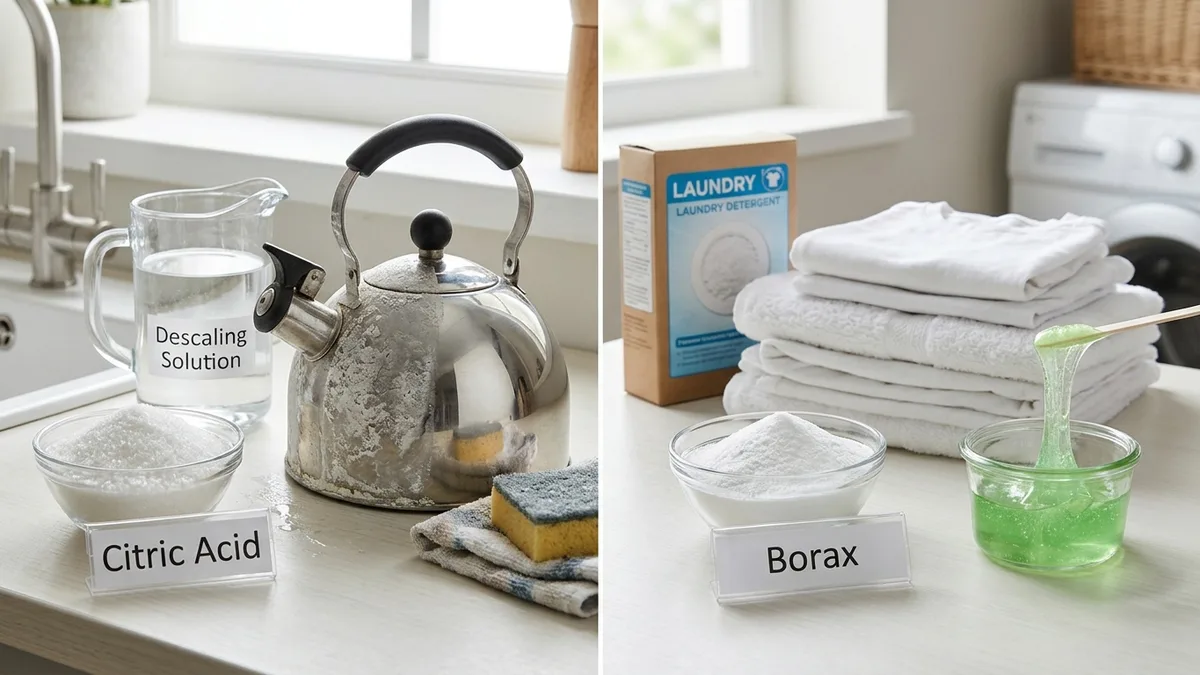
Decide by pH direction first. If your formula must drop in pH, dissolve minerals or bind metals, you need an acid. If it must stay mildly alkaline or needs a crosslinker, you need a borate.
After that, let the grade and the safety profile settle the tie. For anything that touches food, drink or skin, a documented grade of citric acid is the safer starting point. When a recipe names one and you only have the other, treat it as a new formula and retest the pH before scaling up.
Citric acid and borax serve different purposes, so choosing between them depends on the chemical requirements of your application. Citric acid is better suited for descaling, pH reduction and metal chelation, while borax is useful for alkaline buffering, laundry boosting and polymer crosslinking. Their differences in safety, environmental impact and handling also matter when selecting the right compound. Always consider the intended use, required grade and formulation before substituting one for the other. Chemvexa is a chemical platform whose catalog carries each chemical with its formula, specifications, grades and safety notes, backed by guides that explain how those chemicals are used, handled and stored safely.
FAQs
1. Can you mix citric acid and borax?
Yes, and it is not dangerous. The acid converts borate into boric acid and leaves sodium citrate behind. Both chemicals lose their job, so you gain nothing from the mix.
2. Is borax the same as boric acid?
No. Boric acid, H₃BO₃, is a weak acid, while borax is the sodium salt and is alkaline. Borax forms some boric acid when it dissolves, but the two have different pH, solubility and regulatory handling.
3. Is borax banned in the US?
No. In the US, borax is sold for cleaning and laundry with label warnings, but it is not an approved food additive. The EU and UK apply tighter limits because of its reproductive toxicity classification.
4. Is citric acid the same as sodium citrate?
No. Sodium citrate is the salt made when citric acid reacts with a sodium base, and it is much less acidic. Formulators often pick sodium citrate when they want chelation or buffering without a big pH drop.