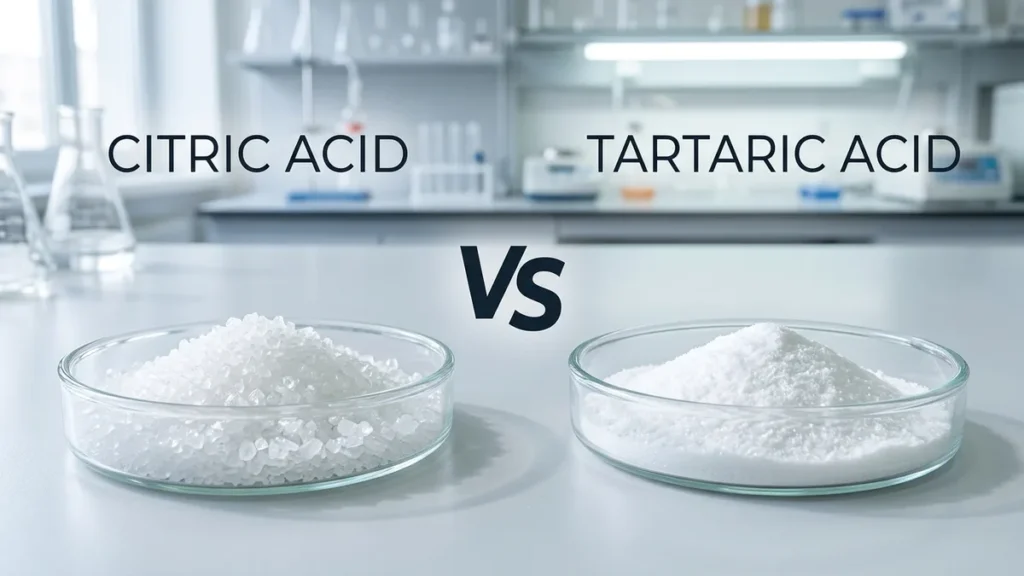
Citric acid and tartaric acid are two of the most widely used organic acids in food, beverages, cosmetics, cleaning products and industry. Both are white crystalline powders and both add sourness, so buyers and home cooks often treat them as interchangeable. That assumption fails in several important cases, from egg foam to wine stability to limescale removal.
This guide compares citric acid vs tartaric acid factor by factor, covering structure, strength, solubility, taste, cost, uses and safe substitution. Use it to pick the right acid, and the right grade, for your formula, recipe or purchase order.
Citric Acid vs Tartaric Acid at a Glance
The table below sets the main properties side by side. Each row is explained in the sections that follow.
| Factor | Citric Acid | Tartaric Acid |
|---|---|---|
| Formula | C₆H₈O₇ | C₄H₆O₆ |
| CAS number | 77-92-9 (anhydrous), 5949-29-1 (monohydrate) | 87-69-4 (L-(+) form) |
| Acid type | Tricarboxylic (3 acidic groups) | Dicarboxylic (2 acidic groups) |
| Molecular weight | 192.12 g/mol | 150.09 g/mol |
| pKa values | 3.13, 4.76, 6.40 | 2.98, 4.34 |
| Main natural source | Citrus fruits | Grapes, tamarind, bananas |
| Commercial source | Fermentation with Aspergillus niger | Wine lees and argol |
| Solubility in water (20°C / 68°F) | About 59 g per 100 mL water | About 139 g per 100 mL water |
| Taste | Clean, bright, fades fast | Sharper, astringent, lingers |
| Chirality | None (achiral) | L-(+), D-(−) and meso forms |
| Food additive code | E330 (US: 21 CFR 184.1033) | E334 (US: 21 CFR 184.1099) |
| Relative cost | Low | Higher |
What Each Acid Is
Citric Acid
Citric acid is a weak organic acid found in lemons, limes, oranges and berries, and its IUPAC name is 2-hydroxypropane-1,2,3-tricarboxylic acid. It also sits at the center of the Krebs cycle, so nearly every living cell makes it. Today it is one of the most produced food acids in the world.
Almost all commercial supply comes from fermenting sugar sources such as molasses or corn glucose with the mold Aspergillus niger. The process scales easily and keeps the price low. Citric acid is sold as anhydrous powder and as monohydrate, which holds about 8.6% water by weight, so the form matters when you calculate dosage.
Tartaric Acid
Tartaric acid is the main acid in grapes and wine, and it also occurs in tamarind and bananas. The natural form is L-(+)-tartaric acid, which is the version sold for food and winemaking. It gives wine much of its structure, freshness and tartness.
Producers recover it from wine lees and argol, the deposits left behind in fermentation tanks. These deposits are rich in potassium bitartrate, which is processed into the free acid. Because supply follows grape harvests and wine production, tartaric acid is less abundant and costs more than citric acid.
How the Chemistry Differs
Acidic Groups and Buffering
Citric acid has three carboxyl groups and one hydroxyl group, while tartaric acid has two carboxyl groups and two hydroxyl groups. The extra acidic group gives citric acid three dissociation steps and a wide buffering range of roughly pH 3 to 6.5. That is why it dominates pH control in food, cosmetics and detergents.
Tartaric acid buffers well between about pH 3 and 4.5. This narrower window suits wine and juice, where the target pH sits in exactly that zone. For formulations that must hold a higher pH, citric acid is usually the stronger fit.
Acid Strength and pH
Tartaric acid is the stronger acid, with a first pKa of 2.98 against 3.13 for citric acid. At the same weight in water, tartaric acid also gives a slightly lower pH. A 10 g/L solution reads about pH 2.1 for tartaric acid and about pH 2.2 for citric acid, based on the first pKa.
The gap looks small, but it matters in tightly controlled processes such as wine acidification. Citric acid still supplies more total acid per gram, because it carries three acidic protons on a molecule of 192 g/mol. So “stronger” and “more acid per gram” point to different acids.
Solubility
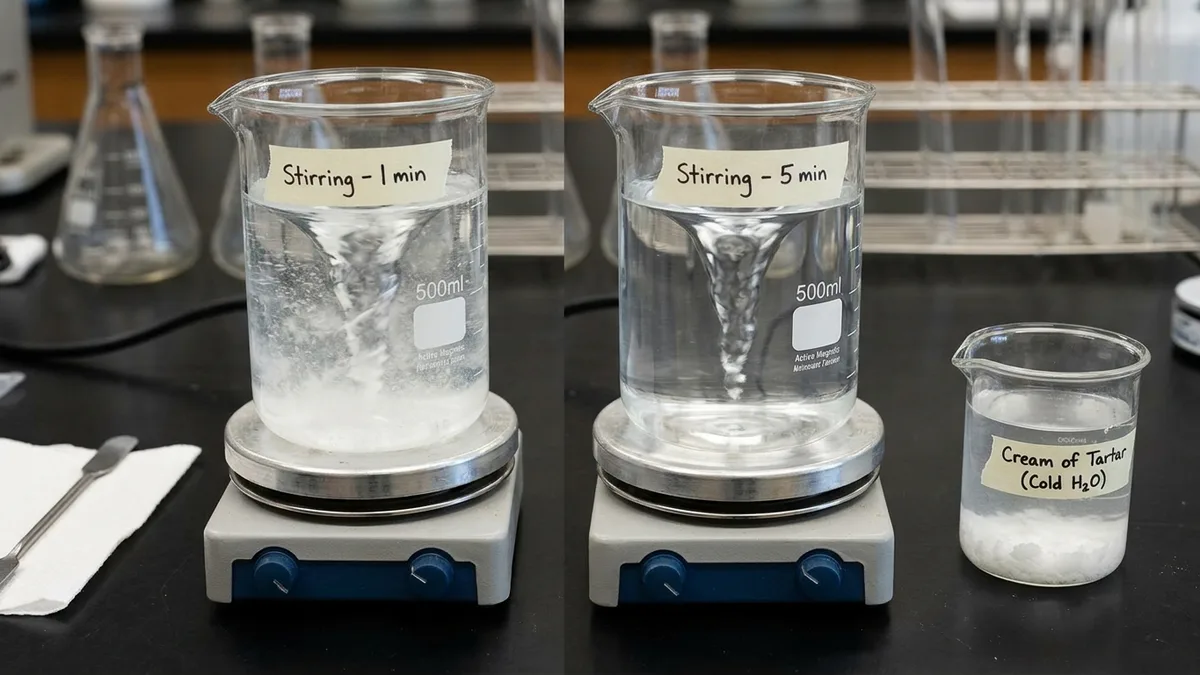
Both acids dissolve freely in water. Tartaric acid is the more soluble of the two at 20°C, dissolving at about 139 g per 100 mL of water, while citric acid reaches about 59 g per 100 mL. Neither value limits a typical syrup, drink or cleaning solution.
The real difference lies in the salts. Potassium bitartrate, known as cream of tartar, dissolves poorly in cold water, at under 1 g per 100 mL. That is why it crystallizes out of wine as “wine diamonds” and why bakers dissolve it in warm liquids.
Chelation and Metal Binding
Both acids bind metal ions, a property called chelation. Citric acid is the stronger and more common chelating agent, and it is used in detergents, descalers, cosmetics and food to bind calcium and iron. Tartaric acid also chelates, mainly in metal surface treatment and some construction products.
Lab teams will recognize the salts of both acids. Common chelation-based uses include:
- Detergents and descalers: Citric acid binds calcium and iron, which softens water and lifts scale
- Cosmetics and personal care: Citric acid ties up trace metals that cause color and odor changes
- Food and beverages: Both acids help prevent metal-driven browning and rancidity
- Analytical chemistry: Fehling’s solution uses sodium potassium tartrate (Rochelle salt), while Benedict’s reagent uses sodium citrate, both to keep copper(II) in solution
Stereochemistry
Citric acid is achiral, so only one form exists. Tartaric acid has two stereocenters, so it exists as L-(+), D-(−) and meso forms, plus the racemic DL mixture. The forms differ in melting point, solubility and how they are used.
Food and winemaking use the natural L-(+) form. When you buy tartaric acid, confirm that the label states L-(+) and the grade, because a DL mixture or technical grade will not meet food specifications.
Taste, Cost and Regulation
Taste Profile
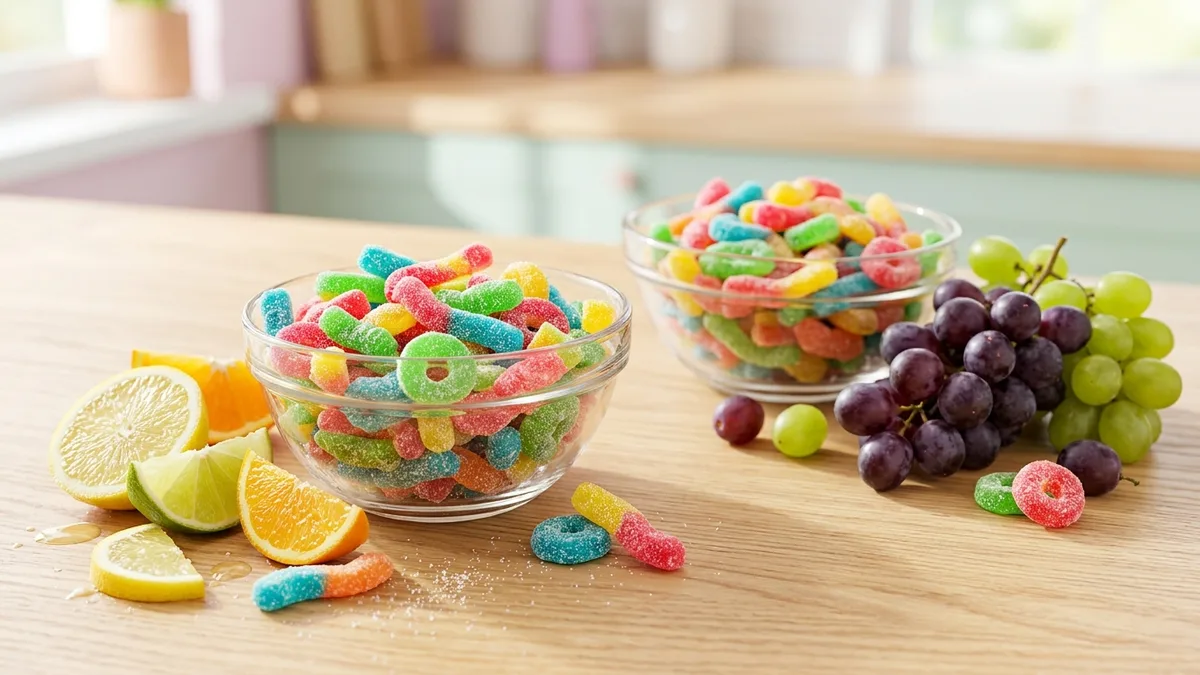
Citric acid gives a clean, bright sourness that peaks quickly and fades. This suits citrus, berry and tropical flavors, because it lets the fruit notes come through. Tartaric acid tastes sharper and more astringent, and the tang lingers longer in the mouth.
Many food technologists prefer tartaric acid for grape, wine-style and some candy flavors for this reason. Sourness also depends on sugar level, temperature and the product matrix. Always confirm the final balance by tasting, not by weight alone.
Cost and Availability
Citric acid is one of the cheapest food acids available, because fermentation capacity is huge and spread across many producers. Tartaric acid comes from a smaller group of suppliers and depends on the wine industry. For large-volume work where either acid would do, price usually favors citric acid.
Regulatory Status
Both acids are permitted food additives. In the US, both are listed as GRAS substances in 21 CFR Part 184, and in the EU they carry the codes E330 and E334. Allowed levels differ by product category and market, so confirm the limits that apply to your product before launch.
Best Uses by Industry
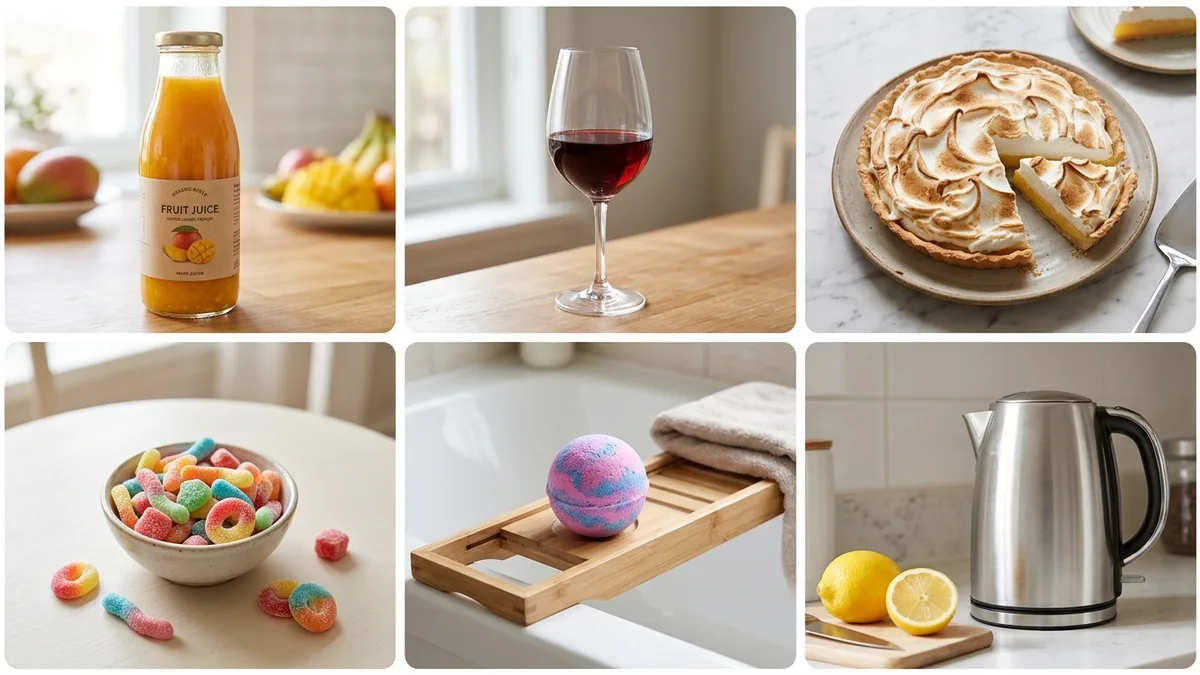
The table below shows which acid is usually preferred in each application and why.
| Application | Usually Preferred | Why |
|---|---|---|
| Soft drinks, juices, flavored water | Citric acid | Clean, fast sourness at low cost |
| Winemaking | Tartaric acid | Natural main grape acid, supports stability |
| Meringue and baking powder | Tartaric acid (as cream of tartar) | Stabilizes egg foam and acts as leavening acid |
| Sour candy coating | Either, or a blend | Citric for fruity bite, tartaric for lasting tang |
| Jams and preserves | Citric acid | Lowers pH for pectin set at low cost |
| Effervescent tablets and bath products | Either, or a blend | Reacts with sodium bicarbonate to release CO₂ |
| Descaling and cleaning | Citric acid | Dissolves limescale and costs less |
| Cosmetic pH adjustment | Citric acid | Wide buffering range, broad compatibility |
| Gypsum and cement retarding | Tartaric or citric acid | Both slow setting time |
Can You Substitute Tartaric Acid for Citric Acid?
For simple sour flavoring, often yes, but not by a fixed rule. Start with equal weight, taste, and adjust. Tartaric acid tastes sharper, so you may need slightly less when replacing citric acid in candy or drinks.
If you need equal total acid, use titratable acidity (TA). By TA, 1 g of tartaric acid equals about 0.85 g of anhydrous citric acid, or about 0.93 g of citric acid monohydrate. Always check which form of citric acid your recipe means, because monohydrate is about 9% lighter in active acid.
| Situation | Substitute? | Note |
|---|---|---|
| Tartaric for citric in drinks | Yes | Start at equal weight, then taste |
| Citric for tartaric in candy coating | Yes | Expect a cleaner, shorter sourness |
| Citric for cream of tartar in meringue | No | Citric acid cannot stabilize egg foam |
| Citric for tartaric in winemaking | Not recommended | Affects stability and volatile acidity |
| Tartaric for citric in descaling | Poor choice | Higher cost and calcium tartrate crust |
| Tartaric for citric in home canning | No | Use only tested recipes, since acid changes affect safety |
For canning, never swap acids on your own. Tested recipes set the acid amount to keep the final pH in the safe range, and tartaric acid is not the validated option. Follow the recipe exactly as written.
Which Should You Choose: Citric Acid or Tartaric Acid?
The right choice depends on the flavor you want, the function you need and your budget. Use the lists below as a quick decision guide.
Choose citric acid when:
- Flavor: You want a clean, fruity sourness
- Budget: You need a low-cost acid for large volumes
- Function: The job is descaling, cleaning or broad pH control
- Product: You are making soft drinks, jams or citrus-style items
- Buffering: You need stable pH across a wide range
Choose tartaric acid when:
- Flavor: You want a sharper, longer-lasting tartness
- Product: You are working with wine, grape or tamarind-style profiles
- Process: You are adjusting acidity in winemaking
- Recipe: A formula needs cream of tartar or tartrate salts
- Dose: You need a lower pH from a smaller dose by weight
Safety, Handling and Storage
Both acids are safe in food at normal use levels, but the powders can irritate the eyes, skin and airways. Citric acid is typically classified as causing serious eye irritation (H319). Some tartaric acid safety data sheets list serious eye damage (H318), so always read your supplier’s SDS for the exact hazard class.
Handling and storage checklist:
- Wear PPE: Use gloves, safety glasses and a dust mask when handling bulk powder
- Control dust: Fine organic powders can form combustible dust clouds, so avoid buildup
- First aid: Rinse eyes with water for at least 15 minutes and wash skin with water
- Store dry: Keep containers sealed in a cool, dry place, since anhydrous citric acid clumps in humid air
- Keep apart: Store away from strong bases, oxidizers, reducing agents and nitrates
- Verify grade: Confirm food grade (FCC), USP or technical grade, plus the SDS, before use
Choosing between citric acid and tartaric acid comes down to the balance of flavour, functionality and formulation requirements. While both offer useful acidity, their differences become more important when consistency, stability and final product quality matter. Understanding how each acid performs helps avoid unnecessary substitutions and achieve better results. Always consider the intended application and required grade before selecting an acid.
FAQs
1. Is cream of tartar the same as tartaric acid?
No. Cream of tartar is potassium bitartrate, a partial salt of tartaric acid. It is milder, dissolves poorly in cold water and behaves differently in recipes, even though both come from the same winemaking source.
2. Can I use citric acid instead of tartaric acid in baking?
Not for jobs that need cream of tartar, such as stabilizing egg whites or making baking powder. Citric acid does not give the same foam stability or reaction timing. For plain sour flavor in a recipe, it can work.
3. Which is better for winemaking?
Tartaric acid is the standard choice because it is the natural main acid of grapes. Citric acid is limited by regulation in many regions and can feed bacterial byproducts that raise volatile acidity.
4. Which dissolves better in water?
Tartaric acid dissolves better, at about 139 g per 100 mL of water at 20°C against about 59 g for citric acid. Both dissolve far beyond normal use levels, so solubility rarely limits either acid in practice.